by Mama B (Saudi Arabia) | Feb 25, 2015 | 2015, Government, Grief, Media, Saudi Arabia, Uncategorized, World Events, World Motherhood
 Early in the evening, we heard that he was not doing well. Then again, as is the way here, we had been hearing a great many things since the king had entered the hospital. Although Riyadh, the capital city of Saudi, has a population of four million, it still functions like a little neighborhood. Everyone has a ‘reliable source’ on the inside. As a rule, I do not believe anything until it is officially on the news–and even then, I take it with a grain of salt. Nonetheless, it was hardly a surprise when, at 2:00 AM, Saudi Arabian television announced the death of King Abdullah bin Abdulaziz Al-Saud at the age of 90. Even though I expected the news, it broke my heart.
I watched the local Saudi channel for a while, then I switched, curious to see how the foreign press would frame the news. They appeared to be competing to see who could be the most negative about Saudi Arabia’s progress under King Abdullah’s reign. Although their own experts pointed to the king’s many accomplishments, the foreign networks seemed to delight in ignoring them and focusing on the dissidents. Reporter after reporter repeated that progress in Saudi was occurring at a ‘glacial rate.’
The western media used its standard to measure my country’s progress.
Maybe they assumed that their standard is the one all the world should aspire to? They ignored how different Saudi is in our priorities, life style, and even our wants and needs. They ignored how young a country we are, and they certainly did not measure how far we have come.
By the morning we had a new king. No bloodshed, no chaos, no ‘state of emergency’, no transitional government. We have come far under King Abdullah’s reign. Yes, Saudis do recognize our shortcomings, and, yes, we do want to–and will–improve. But we should, and will, recognize and celebrate our accomplishments along the way.
We must be doing something right, as we are the most stable country in the region. We are battling the Houthis in the south, ISIS in the north, and successfully fighting terrorism on our own soil, all while growing our universities and health care system. In the past decade, women have been elected to the Shura Council, which advises the king. Twenty-eight universities were built. Two hundred thousand students were given scholarships to universities overseas. Six medical cities were built, 11 specialist hospitals were built, and 32 general hospitals were built. Finally, as a woman in Saudi Arabia, I seen both an expansion of the opportunities I have in my own life, and in the paths that are being laid for my daughter’s future, which far exceed anything available to me when I was her age.
For days after King Abdullah’s death, I could not stop crying. I watched my country mourn on the streets around Saudi. It was as if we had lost our own father. He was so beloved that people who were not related to him, who had never even seen him in the flesh, were giving each other condolences on his loss. His life fulfilled the adage, “When you are born, you cry and the world rejoices. Live your life so that when you die, you rejoice and the word cries.”
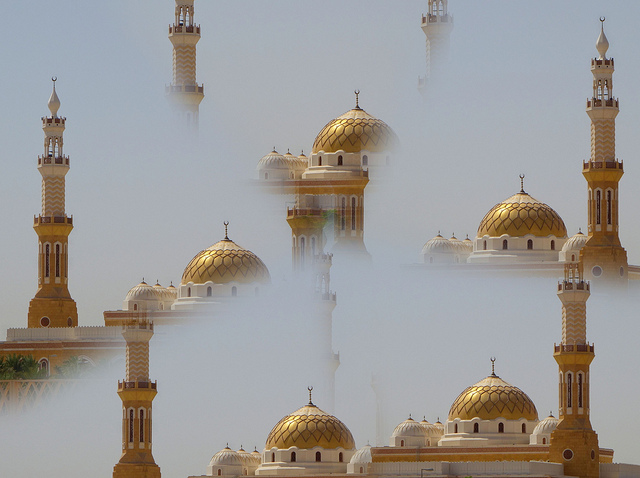
Picture attributed to Edward Musiak and used under a Flickr Creative Commons License.

Mama B’s a young mother of four beautiful children who leave her speechless in both, good ways and bad. She has been married for 9 years and has lived in London twice in her life. The first time was before marriage (for 4 years) and then again after marriage and kid number 2 (for almost 2 years). She is settled now in Riyadh, Saudi Arabia (or as settled as one can be while renovating a house).
Mama B loves writing and has been doing it since she could pick up a crayon. Then, for reasons beyond her comprehension, she did not study to become a writer, but instead took graphic design courses. Mama B writes about the challenges of raising children in this world, as it is, who are happy, confident, self reliant and productive without driving them (or herself) insane in the process.
Mama B also sheds some light on the life of Saudi, Muslim children but does not claim to be the voice of all mothers or children in Saudi. Just her little "tribe." She has a huge, beautiful, loving family of brothers and sisters that make her feel like she wants to give her kids a huge, loving family of brothers and sisters, but then is snapped out of it by one of her three monkeys screaming “Ya Maamaa” (Ya being the arabic word for ‘hey’). You can find Mama B writing at her blog, Ya Maamaa . She's also on Twitter @YaMaamaa.
More Posts

by Jacqueline Jenkins (Jordan) | Feb 4, 2015 | Caring, Education, Gender, Helping, Human Rights, Humanity, Jordan, Multicultural, Refugees, refugees, Relocating, School, Social Good, Uncategorized, United Nations, World Motherhood
GRIT.
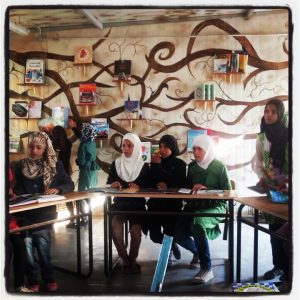
The girl children in the library reading the books which Jackie Jenkins bought.
We talk about it a lot as educators and parents. A few weeks ago I saw what it really means: to dig deep and push on with a smile on your face and a belief in a better tomorrow, even when faced with war on your doorstep and trauma in your past.
I had been waiting to go to the Zataari refugee camp with Rob (my husband and Representative for UNICEF Jordan) since we arrived in Jordan. The day finally arrived.
We viewed the water sanitation facilities and delivery trucks, which was fascinating. As an educator, however, I was most excited to see some of the schools. I was in my element the minute we walked through the gates. While Rob went to check on the status of classroom desks, play space construction, and water in the latrines, I wanted to see some kids.
I met two incredible principals of the girls’ section of school (girls attend school in the morning, boys in the afternoon). They told me that the Ministry of Education has done an excellent job at getting them all the teaching materials they need and that the school was in good condition. But class sizes are a problem. . . and so we began to walk. . . .
Grade 2 has more than 100 students in a classroom. Girls sit three to a bench, with the overflow sitting on the floor. When I walked in, they burst into a song, which I am sure I was meant to stand and smile at. But I can’t help myself around small people, so I just started dancing all over the place, up the aisles and in the front. The girls laughed and laughed. Kids are the same everywhere! But these children deserve a whole lot more after what they have been through.
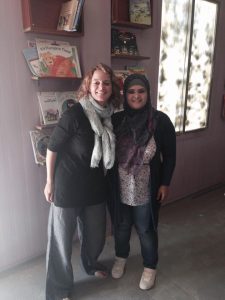
World Mom, Jackie Jenkins, with Iman Alkhaldi, the Librarian.
Luckily, there are people in their lives like Iman, whom I also met that day. She single-handedly built a library in one of the containers that serve as school rooms. She painted it, collected wood to build shelves, and is now looking for books. She spoke good enough English for me to understand her dreams and passion, and for me to tell her, “It is women like you who will change the world. You already are.” She cried, and I cried, and I also promised I would fill that room with books written in Arabic and English.
So I left with a new mission. If Iman can build a library oasis, if the dedicated teachers can manage to educate 100 students in a classroom without a complaint after walking out of their country affected by war, I could certainly help fill that library.
Within hours of being home, we set up a crowdrise page for donations. I sent out emails to international schools globally telling them the story of Iman and the children I had met. My 14 year old daughter talked it up on her social media networks, and I went to bed that night feeling a fire in my belly that I had not felt since my arrival. A deep passion to make a small difference in an immediate way. It seems the story resonated with many. In just 48 hours, I had reached my target goal, and was able to purchase more than 500 English and Arabic books, which were delivered to the library within the week.
Grit plus humanity–the connection and compassion with those around us–can accomplish astounding results. Yet again, I am filled with a sense of hope for the future of a region plagued by conflict and stress.
How do you help our children grow up with grit and the perseverance to face the challenges inevitable in their future? What is one concrete thing you might be able to do in your home or life that is a change for good?

We are a few months into our new 'home of our heart' location in Amman, Jordan. Originally from Canada, I have been moving around the globe for more than twenty years as my husband works for UNICEF. While we were a carefree couple in Uganda, Lesotho and Bangladesh, Meghan joined our family in 2000, while we were living in Myanmar. She was joined in 2005, while we were posted in India by Charlie, her energetic younger brother! Since then we have lived in Mozambique and New York. I am an educator and have been incredibly fortunate to have found rewarding jobs in international schools wherever we have been posted. Most recently I was the Elementary School Principal at the United Nations International School in Manhattan. Since arriving in Jordan, I have been a stay at home Mum, exploring, photographing and learning about the incredible history of the region and the issues facing not only the Jordan population but the incredible number of Syrian refugees currently residing in the country. While I speak English and French, I have not yet started to learn Arabic; a big goal for our time here.
I write to record and process this incredible journey we are on as a family. Time passes so incredibly quickly and without a recording of events, it's hard to remember the small moments and wonderings from each posting. Being a mother in this transient lifestyle means being the key cheerleader for our family, it means setting up and taking down a house with six weeks notice, it means creating close friendships and then saying goodbye. All this, while telling yourself that the opportunities your children have make the goodbyes and new hellos worthwhile. Raising a child in this lifestyle has incredible challenges and rewards. The challenges include culture shock every single time, even when you feel the move will be an easy one. It means coaching yourself, in your dark moments to be present and supportive to your children, who have not chosen to move but are trusting you to show them the world and the meaningfulness of the lifestyle we have committed to as a UNICEF family. The upsides to this lifestyle are incredible; the ability to have our children interact and learn about cultures, languages, food, and religions firsthand, the development of tolerance and empathy through relationships with many types of different people and the travel, they have been to more places before the age of ten than some people do in a lifetime! My commitment to raising children who believe in peace and feel responsible for making a difference in creating a better world is at the core of everything I do.
More Posts
Follow Me:


by Karien Potgieter | Jan 21, 2015 | Husband, Moving, Relocating, South Africa, Uncategorized
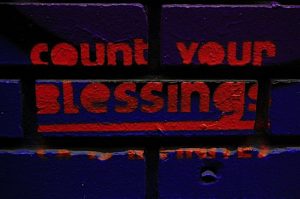
Isn’t it a blessing that we aren’t able to see into the future? That we only get to live life one moment at a time, in the present?
2014 was hard on my family. It was the kind of year that one would want to skip if its events could have been known in advance. After experiencing the indescribable joy of a new addition to the family at the end of 2013, things quickly went south for us. My husband lost his job (his employer downscaled); our kids were hospitalized numerous times; we moved to a new province, leaving behind all that was near and dear to us; and, in the midst of it all, I was frantically trying to be Supermom. It was exhausting.
Last year brought unfathomable hardships to my family, but also a lesson for which I’m eternally thankful.
No matter how dire our situation seemed, we would always, without exception, cross paths with someone whose situation was far worse. In every single instance, however, I was humbled by how they handled their situation with grace and even joy.
Take, for example, our beloved 59-year old nanny, with her beautiful toothless smile, whom we had to leave behind, unemployed, after moving to a new city. Still jobless after almost six months of non-stop job hunting, she still smiles at my inquiries and says: “Don’t worry, Madam, I’ll find something.” Or take the lovely young couple who occupied the bed next to ours in the pediatric ward during one of our hospital stays. Their gorgeous, tiny, one-month old son was admitted for non-stop seizures. Despite their own exhaustion and worry, this couple (and their parents, too) were the calmest, friendliest people in the ward, and enveloped their son and grandson with nothing but love. My list goes on and on.
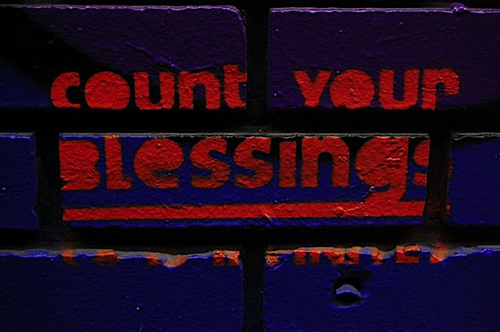
So I enter 2015 determined to remember to count my blessings. Always and in all circumstances. Despite our year in the figurative wilderness, I realize I’m incredibly blessed to be a mom to two precious children and to be married to a man who’s my greatest supporter and fan. What a joy to be able to share this adventure called life. By any measure, I am richly blessed.
What unexpected lessons have you learned from the years that you might have preferred to skip if you’d known in advance how difficult they’d be?
This is an original post written by Karien P. in South Africa for World Moms Blog. She can also be found on her blog, Running the Race.
Photo credit: Rebecca Wilson and used under a Flickr Creative Commons License
Karien Potgieter is a full-time working mom of two toddlers. She has a master’s degree in ecology and works in the conservation sector in beautiful South Africa. Her other big passion, apart from her family and caring for the environment, is running. To date she’s participated in races on three continents and in six countries and she dreams of travelling to and running in many, many more. You can follow her and her family’s running adventures on her blog, Running the Race (http://www.runningtherace.co.za).
More Posts - Website
Follow Me:


by Dee Harlow (Laos) | Jan 14, 2015 | Africa, Domesticity, Expat Life, Family Travel, Global Citizenship, Inspirational, Lesotho, Moving, Relocating, South Africa, Uncategorized
 In 2002, my international investment banking career in Singapore had left me drained. I needed to find the physical and mental freedom to return to my first passion, which was development work. I left my job and embarked on a solo backpacking journey, looking for peace and inspiration. By the time I circled around sub-Saharan Africa and ended in Lesotho, I found both. I have never looked back.
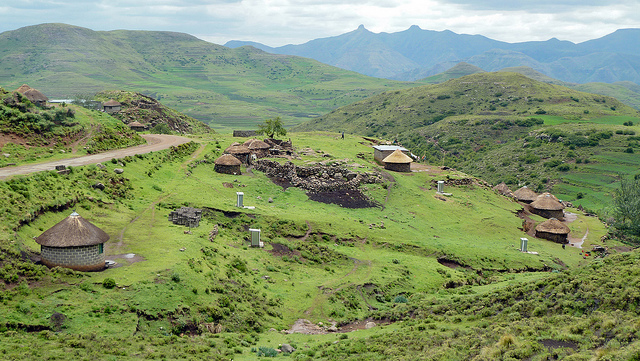
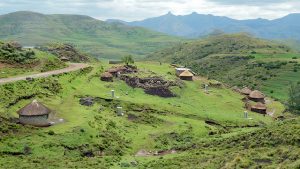
My very first impression of Lesotho came from the high peaks of the Drakensberg mountain range in the eastern part of the country, where the autumn air was cool and crisp. Dirt roads wound through small villages dotted with tradition rondavels made of stones or mud, with thick thatched roofs. The vast mountain plains opened up into a broad blue sky and brilliant, high-altitude sunshine. Our hiking trail climbed up rocky table mountain tops and down into freezing cold streams that cut through house-sized boulders, groves of thirsty willows, and into caves of prehistoric paintings. Lesotho, tucked completely within the walls of South Africa, seemed an ideal natural treasure to me.
Fast forward thirteen years. After living in Vientiane, Laos, for two years, last November, I arrived back in Lesotho. This time, I had a family in tow. My husband is in the U.S. Foreign Service. The rhythm of our family life consists of an international move every two to three years, with trips back to the States for home visits and language training in between.
Where I once turned to travel to help me change my life, what I now seek at each new destination is stability and conetinuity for my family.
After 22 hours of travel, we arrived in the capital city of Maseru, which is situated in the hilly western lowlands. The air is again cool and crisp, although now it is springtime. The backyard of our new house is full of bright yellow birds, endlessly flitting back and forth to complete their work. The males are busy constructing round grassy nests, which dangle festively in our trees. If a female doesn’t accept the nest, the male bird tears the entire thing apart and starts all over again. The kids and I have named one “Butternut”, and we admire his tireless work everyday.
Maseru is a small city with a growing suburban sprawl. There are barely 300,000 people in the entire urban area. The buildings are low, the traffic flows, and only a couple of noteworthy malls have popped up within the past two years. “First impressions” this time around are mainly focused on the business of getting on with life for our family–new school, new friends, new job, new supermarkets, getting the internet set up, figuring out a car, and obtaining household help. Luckily, it’s been quite easy to get everything that we need. As far as Western-style life needs go, there are plenty of products here that are brought in from South Africa and beyond.
With our basic needs met, we’ve been exploring beyond the city. I still find Mother Nature calling at every turn. Within Lesotho, you can go hiking just about anywhere. Cross a bridge and stop to hike down to explore up the river. Head up a hill to find herdsmen tending livestock. When it rains, we hike in the mud (the kids’ favorite). When it’s hot, we cool down in streams and waterfalls. The nearby children find us no matter where we go; the adults are not engaging but very courteous. Fortunately, the personal safety issues prevalent in most of South Africa are not as concerning in Lesotho yet, and most of the expats we’ve met are comfortable exploring the countryside.
After the scant two-and-a-half months that we’ve been here, we are already feeling more settled. And while we all miss what we’ve left behind in our “old” life in Laos . . . and Mexico. . . and the U.S. . . ., we begin anew to embrace what we have and to anticipate what gifts our new country holds.
Is there a change in your life that you’ve made or would like to make? What have you left or would like to leave behind, and what have you found or hope to find?
This is an original post to World Moms Blog by our mother of twins writer, Dee Harlow, currently living in Lesotho. You can also find her on her blog Wanderlustress.
Photo credit attributed to Damien du Toit. This photo has a Flickr Creative Commons Attribution-Non-Commercial-ShareAlike license.
One of Dee’s earliest memories was flying on a trans-Pacific flight from her birthplace in Bangkok, Thailand, to the United States when she was six years old. Ever since then, it has always felt natural for her to criss-cross the globe. So after growing up in the northeast of the US, her life, her work and her curiosity have taken her to over 32 countries. And it was in the 30th country while serving in the Peace Corps in Uzbekistan that she met her husband. Together they embarked on a career in international humanitarian aid working in refugee camps in Darfur, Sudan, and the tsunami torn coast of Aceh, Indonesia.
Dee is now a full-time mother of three-year old twins and continues to criss-cross the globe every two years with her husband who is in the US Foreign Service. They currently live in Vientiane, Laos, and are loving it! You can read about their adventures at Wanderlustress.
More Posts

by Mirjam | Jan 12, 2015 | Childhood, Kids, Life Lesson, Motherhood, Netherlands, Uncategorized
 I had a little ritual with my son when he used to be little.
Sometimes when snuggling I would sit him down and tell him a little story.
I would tell him about the biggest most precious gift I ever received.
It has been ages since I told him that little story, but I still remember my son’s eyes turning big in anticipation as I got to the end of the story, revealing what the gift was.
“The gift was you,” I said.
And I proceeded to tell him how happy the gift made me and how loved he was.
No matter how many times I told him the same story, he never got tired of hearing it.
And I never got tired of telling him the same story.
I had promised myself very early on in life that if I ever had children, I would make sure they knew they were loved. As far as I was concerned, they would never have to deal with low self esteem or feel unwanted.
For most of my childhood, I spent time excusing myself for being me.
I tried to change myself, copy others, or suppress things that were typically me.
I apologized a lot. When you spend that much time being aware of what you are not supposed to be, you’re under a lot of pressure.
I used to bite my nails almost to the point of bleeding and I was shy and clumsy.
I broke things, I fell a lot, I bumped into things. It was a hard task, trying not to be me.
Today when I look at my middle child, who is almost like a copy-print of me, I laugh at my attempts.
That kid is so present, so alive, so wild, so loud, so emotional, so outspoken, so amazing.
There is no way to tone that down. And what a waste would it be to do so.
My kids have taught me that it is okay to be exactly who you are and that the flaws and the twitches are what makes a person unique.
My kids have helped me accept myself. I see myself when my daughter is persistent. I see myself when my oldest child gets emotional, I see myself when my kids do silly dances and I see myself when one of them nestles on the couch and disappears in a book.
It doesn’t bother me that my daughter feels too shy to speak around strangers, or that my son is difficult when he feels overwhelmed. Nor does it bother me that my daughter is chaotic and would forget to bring her own head to school, if it wasn’t attached to her body.
I see me.
Whenever I look at my kids, really look at them, my heart bursts with love.
I have always promised myself that whenever I had kids, I would give them the space to be themselves.
What I never expected was that through my love for them, I would learn to love and accept myself more.
And that is truly a gift.
What gift have your kids added to your life?
This is an original post to World Moms Blog by Mirjam of The Netherlands. Photo credit to the author.
Mirjam was born in warm, sunny Surinam, but raised in the cold, rainy Netherlands.
She´s the mom of three rambunctious beauties and has been married for over two decades to the love of her life.
Every day she´s challenged by combining the best and worst of two cultures at home.
She used to be an elementary school teacher but is now a stay at home Mom. In her free time she loves to pick up her photo camera.
Mirjam has had a life long battle with depression and is not afraid to talk about it.
She enjoys being a blogger, an amateur photographer, and loves being creative in many ways.
But most of all she loves live and laughter, even though sometimes she is the joke herself.
You can find Mirjam (sporadically) at her blog Apples and Roses where she blogs about her battle with depression and finding beauty in the simplest of things. You can also find Mirjam on Twitter and Instagram.
More Posts - Website
Follow Me:

by Ecoziva (Brazil) | Nov 17, 2014 | 2014, Being Thankful, Brazil, Communication, Computers, Sexual Assault, Social Media, Uncategorized
 Imagine the scene: an eight year old girl with a Facebook account – allowed for by her parents. I will call her Maria. Maria’s parents both work full time and after school she stays at home with the maid. She has full access to the computer and knows how to navigate the Internet quite well.
Several hundred kilometers away, a grown man creates a fake Facebook account using childhood photographs of a famous teenage singer. He contacts Maria and she accepts him as her online friend. They chat. At one point he says he loves going to the beach and sends her a picture of the singer, when around age eight, at the beach. “I also love going to the beach!” she says and, when prompted, sends him a picture of herself at the beach wearing a bikini.
The friendship progresses over several days. Maria is happy because she and the cute boy seem to have a lot in common. One day he asks for her phone number. He says his birthday is coming up and he wants to invite her. Using a child’s voice, he talks to her briefly and then asks if she can talk to his father. The “father” says the “birthday” will be a lot of fun: he will pick her up at school and take them to the mall, to the movies, for ice cream and other fun things.
He also tells her not to worry about talking to her parents. He will call them later and they will work everything out.
The day of the “birthday” arrives. The man gets to Maria’s school and tells the porter he is her uncle. The porter says he will have to call Maria’s parents to get permission for her to go with him. “No problem,” he says, “while you call I will go pick her up in her classroom”. Her parents deny the story and the man is not able to leave the school grounds with Maria. At this point the school staff has started to get suspicious and they are able to record the number of his license plate and inform the police.
The man is later intercepted at the state border. He has a criminal record and has already spent time in prison for molesting children. Unfortunately, as there was no formal accusation, the police are not able to arrest him.
The scary situation I described above is a true story that happened to the daughter of one of my husband’s colleagues. The topic came up in a talk how nowadays children are so computer savvy, and my husband commented on how we limit the kids’ screen time: we have no TV set at home; the eldest has limited time on the Internet and no social media or e-mail accounts; and, more recently, we have cut all screen time for the two smaller kids (both under four) with the exception of days at grandma’s and the rare trip to the movie theater. At that point the co-worker stated that nowadays it is impossible to control kids’ screen time and recounted what happened to his girl.
Valdemar Setzer*, a professor at the Computer Science Department of the University of São Paulo (USP) researches the impacts of screens on children and advocates that kids – for lack of maturity – should have no access whatsoever to the Internet (teens included). I recently heard him talk and a lot of what he said only confirmed my own opinions and reinforced the hard decision of eliminating all screen time for my two youngest kids at home.
On the other hand, it also got me thinking about how part of the problem doesn’t have to do with the screens themselves: it is much more about parents and children who spend way too little (quantity) time together, parents who overwork to make ends meet and are (understandably) too tired to play or do outdoor activities with the kids and the end of the day or during the weekends, or simply parents and kids which communication needs to improve a lot.
I am not trying to be judgmental here – I am grateful my job is flexible and allows me to have a lot of time with my kids, but I know other parents are not so fortunate.
However, even in my case stories like this make me once again rethink my priorities and find ways to organize our family life, as there is always room for improvement. After all, there is nothing more important to me that my children, and I believe that is the case for most parents. Also, despite all the benefits the Internet and other new means of communication have brought about (such as bringing together mothers from around the world in this blog!), for me real, active life is always better than the passive life that goes on “behind the screens” – not only for children, but for adults too!
And you, do you control your children’s screen time? If so, how? Please share your story!
[*] Prof. Setzer’s website is loaded with information on the effects of screens on children, including stuff in English – http://www.ime.usp.br/~vwsetzer/
This is an original post to World Moms Blog by Eco Ziva of Brazil. Photo credit: Sinistra Ecologia Libertá. This picture has a creative commons attribution license.
Eco, from the greek oikos means home; Ziva has many meanings and roots, including Hebrew (brilliance, light), Slovenian (goddess of life) and Sanskrit (blessing). In Brazil, where EcoZiva has lived for most of her life, giving birth is often termed “giving the light”; thus, she thought, a mother is “home to light” during the nine months of pregnancy, and so the penname EcoZiva came to be for World Moms Blog.
Born in the USA in a multi-ethnic extended family, EcoZiva is married and the mother of two boys (aged 12 and three) and a five-year-old girl and a three yearboy. She is trained as a biologist and presently an university researcher/professor, but also a volunteer at the local environmental movement.
More Posts

 Early in the evening, we heard that he was not doing well. Then again, as is the way here, we had been hearing a great many things since the king had entered the hospital. Although Riyadh, the capital city of Saudi, has a population of four million, it still functions like a little neighborhood. Everyone has a ‘reliable source’ on the inside. As a rule, I do not believe anything until it is officially on the news–and even then, I take it with a grain of salt. Nonetheless, it was hardly a surprise when, at 2:00 AM, Saudi Arabian television announced the death of King Abdullah bin Abdulaziz Al-Saud at the age of 90. Even though I expected the news, it broke my heart.