by Mannahattamamma (UAE) | Jun 30, 2016 | Africa and Middle East, Brothers, Competition, Cultural Differences, Expat Life, Global Citizenship, Living Abroad, Middle East, Older Children, School, Travel, UAE, World Motherhood
When we moved to Abu Dhabi from Manhattan five years ago, we intended to stay in “the Dhabs” for a year. Our kids had scored the Manhattan Grail: spots in a “gifted and talented” public school, which meant we wouldn’t have to sell everything we owned to pay for private school, and if we stayed away from the city for more than a year, we would lose the seats.
“But you have two spots at the school,” people said to me when I told them we were leaving. To ease their doubts, I kept talking about the benefits of an international education and experiencing different cultures–but to tell the truth, I think I was trying to convince myself. After all, if you’re a student in a Manhattan public school, you’re going to be connect with kids from around the world; it’s unavoidable. Did we really need to move halfway around the world to get a “global experience?” I wondered.
Three-quarters through our first year, we decided to take the leap and sign on for another year (or four) of expat life. A year just didn’t feel like enough time: we would have been packing up to move back just as we were starting to settle in. I felt as if all the energy (and exhaustion and not a few tears) that went into adjusting would have been wasted if we returned to New York after just a year.
The boys are studying Arabic in school, and in our travels through the region, they’ve picked a few phrases here and there — mostly “hello” and “thank you” and “chocolate” — in Sinhalese, Punjabi, Italian, Swahili, Korean. The trips we’ve been able to take from Abu Dhabi would have been impossible from Manhattan, especially on the salaries of two literature professors, and so in that regard, our expat life has delivered the sort of global awareness we were hoping for.
Or at least that’s what I think on my optimistic days. On other days, I wonder: does the simple fact of being able to say “hello” in eight different languages really make you globally aware? I suppose my wavering back and forth is just the expat version of questions most parents ask themselves–“is this school the right school,” “are we doing the best we can for our kids”–and we all have good days and bad days in terms of those answers. How do we raise global citizens? That question, in the light of “Brexit” and the demagoguery of Trump, seems increasingly important, even as the answers get more complicated.
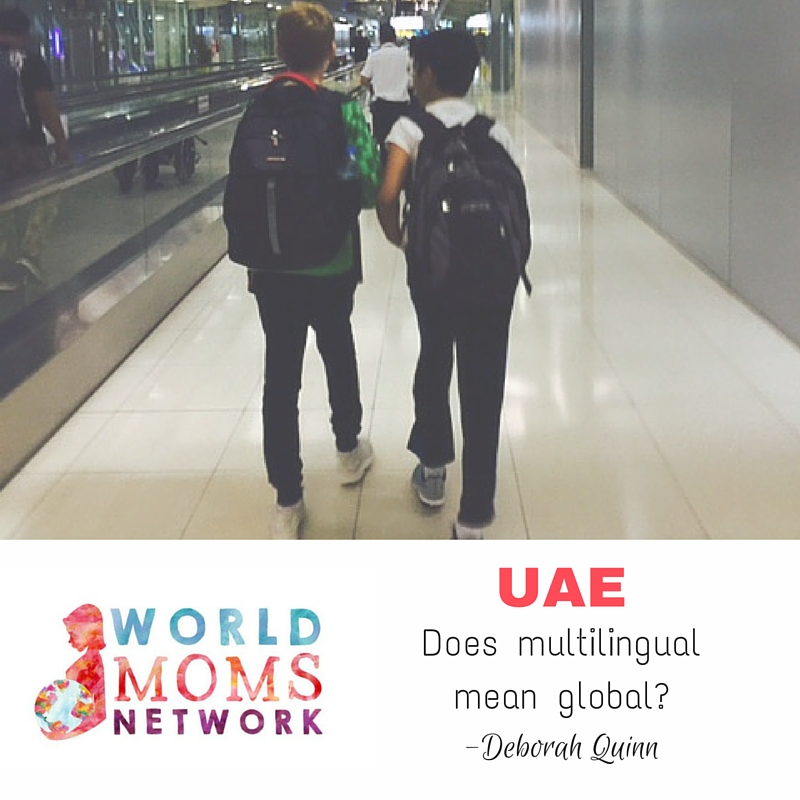
I had to confront those questions just the other day in an emotional conversation with my younger son (now almost twelve). We were sitting on his bed in a hotel room in Bangkok, where we’d come for the Global Round of the World Scholar’s Cup, an academic competition that draws kids from, yes, around the world (but mostly Asia). I’d asked C. if he were nervous about the upcoming three days of competition in writing, debate, and current events quizzing, and his eyes welled up. He admitted that he wanted to do as well as his brother had, two years ago, in the same competition, but also, he said, “I don’t want you to feel like it was a waste for you to bring me here.”
Argh! A blow straight to the heart! How had he gotten the idea that my husband and I would resent the money we spent on airline tickets if he didn’t do well? Suddenly I was the one almost in tears.
I assured him that we didn’t think it was a waste at all and that we were ridiculously proud of him already, just for doing the work to get this far. “Being able to do things like this are why we moved to Abu Dhabi,” I said. “We couldn’t afford flying to Bangkok if we still lived in New York.” My son nodded, vaguely reassured (although still nervous and still in the grips of sibling rivalry).
Truth be told, he probably doesn’t believe me when I say that we’re proud of him already. In the mind of an almost twelve-year old boy, “winning” is pretty much the only thing that matters. Given that there are about 2,000 kids competing in his division, I’d say winning anything is a long shot. (Though if there were a category called “Minecraft knowledge,” he’d probably outscore the entire world.)
What I realized after our conversation, is that yes, this experience is part of why we moved to Abu Dhabi, even though at the time we’d never heard of the World Scholar’s Cup. Even with the international flavor of New York, this sort of intense week-long bonding experience with kids from around the world would not have been possible. This experience, of negotiating differences and finding connections across cultures, will go a long way (I hope) in establishing the foundations of a global citizenry.
C. will remember this week in Bangkok long after he’s forgotten how to say “hello” in Sinhalese. For this week, at least, I’m pretty sure that becoming an expat family was the right thing for us to do.
What about you? How do you raise your global citizens?
This is an original post to World Moms Blog by Deborah Quinn, Mannahattamamma of the UAE. Photo credit to the author.
After twenty-plus years in Manhattan, Deborah Quinn and her family moved to Abu Dhabi (in the United Arab Emirates), where she spends a great deal of time driving her sons back and forth to soccer practice. She writes about travel, politics, feminism, education, and the absurdities of living in a place where temperatures regularly go above 110F.
Deborah can also be found on her blog, Mannahattamamma.
More Posts
Follow Me:


by Adwoa Gyimah | Jun 23, 2016 | 2016, Africa, Africa and Middle East, Education, Ghana, Special Needs, World Motherhood
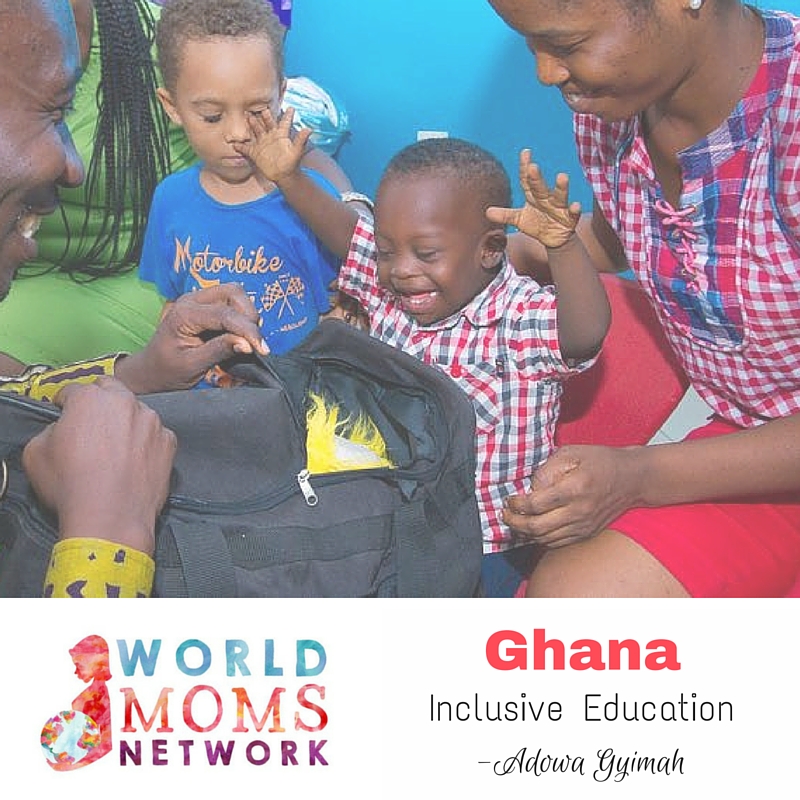
I am often asked why I decided to enrol my mainstream children in an inclusive school. I did a great deal of research when looking for the best school for my family, and I was encouraged by the testimonials of parents who had chosen this path for their mainstream children. I decided that an inclusive education was the best choice for my children.
Inclusion in education is an approach that seeks to embrace students of all abilities, including those with special educational needs. In inclusive schools, students with special needs learn side-by-side with their non-disabled peers. This educational approach avoids the use of separate schools or classrooms to separate students with disabilities from those without.
The inclusive school I chose for my children is the first of its kind in Ghana. Multikids Inclusive Academy is an inclusive international school educating children of all educational needs and abilities in a co-existing learning environment. In this school, children with special needs are not separated from the children without – they are integrated in the same class.
The school provides the best of both worlds to children with special of all abilities. They maintain small class sizes, making it possible for every child to get the assistance and attention they need. The school envisions a society where all people can live side by side respectfully and appreciate that we each have a unique contribution to make to the world. The academy seeks to build confidence and competency in all learners, and to promote excellence through an enabling environment. In this school, every child truly matters.
I am so happy that a school like this one exists in Accra, Ghana. My children will benefit from learning side-by-side with students of all abilities, and will learn that all children can reach their potential with the right support and encouragement.
Do you have inclusive schools where you live? Would you consider an inclusive education for your child?
This is an original post written by Adowa Gyimah of Ghana for World Moms Blog.
Photo courtesy of Multikids Inclusive Academy, Ghana.

by Nancy Sumari | Jun 16, 2016 | 2016, Africa, Africa and Middle East, Home, Life, Marriage, Motherhood, Moving, Nancy Sumari, Relationships, Relocating, Tanzania, Womanhood, World Motherhood
I recently discovered that there are 5 things deemed the most stressful in life. The topic came up in a conversation I was having with a friend and I was shocked to check two boxes out of the five that were listed! Box 2. Getting married, Box 4. Moving.
“How did you get here,” begs the obvious question!
Well, we have been working on our home for a little over a year now. Like many who have done it before, we have had to learn the hard way that construction is no easy feat. Whatever your plan, expect it to take double the time and cost twice as much. Somewhere within that space, my longtime partner proposed to me. So – yes! – we also had a wedding to plan. We had originally planned for a small affair at the beginning of the year, anticipating to move into our new house before July.
As life would have it, owing to work obligations, we had to switch things around. Now we are getting married AND moving into our new home at the same time, mid-year. Through all this, I have felt tested more than ever before. In between wedding planning, my day job, community work, dealing with the construction, and being a mother, it has often left me stretched too thin!
I must say though, I feel this is what we as mothers and women are best at. We handle it, all and all. Week by week I read amazing stories on World Moms Blog about women and mothers the world over that inspire me and sustain me.
Even though, it feels like I am in the eye of the hurricane, my feet are firmly in the ground, my focus is sharper than ever, and I am not wavered in my resolve. How? Well I am a World mom aren’t I?
What challenges have you endured as a woman and a mother? How do you manage it all?
This is an original post written for World Moms Blog by Nancy Sumari in Tanzania.
Image credit to the author.

by Maryanne W. Waweru | Jun 9, 2016 | 2016, Africa, Africa and Middle East, Boys, Child Care, Cultural Differences, Kenya, Motherhood, Parenting, World Motherhood
Over a sumptuous dinner with my girlfriends last weekend, we naturally got talking about our children. One of us had just enrolled for an eight-week programme specifically for ‘Mothers with Sons’.
For a cost of about $150 USD, with learning taking place once a week (Saturdays) for two hours, the course teaches how to raise our sons into fine young gentlemen. This is a good idea, if you ask me, because there is something about the crop of young men that we are increasingly seeing in Kenyan society today –men who are not as ambitious or focused as their fathers were, and men who would rather take the back seat as women take up the role of being the heads of the home.
In Africa, and I believe the much of the rest of the world, it is traditionally men who take up the leadership of the home. However, we are nowadays seeing more and more female-headed households.
This is due to a myriad of reasons, one of them being the fact that some men are just not willing to take up that kind of responsibility. This leads to the question: how were these men raised as boys? Weren’t our core values of hard work, discipline, consistency and responsibility instilled in them by their parents? This, I suppose, forms the rationale of such a programme that my friends and I were discussing last weekend.
The majority of moms who attend the programme are urban moms – career women who have enviable corporate or NGO jobs or run their own businesses. They are in their thirties to mid-forties, with their children mostly below the age of 12 years. These are women who receive updates from Baby Center and other informative parenting sites on how best to raise children. They attend First Aid courses and other related programmes about parenting. Some of these programmes are church-based, while others are sponsored by brands that seek out these types of moms and their children. Keen on learning different things about raising their children, you’ll find many urban moms today engrossed in courses and informative material about how to best raise their children.
But as my friends and I asked ourselves over dinner – do we pass on all we learn to the people who are helping us raise our children, specifically our housekeepers and nannies? In Kenya, most middle and upper-income families employ housekeepers and nannies to help with the domestic chores and take care of the children. They are the ones who actually spend a significant amount of time with the children during the day.
With all the demands of today’s modern woman – challenging jobs that require them to leave their homes at the crack of dawn and return at about 9pm – after spending hours in the traffic jam, or checking on their small business after work, or attending their Masters’ degree programme in the evening, attending a business meeting, or even having cocktails with the girls. By the time these modern women get home, the children are already asleep. On Saturdays, these women are busy running errands or attending weddings or baby showers/bridal showers, parenting classes and other such engagements and once again, return home late in the evening. Sunday is the only day where they get to spend time with their children.
So six days per week, it is essentially the nannies who are ‘raising’ their children. Nannies actually spend more time with their children than the moms do. So my girlfriends and I wondered, do these moms then pass on the information that they learn in their expensive courses, parenting newsletters and websites to the nannies? If the nannies are the ones spending the most time with the children, should we not focus on giving them the wealth of information we seek out about raising children? We didn’t get an answer, but I hope we will sometime.
This is an original post to World Moms Blog by World Mom, Maryanne W. Waweru of Kenya of Mummy Tales.
Photo courtesy of Michal Huniewicz / Flickr.
Maryanne W. Waweru, a mother of two boys, writes for a living. She lives in Nairobi, Kenya with her family. Maryanne, a Christian who is passionate about telling stories, hopes blogging will be a good way for her to engage in her foremost passion as she spreads the message of hope and faith through her own experiences and those of other women, children, mums and dads. She can be found at Mummy Tales.
More Posts - Website

by Ibtisam Alwardi | Jun 2, 2016 | 2016, Africa and Middle East, Ibtisam Alwardi, Oman, Parenting, Reading, World Motherhood

Being a bookworm myself, reading has been an issue of interest for me for ages. I believe reading is what made me the person I am today and surely will keep adding more to my personality as I grow older.
“A reader lives a thousand lives before he dies. The man who never reads lives only one.”
George R.R. Martin
Reading has been a crucial part of my life. As a speech and language therapist, I have used story books with my patients to work on speech, language and social skills. I have used them to break the ice and make the children at ease. I have also used story books while working on imaginative play, and more. Reading is essential for my work with children at my private business, and it is invaluable in my voluntary work with children in different settings. My son reads a great deal each day, and I read to my daughters almost daily as well. It is quite an integral part of my daily life, and that of my children as well.
This is all normal and would normally be nothing worthy of noting. However, in the region of the Middle East, it is an issue that has been of alarm. A study done by Arab Thought Foundation in 2012 revealed that Arabs read only an average of 6 minutes a year!
I am not exactly sure of the reasons that lead to such a lack of reading in our culture. In my personal experience, I found that many Omani families do not read to their children. Some do not even know why reading aloud to children is important, and very few are willing to spend the money to buy children’s story books. I remember a few parents asking me to provide literacy work (counting, alphabets, etc.) for their children instead of story books because the former will help with school while the latter is a waste of time and money. The number of women I met personally during my life in Oman who read for leisure are so few I can name them. Reading is almost completely unheard of.
I think this is an important subject to target in the next few years. There are some wonderful initiatives that focus on encouraging reading among children, like the Sheikh Mohammed bin Rashid Reading Initiative, which encourages students across the Arab world to read more. Academics have begun researching this topic as well, examining the lack of reading culture and the benefits that would be gained in developing such culture.
What do you think about this reading dilemma? Is reading to children a part of your culture?
This is an original post for World Moms Blog by Ibtisam Alwardi from Oman.
Photo courtesy of Rosmarie Voegtli / Flickr.
Ibtisam (at Ibtisam's musings) is an Omani Mom of three, living in the capital city of Oman ,Muscat.
After working for ten years as a speech and language therapist in a public hospital, she finally had the courage to resign and start her own business. She had a dream of owning a place where she can integrate fun, play and 'books', thus the iPlay Smart centre (@iplaysmart) was born.
Currently she is focusing on raising awareness through social media about parenting, childhood, language acquisition. She started raising awareness on (the importance of reading) and (sexual harassment) targeting school-aged children.
Ibtisam enjoys writing, both in Arabic and English, reading and working closely with children.
She plans to write children books (in Arabic) one day.
Contact Ibtisam at ibtisamblogging(at)gmail.com.
More Posts - Website
Follow Me:


by Ketakandriana Rafitoson | May 26, 2016 | 2016, Africa, Africa and Middle East, Madagascar, World Motherhood
I am writing this post in chilly Dublin, far away from home. I miss my family and I’m happy to go home soon. I have to stay awake in order to catch my flight and seize this moment to write about a story which recently marked my life.
On May 10, I met Ban Ki-moon, the UN Secretary-General and his wife, in my hometown, Antananarivo. The local branch of UNHCHR sent me a personal invitation a few days before, and then someone recalled me saying that I’ve been dropped from the list….Two days later, they called me again to say that I’m on the list. It was quite weird! In fact, it appeared that some UN people didn’t want Mr Ban to meet civil society representatives because they had the feeling that CSOs are “disturbing”, “always critical”, “negative”, and so on….
But someone fought for us and finally, my name was put on the list among 11 other people. I was officially supposed to represent Liberty 32, a non-profit which mainly deals with civic education and human rights, but I also wanted to say something on behalf of Wake Up Madagascar, a nonviolent civil resistance movement that I’m part of.
I thought about a genuine way to pass a message to Mr Ban, which was “Don’t let Malagasy politicians fool you. Our reality is far more horrible than what they will show to you.” In fact, a few days before Ban’s arrival to Madagascar, streets were cleaned, merchants chased from their daily places and misery hidden. Shameful!
On May 9 the 12 of us were asked to meet local UN representatives for a briefing.
They told us to be constructive, not to openly criticize the government because this will put Mr Ban in an “uncomfortable position’. I was more than upset to hear that, and that strengthened my need to do something exceptional.
The D-day, we’d been given an appointment in one of the most luxurious hotels of Antananarivo. No pictures allowed, last briefing remarks. We were ready to meet THE man.
He arrived with his wife and staff, very cool, smiling, and frank. We took an official photo (which we haven’t yet seen since), and we sat down around a square table. After the usual opening remarks and self-introductions, Mr Ban said a few words about his visit, saying that he has always worked with civil society and that this meeting was crucial to him. Then, our representative read our common declaration for 5 minutes.
Afterwards, the Chair asked if someone would like to briefly take the floor. I grabbed the mic and said all I wanted to say in 2 minutes: women and youth problems, insecurity, political instability, fragility, the need to improve citizens’ political participation, and so on. I ended by asking the permission to give Mr. and Mrs. Ban a small gift. Security guards and policemen stood right on their feet but the SG allowed me to do so.
I offered them a special photo album prepared by Wake Up Madagascar – and which I hid as my notebook while entering the room. 15 striking photos showing Malagasy people’s misery and extreme poverty…. I kindly asked Mr Ban not to throw it away, and I believe (I hope) he didn’t…. After answering our talks in a very sincere way, he kept the album with him, didn’t give it to his assistant, as he left us.
On May 11, Mr Ban gave an address before MPs and the government, and his words were sharp as a knife. Have our messages reached their destination? Who knows? I wanted to share this story because it made me so proud. Being a mom implies taking some risks, not only for your family, but also for your country. Don’t you ever let someone tell you to close your mouth when you have something important to say! Speak up! Speak out! That may change some lives! I don’t pretend I’ve changed the world, but I stood for my world, at my small scale. And that matters.
This is an original post for World Moms Blog by Ketakandriana Rafitoson, our new contributor from Madagascar.
Photo courtesy of Inge van Mill, via Minister-president Rutte / Flickr.