by Karen Williams | Dec 1, 2016 | 2016, Africa and Middle East, Life Lesson, Middle East, UAE, World Motherhood
My husband’s grandfather recently passed away at the grand age of 94. Along with other members of the family residing overseas, we rushed home for the funeral. As we prepared with the packing and arrangements, my husband and I wondered how we should tell our daughter. Would the loss of a loved one would be too complex for my three year old to understand?
How would we explain this? What might she feel? How could we help her to deal with these feelings? Would she be confused and scared if she saw others expressing sadness over their loss? Previous parenting challenges diminished in the light of this gargantuan one; it seemed so daunting that we shelved the topic temporarily.
When she asked why we were packing, I said we were going back to Singapore. She asked innocently, “For a holiday?” After a long pause, I explained that Grand-Papa had gone to heaven and we needed to tell him goodbye. “He’s in heaven, like Nanny?” (Nanny is her great-grandmother who passed away the year before she was born.) After that, she carried on playing with her toys. While I was glad we had this conversation, had she really understood?
In Singapore, the wake is usually held before the funeral. The open coffin is displayed for friends and family to pay their respects and say their farewells. With the coffin on a raised platform, I was relieved that my daughter was not tall enough to see. However, sometime that afternoon her grandmother walked up to the coffin with my daughter in her arms. I suddenly realised that my daughter was looking at her Grand-Papa’s body and my heart leapt. But contrary to showing any fear or confusion, she just looked at his peaceful face and commented, “Grand-Papa is sleeping.”
On the day of the funeral, she amazed us with her good behaviour. I had been worried she’d want to walk around during the service, but she seemed to sense the gravity of what was happening and knew she had to sit quietly. She asked me a few questions but was quite content to sit on my lap or next to her grandmother. When it came time to say our farewells, I gave her a rose to lay on her Grand-Papa and whispered into her ear that she had to say goodbye. After looking around at her family, she turned back and said, “bye Grand-Papa.” It was such a sweet send-off to her great-grandfather of whom she has such loving memories and whom she had the privilege to know. I tried to hide my tears as I hugged her tightly.
As a parent, I worry about my daughter all the time. Each time we move to a different county, I worry about how she will adjust. I fret about her relationship with her family whom she sees maybe once a year. I agonize about how she’s eating and sleeping, and if she’s growing well. Most of all I worry about the world she lives in, for it can be such a scary and hostile place. And while I want to protect her from every single danger, I know that she has to face disappointment, sadness and most recently, loss.
In trying to protect her, I underestimated my child and how mature she can be. She might be very young, but she surprisingly taught me something in her own experience. She had shown no signs of being upset or afraid, even when looking at her resting great-grandfather. It wasn’t because she did not understand, because we recently had a conversation about Grand-Papa and Nanny being in heaven, and she exclaimed that it was unfair as she missed them very much. She really does understand that they are gone and she can’t see them anymore.
Even though she has not experienced loss to the same depths and understanding that we have, she has comprehended it in her own way. When she saw her great-grandfather, she had recognised his face, and remembered him playing games like “tweet tweet, where’s the birdy” and “meow, where’s the kitty cat.” She had remembered going to his house in Singapore and sitting on his lap while he talked to her in his ever-gentle voice. All she had seen in that face was love. And if that is her strongest or only memory of her Grand-Papa, she is truly blessed.
I can’t shield my child from everything, nor would I want to. I strongly believe that she has to go through pain, mistakes, struggles, and loss in order to fully appreciate people and what she has in her life. It will make her a stronger person, it will give her perspective and hopefully it will motivate her to bigger goals. She will eventually learn from experience that the world isn’t the utopia of her childhood, but I deeply hope that she will never fail to see love in the faces around her.
How do you help your children to understand and deal with difficult life experiences, like the loss of a loved one?
This is an original post to World Moms Network by Karen in Abu Dhabi, United Arab Emirates.
Photo credit to the author.
Karen is a Singaporean with an 8 year-old daughter who’s a little fire-cracker version of herself. She’s spent the last 15 years in her various roles of supportive trailing spouse, mother, home-maker and educator. Having experienced six international moves alternating between overseas postings and her home country of Singapore, Karen considers herself a lover of diverse foods and culture, and reckons she qualifies as a semi-professional packer. She is deeply interested in intercultural and third-culture issues, and has grown immensely from her interactions with other World Mums.
Karen is currently living in Brunei with her family.
More Posts

by Alison Fraser | Nov 29, 2016 | Awareness, street children, Tanzania, Travel, World Voice
I have always been told that I am too sensitive. Even as a child, images, stories and movies that most young children could watch with little to no effect, would leave me upset for weeks. As an adult, this still holds true. I am sensitive. I can’t brush off experiences like many can. I am haunted by people and places. With each trip to Tanzania, I come back emotionally drained and to a suffering bank account! It takes me months to re-calibrate and function properly again. I am told that I think with my heart and not my head, and that maybe I am just not cut out for this type of charity work.
So on this last trip to Tanzania, earlier this month, I built a wall of self-preservation. I decided to focus on all of the positive aspects of Tanzania including the beautiful mountainous landscape, the incredibly kind and generous people, the new infrastructure being built that would improve lives, the success of our current students and graduates, and the refreshing Tanzanian culture where family comes first. I was going to focus on the good and transition easily back into my Canadian life. It sounded like the perfect plan. Keep my focus on “happy thoughts”.
Enter Milambo, also known as Rambo!

Milambo aka Rambo, Tanzania
While visiting the local market to order food packages for Mom2Mom Africa families, he approached us in dirty and ‘barely there’ clothes. He was hungry. So we bought him lunch. He wasn’t done yet. He followed us through the market, asking to be sent to school and explaining a life of begging on the streets. And just like that, my walls came tumbling down. He is the same age as my youngest daughter. It hit me hard. We drove to his home. The smell was overwhelming. His father had left the family. No one had heard from him in years. Milambo’s mother was illiterate; actually the entire family, including Milambo, could not read or write. He was a beggar on the street. That was his job. He was required to provide for his family at 9 or 10 years old (no one knew his real age as they couldn’t read the birth records). He left us all shaken.

Milambo and his brother
Milambo is now a student in our program thanks to the generosity of my friend and travel partner, Brenda. His brother is also a student, in order to prevent the job of beggar to be passed on to him. Their lives are forever changed. They will lift their family out of poverty at some point. They have teachers and our partners on the ground watching out for them, monitoring their progress and health, and making sure they are successful at school. A few short weeks since that chance meeting, Milambo is reading. He walks to school every day with his brother. It is a 40 minute walk and they are always on time and have never missed a single day.
My point is that there is no such thing as being too sensitive. Imagine a world where sensitivity prevailed! Good would happen. I am just the right amount of sensitive to see the world for what it is and to hopefully make a difference.
Sensitivity is not a flaw; indifference is.
If I had kept that wall up, would I have even noticed Milambo? Would his story have affected me? Probably not.
Shout out to my sensitive travel companions and kindred spirits Marieke, Brenda, and Corrina who let me cry, get frustrated, get incredibly angry and then melt again because they do the same… so get it! And special thanks to Milambo, who made all four of us realize that being sensitive is okay and might just be more of what this chaotic world needs.
This is an original post written for World Moms Blog by Alison Fraser of Mom2Mom Africa
Has there been a time in your life when you were grateful for your sensitivity?
Alison Fraser is the mother of three young girls ranging in age from 5 to 9 years old. She lives with her family in Cambridge, Ontario, Canada. Alison works as an Environmental Toxicologist with a human environment consulting company and is an active member of the Society of Environmental Toxicology and Chemistry (SETAC). She is also the founder and director of the Canadian Not for Profit Organization, Mom2Mom Africa, which serves to fund the school fees of children and young women in rural Tanzania. Recently recognized and awarded a "Women of Waterloo Region" award, Alison is very involved in charitable events within her community including Christmas Toy and School Backpack Drives for the local foodbank.
More Posts - Website
Follow Me:


by Aisha Yesufu | Nov 24, 2016 | 2016, Africa, Africa and Middle East, Nigeria, World Motherhood

Child grooming is a term that describes the befriending of and establishing an emotional connection with a child, and sometimes the family, to lower the child’s inhibitions for child sexual abuse. Many young girls have been married off to older men or have been lured into predatory relationships through this tactic. Some of these girls are said to give their consent, but what does a child know? It’s our duty as parents and society to protect our children. Child grooming is unacceptable and people should be prosecuted for it. In my youth, I experienced child grooming by a man old enough to be my father. I probably would have been married at the age of 14 with loads of children and a truncated life had he not been stopped.
The child grooming started when I was about 14. There was a man about my father’s age who lived in our neighborhood. As is our cultural tradition, I treated him like a father. I would greet him whenever I see him and I never thought anything about his smiling to talk to me and ask me how I was faring. I was just 14 and reading novels was more on my mind than marriage.
Since my school was far from our home and I didn’t have enough money for transport, I had to leave home early to get to school on time. At some point, the man started to meet me on my way to school. I would greet him at the bus stop as we were all brought up to do, and he would pay my bus fare. After the first few times I grew wary. I hate anything free in my life – I still do. Sometimes I would sit in front seat and pay before he got the chance to pay for me. This went on for months and in the the process he started chatting me up and offering me money, which I would always refuse.
I became desperate to avoid him, but he would always be hanging around waiting for me. Of course, I couldn’t insult him or walk away from him, because respect for one’s elders is a critical part of our culture. This old man was a cloth merchant, and was incredibly wealthy by our standards. His children were always well fed and clothed. He would offer me money, more money than I had ever seen in my young life, money that was supposed to tempt a hungry child who had nothing. I would always refuese. One day, he forced the money into my hand and I let it fall to the ground.
I became desperate to escape that old man, but I could not. I switched to a bus stop further from my house, yet he found out and started following me there. I was hunted for over a year by this man and I didn’t tell anyone. Who was there to tell? I didn’t even think it was in my place to tell anyone. We didn’t have that closeness we have with our children today and I pray our children have more with their own children. After a while he started talking about marriage and how he would make my life enjoyable and also he would take me on trips abroad.
The old man even started giving food and money to my parents. Imagine what it was like for a starving family to get such assistance. He was adored in our house. This was classic groomer behaviour: buy the child, then try to buy the parents. Sometimes I try to imagine what would have become of me if I had not been so strong-willed at age 14. Would I have decided I wanted to marry him?
The harassment lasted for a long time, but eventually he left me alone when he realised I was not interested in his thoughts of marriage. When I was 15, he married an even younger girl of maybe 13 years. She was taken out of school to marry him. They had a daughter together, and years later they divorced. All this happened before I even got married at 24.
The old man has since passed away and is no longer a threat to me or any other owman. I cry when I think about this story, knowing how an old man had tried to trap me, and how he eventually trapped another young girl. I know what it was like to live with this harassment and fear. I know child groomers when I see them. When I hear about dirty old men saying a 14 year old decided to marry them, I see a child groomer who should be in jail for putting such thoughts in her head in the first place. Grooming a child with money, promises, love and hope should be made illegal. Many lives have been destroyed by it.
God protect our teenage daughters. They are an endangered species.
This is an original post for World Moms Network by Aisha Yesufu of Nigeria.
Photo courtesy of Phil Warren / Flickr.
by Mama B (Saudi Arabia) | Nov 17, 2016 | 2016, Africa and Middle East, Middle East, Religion, Saudi Arabia, World Motherhood
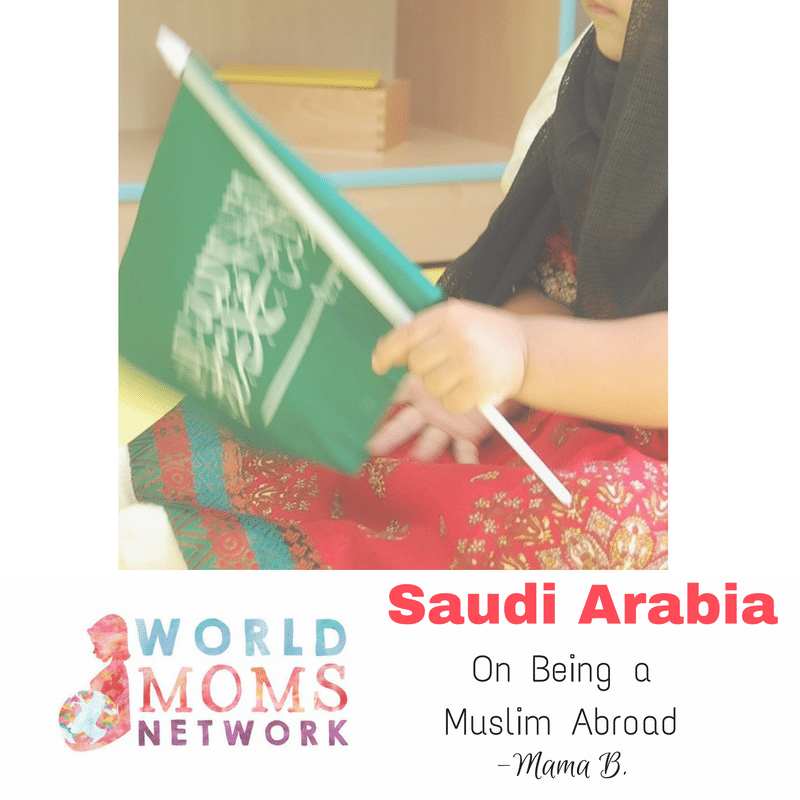
Paris, 1989, on a playground. A young girl only a year or two older than I asks me, in French, “Where are you from?” “I am from Saudi Arabia,” I reply. She asks me where that is. This happened to me frequently, and I couldn’t understand how children didn’t know where Saudi Arabia was! I knew where France was… Why shouldn’t they know where Saudi was?
Vermont, 1993. Camp Kenya. “Do you have an oil well in your backyard?” “Are you a millionaire?” “Do you live in a tent?” We indulged the questions at first, but it started to get a bit old. My cousin and I tried to blend in as best we could, without joining in on the conversations about boys and first kisses. While we obviously stood out, our novelty wore off quickly, especially when our answers to their questions were not as exotic or mysterious as the other children hoped.
1998, London, American University. “Oh! You don’t seem like a Saudi,” a fellow student exclaimed. “How many Saudis have you met?” I asked her. “None,” she replied. Another student remarked, “Wow, a Saudi woman studying graphic design in London! What a huge step for women!” I couldn’t help but be offended. ”Ummmm… my mother studied in Switzerland, is fluent in 3 languages and has devoted her life to women empowerment… Studying graphic design in London is no great feat.”
2000, London, American University. In response to the news of my engagement, one of my teachers called me into his office. “Are you ok?” he asked me. “Yes, why?” I replied. “Is it your choice to get married?” he asked. I was shocked by his question, so I replied, “Yes, it is. Why would you ask me that?” “I would hate for you to be coerced into something you didn’t want.” This is from a professor I had known for 2 years. In his classes, he knew me to be an opinionated, creative and confident woman. But apparently the cliches don’t shift.
September 11, 2001, London. At home. The phone rings. “Switch on the TV!” my cousin tells me. “What channel?” I ask. “Any channel,” she replies. We get a warning to stay home from University for a while, so my sister camps out in the living room in front of the news for days on end. “I am from Saudi Arabia,” is not longer greeted with curiosity and questions about oil wells in our backyard.
Watching the events unfold that day was horrific, devastating and gut wrenching. As a 21 year old college student, I felt society expected me to take responsibility or apologise, even though this act was so far away from anything I knew, anything I was raised with, anything I or anyone else I knew believed. I didn’t understand why these acts by these men changed people’s impression of me. “It’s me!” I wanted to shout. I haven’t changed as a result of what terrorists have done. I don’t have a hand in this.
The cliche had changed overnight. ‘I am Saudi,’ was no longer only synonymous with, “I am an oppressed woman whose biggest ambition in the world is to buy half of Harrods.” It now also became synonymous with “I am a hateful person to be feared. I come from a country without a shred of good in it. I come from a country that breeds terrorists. Therefore I am sure to breed the myself. And my silence means I condone every terrorist act committed not only by a Saudi but by anyone claiming to be a muslim.” You may think this is a bit dramatic. I wish it was. It was very much black and white.
Looking at the world events in the last few months. Listening to the rhetoric coming out of the UK after Brexit and the US after the elections it is clear that nothing is ever black and white. Every country, every community, every family and every person has the capacity for both good and bad. I have lived my whole life knowing this. We were raised knowing this. That is why it is so difficult to understand when people paint a whole culture and country with one brush. I did not look at these situations and think, “That’s it! They hate us! They would rather see us gone.” Maybe I had the luxury of travelling to many places and meeting many people from different cultures. What I am certain of is that nothing and no one is perfect, what matters more is the effort people put into their betterment.
They have opinions about me, and about my people, but there is much that they do not see, that they do not know. Since September 11th Saudi Arabia has had dozens of terrorists attacks on its own soil targeting not only expats but Saudi civilians and law enforcement, as well as members of the government. The Saudi government has been actively fighting terrorism and has had many successes in this war against terror. Saudi Arabia has taken measures to regulate all charitable donations, requiring proper permits and security checks to ensure every donation is going where it is intended. The Saudi government recognised an underlying problem in our education system and has since changed the textbooks and method of teaching.
The Arab and Muslim world has lost many lives to extremist ways of thinking and terrorism. Likewise, the Arab and Muslim world has a great deal to gain by fighting the war of terror. We are together in this.
This is an original post to World Moms Blog by Mama B. of Saudi Arabia. Photo credit to the author.

Mama B’s a young mother of four beautiful children who leave her speechless in both, good ways and bad. She has been married for 9 years and has lived in London twice in her life. The first time was before marriage (for 4 years) and then again after marriage and kid number 2 (for almost 2 years). She is settled now in Riyadh, Saudi Arabia (or as settled as one can be while renovating a house).
Mama B loves writing and has been doing it since she could pick up a crayon. Then, for reasons beyond her comprehension, she did not study to become a writer, but instead took graphic design courses. Mama B writes about the challenges of raising children in this world, as it is, who are happy, confident, self reliant and productive without driving them (or herself) insane in the process.
Mama B also sheds some light on the life of Saudi, Muslim children but does not claim to be the voice of all mothers or children in Saudi. Just her little "tribe." She has a huge, beautiful, loving family of brothers and sisters that make her feel like she wants to give her kids a huge, loving family of brothers and sisters, but then is snapped out of it by one of her three monkeys screaming “Ya Maamaa” (Ya being the arabic word for ‘hey’). You can find Mama B writing at her blog, Ya Maamaa . She's also on Twitter @YaMaamaa.
More Posts
by Ketakandriana Rafitoson | Nov 10, 2016 | 2016, Africa, Africa and Middle East, Awareness, Gender, Girls, Madagascar, Sustainable Development Goals

Did you know that each year, there are 16 days dedicated to the fight against gender-based violence? Starting from November 25 (International Day for the Elimination of Violence against Women) to December 10 (Human Rights Day), millions of activists around the world join this campaign, plan actions and speak up to break the curse of violence in their societies.
First launched in 1991 by the first Women’s Global Leadership Institute, the “16 Days Campaign”, as it is usually called, is coordinated by the Center for Women’s Global Leadership, in partnership with Rutgers University. The event is supported by UN Women and other international institutions aiming at the fulfilment of the Sustainable Development Goal (SDGs) #5: Achieve gender equality and empower all women and girls. The fact is that there can’t be any form of empowerment if girls and women still face violence. Women must first be freed from the heavy burden of violence, which impedes all attempts of (r)evolution.
What is gender-based violence? According to the Convention on the Elimination of All Forms of Discrimination Against Women (CEDAW), Gender-based violence is “violence that is directed against a woman because she is a woman or that affects women disproportionately” (CEDAW GR 19, Article 3 Istanbul Convention). And in its Declaration on the Elimination of Violence Against Women (A/RES/48/104, article 2), the UN General Assembly identifies various forms of violence, as per the following:
“(a) Physical, sexual and psychological violence occurring in the family; including battering, sexual abuse of female children in the household, dowry-related violence, marital rape, female genital mutilation and other traditional practices harmful to women, non-spousal violence and violence related to exploitation.
(b) Physical, sexual and psychological violence occurring within the general community, including rape, sexual abuse, sexual harassment and intimidation at work, in educational institutions and elsewhere, trafficking in women and forced prostitution;
(c) Physical, sexual and psychological violence perpetrated or condoned by the State, wherever it occurs”
This list has certainly evolved since 1993, especially with the advent of social media and new communications technologies which open the door to new forms of harassment. Strategies developed to tackle this curse must evolve along the same lines.
In Madagascar, domestic violence is one of the most widespread types of gender-based violence and is considered a social taboo. Traditionally, each bride-to-be is advised by her mother or grandmother to remain silent, whatever might happen in her marriage. Women are told that what happens in the bedroom and at home must remain there. My own grandmother, whom I love and cherish, told me that “Marriage means sacrifice. Your husband may do things to you (we never name the evil in Madagascar), but just bite your tongue and everything will be fine.” Thankfully, my husband is not that kind of man, but I still feel it is my duty to stand against this curse and to help the unspeakable to be spoken.
Our first project with the 16 days campaign dates back to 2013. We wrote and produced a short film called “Lettre Femme” (a French pun meaning at the same time letter from/to a woman, the female being, or simply a woman). We shot the film at my mom’s house, featuring my friends, who generously volunteered to participate. Last year, we launched the Malagasy Women’s Manifesto Against all Sorts of Violence through a petition. This year, we plan to organize a variety of trainings about nonviolence.
It is a tragic fact that many Malagasy women are convinced that they deserve some kind of violence from their partner. “If he beats me, it’s because I’ve done something wrong. It’s my own fault.” Even worse, women (mothers mainly) are the ones who help perpetuate this violence – by silencing their girls and normalizing the belief that violence is part of marriage. Our whole society needs to be educated in order to eradicate violence, and this struggle must start in every household. Teach your boys to respect women – this is the message we have to spread to all parents.
If you are interested in joining this year’s official 16 Days Campaign, please click here. You’ll find all the information related to the event, a Toolkit for Action as well as the communications templates that you can use. Register your event and share it with the world so that we can show the world that women are united against violence. Remember, Unity matters! We shall overcome!
This is an original post for World Moms Blog by Ketakandriana Rafitoson, our contributor from Madagascar.
Photo credit to the author.

by Susie Newday (Israel) | Nov 3, 2016 | 2016, Africa and Middle East, Inspirational, Israel, Life, Life Lesson, Middle East, Susie Newday
I think the word mother is synonymous with busy. Time is a precious resource and when we have a bit of it to ourselves we’re often too exhausted to even enjoy it, let enough do things for ourselves.
I’m not the only mother out there constantly playing the waiting game, pushing off things I want to do because I have other obligations or not enough energy.
It’s funny how even when we know how fragile life can be, we still think we have plenty of time to do the things we’ve been meaning to do.
I think we should learn from our kids, they don’t wait. They just jump into new things. They can be exhausted but still insist on playing a new game or coloring a picture. They enjoy crawling and don’t waste time dreaming about when they will finally walk.
They’re right, because life is too short for the waiting game.
Waiting for the right time or the right moment.
Waiting for the inspiration to hit.
Waiting to be sure.
Waiting to take a chance and go out on a limb.
Waiting to take a class or learn something new.
Waiting for someone else to tell me I’m worthwhile.
Waiting until ______.
I want to stop waiting.
Because no one else is responsible for my happiness.
No one else can give me the answer to what’s right for me.
No one else can grant me satisfaction with my life.
No one else can open doors for me if I am holding them shut.
No one else can fill my life with love if I don’t love myself.
Do the things that bring you joy and make you happy. Stop waiting for tomorrow. Just do it. Now.

This is an original post to World Moms Blog by Susie Mayerfeld, our contributor in Israel.
Photo credits to the author.
Susie Newday is a happily-married American-born Israeli mother of five. She is an oncology nurse, blogger and avid amateur photographer.
Most importantly, Susie is a happily married mother of five amazing kids from age 8-24 and soon to be a mother in law. (Which also makes her a chef, maid, tutor, chauffeur, launderer...) Susie's blog, New Day, New Lesson, is her attempt to help others and herself view the lessons life hands all of us in a positive light. She will also be the first to admit that blogging is great free therapy as well. Susie's hope for the world? Increasing kindness, tolerance and love.
You can also follow her Facebook page New Day, New Lesson where she posts her unique photos with quotes as well as gift ideas.
More Posts - Website
Follow Me: