by Jennifer Burden | Aug 15, 2014 | 2014, Shot@Life, Social Good, United Nations, World Voice, Youth
World Moms Blog has a long history of advocating for global vaccinations with the UN Foundation’s Shot@Life campaign, and we are honored to host a post for their #Blogust campaign going on this month! The goal of the campaign is to raise awareness for vaccinations for the children who need them most. Every comment on this post will unlock one donated vaccine for a child. And don’t stop there — every social media share counts, too! You can visit all the posts in the relay at www.blogust.org.
So, tell me now, have you ever experienced any “firsts” growing up that were better than you ever expected or were highly impressionable on who you are today? Many highly anticipated first experiences often come and go forgotten or don’t really mean anything today in retrospect, right? But, here’s a story of one first in my life that made an impact, and I admit to even going back for more! It’s not chocolate, but could have been chocolate, but no, it wasn’t.
Ok, here goes…My age was only 14. I boarded a big yellow school bus to travel to the great big city to my first international summit. And I left with a new perspective on what one person, one child, in fact, could have on the world. This is the story of my first trip to the UN in New York city and how I wound up there as a teenager…
Growing up on the Atlantic coast in New Jersey, USA, it’s common to spend many days on the beautiful sandy shores of my home state and playing in the surf. What was not to love back then?
The pollution, that’s what.
Back in the 1990s, plastic bags, straws, cans, plastic tampon applicators, you name it — all washed up on our beaches. Beaches were closed after hypodermic needles arrived on our shores with other hospital waste. We were swimming in this dangerous mess, and as a species, we were not only endangering our fellow humans, but recklessly damaging a habitat that marine life called home.
The pollution and lack of empathy to preserve our planet drove me nuts!
So, as a teenager I wound up joining a local environmental advocacy group to help raise awareness about the importance to keep our oceans clean and attended their beach clean ups. At a meeting back in 1990 they gave us the news that the UN would be hosting an environmental summit for youth in New York City. I had to go — the UN! The environment!! Yes!!!
I took the information about the youth summit to my high school principal and made the case that our school should be represented. On the day of the summit, my school, Brick Memorial High School, had a delegation en route with our amazing science teacher, Mrs. Kingman.
We were wide-eyed while entering the famous main UN room with seats and labels for delegations from each country. It was a place where decisions were made on human rights, trade, embargos, and we sat down and took to playing with the microphone systems (so hard to resist!). We looked around at all the other students, both, similar and different to us. We didn’t know what to expect from the event, and as it got started, out came speaker after speaker — all kids like us, at the time, from around the world. They spoke of environmental issues affecting the areas they lived in and what was needed or what they were doing to make a difference.
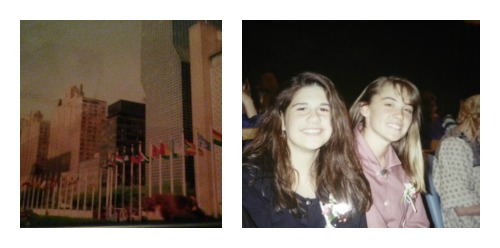
At the UN’s environmental youth summit in the 1990s.
Back in the early 1990s at the UN youth environmental summit, one boy in particular — I remember him being younger than me at the time, maybe 12 years old? maybe younger? — gave a presentation on how the lives of sea turtles in Florida were becoming threatened. He, on his own, was responsible for saving the lives of thousands of babies by protecting their nests and helping the hatchlings out to sea. Our delegation went from wide-eyed to teary eyed. He brought the house down in applause and pride for our fellow youth. That moment engrained in me of how one person, regardless of age, can make an impact on the planet. He was an inspiration.
My first experience at the UN was definitely one that was positive and inspiring — a big realization that we were all players in a world much larger than our own hometowns. And kids could make change, too! They were even already doing it. This mindset is something that inspired me as a kid and will continue to impact how I raise my young daughters today and in the future.
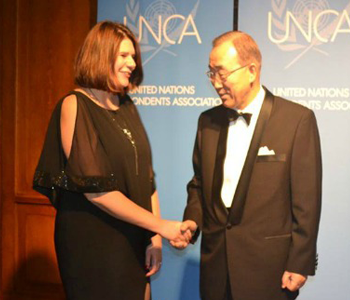
As a part of World Moms Blog, I still jump on the opportunity to head to the UN when we’re invited to report, especially around the UN General Summit & Social Good Summit and for the annual State of the World’s Mother’s Report. We have become our own “United Nations” of moms, here! And additionally, in 2012 when I was asked to be part of a UN Foundation delegation to Uganda with Shot@Life, I was honored to answer the call, too, with the same 14-year old excitement I had when attending the environmental youth summit back in the early 90s. Which brings me back full circle for the purpose of this post…
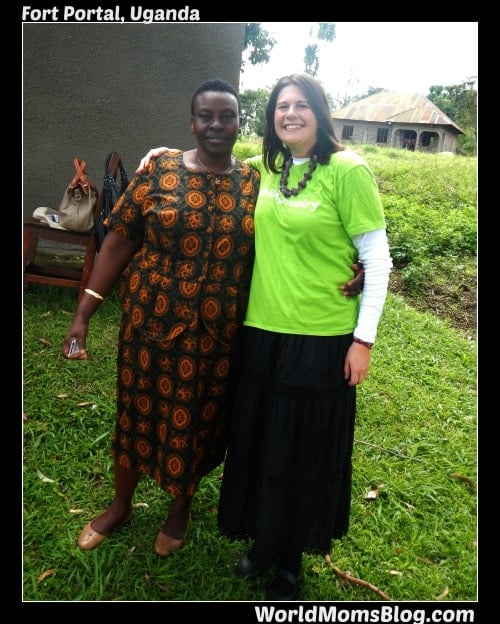
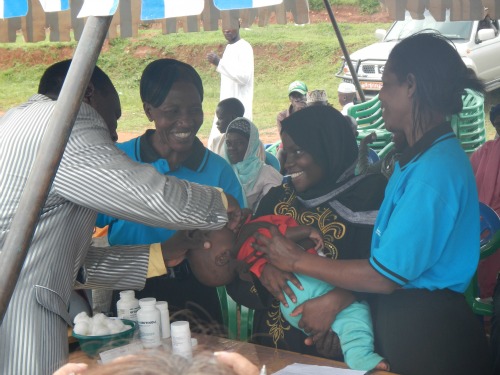
Elizabeth, a volunteer health worker in Fort Portal, Uganda with World Moms Blog Founder, Jennifer Burden on a Shot@Life trip October 2012.
While in Uganda with Shot@Life, I witnessed children receiving life-saving vaccinations at UNICEF’s Family Health Days around the country. We sat under shady trees and spoke with mothers who wanted the same for their children: good health and an education. We played with lots of children, knowing that because they were being vaccinated against measles, pneumonia, rotavirus and polio (the four deadliest killers of children under 5) that they had a healthier shot at living past their fifth birthday and experiencing more “firsts.”
There is no doubt in my mind that life-saving vaccines are needed in the world.
Every 20 seconds a child dies from a disease that could have been prevented through immunization, which is an inexpensive global health solution to save lives. Healthcare in far to reach or developing areas can be ineffective at keeping a child alive in the event of severe diarrhea or pneumonia. A vaccination can work as a shield to protect a child from even contracting these diseases in the first place.
Today, and all this month, you have the unique opportunity to comment on #Blogust posts and help save lives. Walgreens will donate one vaccine to a child who needs it most in response to your comment on this post, those on all the #Blogust posts this month, as well as, any social media shares.
Please, give more children the chance to live past their 5th birthday, the chance to attend a global youth summit, the chance to single-handedly save marine life, the chance to make a positive impact on animal life and on others, the chance to ride a bus to the UN, the chance to live and be a kid. Join me in being a game changer. Help start the conversation to unlock life-saving immunizations!
During Shot@Life’s Blogust 2014—a month-long blog relay—some of North America’s most beloved online writers, photo and video bloggers and Shot@Life Champions will come together and share stories about Happy and Healthy Firsts. Every time you comment on this post and other Blogust contributions, or share them via social media on this website, Shot@Life and the United Nations Foundation pages, Walgreens will donate one vaccine (up to 60,000). Blogust is one part an overall commitment of Walgreens donating up to $1 million through its “Get a Shot. Give a Shot.” campaign. The campaign will help provide millions of vaccines for children in need around the world.
Sign up here for a daily email so you can quickly and easily comment and share every day during Blogust! For more information, visit shotatlife.org or join the conversation on Facebook and Twitter.
This is an original post to World Moms Blog by founder, Jennifer Burden, of New Jersey, USA.
Photo credits to the author.

Jennifer Burden is the Founder and CEO of World Moms Network, an award winning website on global motherhood, culture, human rights and social good. World Moms Network writes from over 30 countries, has over 70 contributors and was listed by Forbes as one of the “Best 100 Websites for Women”, named a “must read” by The New York Times, and was recommended by The Times of India.
She was also invited to Uganda to view UNICEF’s family health programs with Shot@Life and was previously named a “Global Influencer Fellow” and “Social Media Fellow” by the UN Foundation. Jennifer was invited to the White House twice, including as a nominated "Changemaker" for the State of the World Women Summit. She also participated in the One Campaign’s first AYA Summit on the topic of women and girl empowerment and organized and spoke on an international panel at the World Bank in Washington, DC on the importance of a universal education for all girls. Her writing has been featured by Baby Center, Huffington Post, ONE.org, the UN Foundation’s Shot@Life, and The Gates Foundation’s “Impatient Optimists.” She is currently a candidate in Columbia University's School of International and Public Affairs in the Executive Masters of Public Affairs program, where she hopes to further her study of global policies affecting women and girls.
Jennifer can be found on Twitter @JenniferBurden.
More Posts - Website
Follow Me:


by Ewa Samples | Jun 20, 2014 | 2014, Awareness, Environment, Family, Health, Human Rights, Humanity, Inspirational, Motherhood, Parenting, Polish Mom Photographer, Safety, USA, World Motherhood
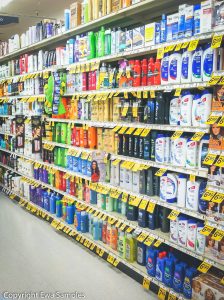
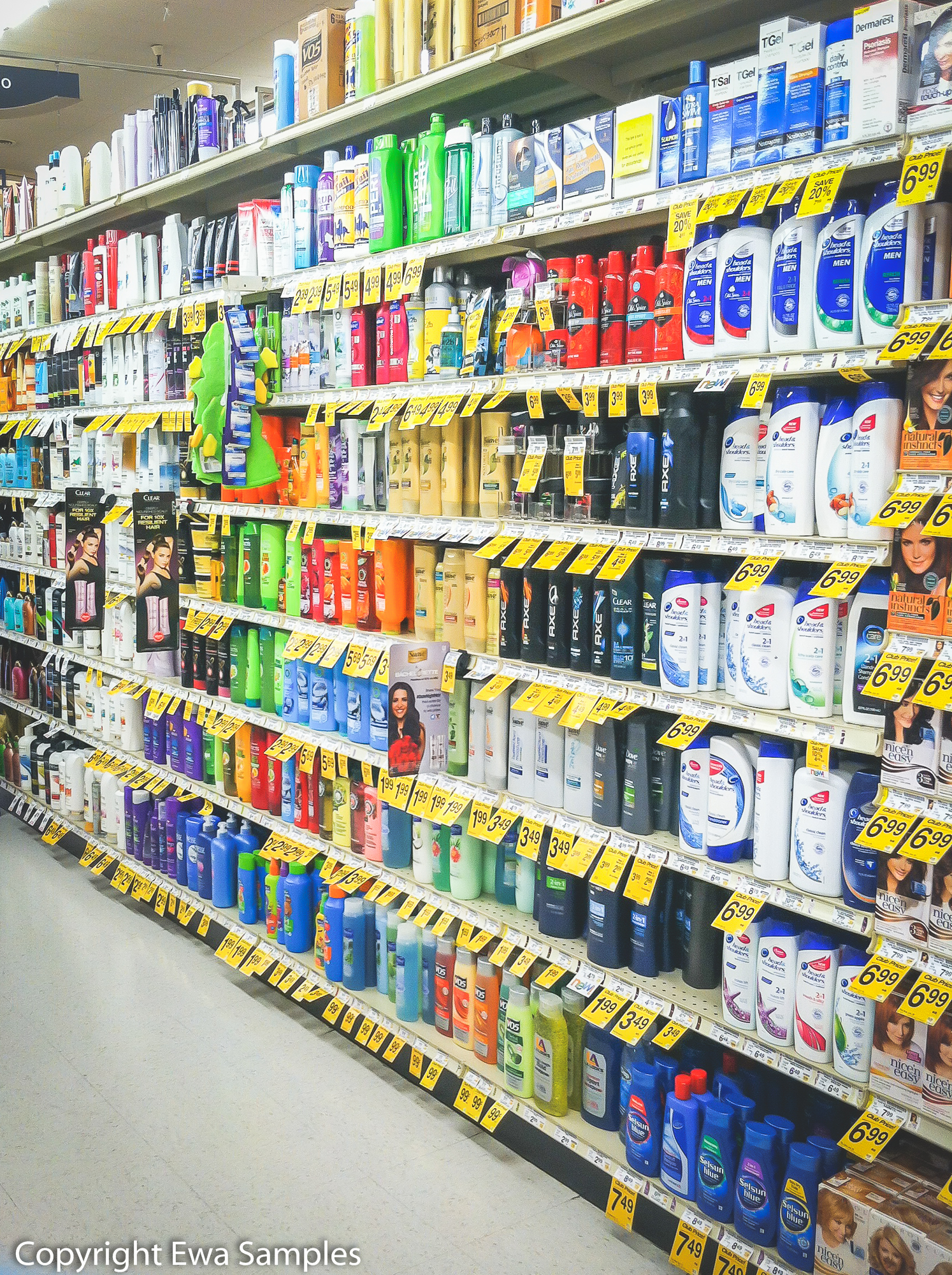
Four years ago I bought my last body lotion and body wash. Two years ago, for several months I went “no-poo”. Around that time I also threw all my deodorants in a trash can.
The only thing I have gotten back to is the shampoo. I do, though, try to make it myself every now and then. The rest of the cosmetics are not very welcome on my bathroom shelf, unless I make them myself.
Because of that, I normally try to stay on top of situations in which I may run out of something (and also because I simply refuse to use the toiletries that are on my husband’s shelf in the bathroom). Funny thing is that he has way more “beauty products” than I do, and he does not have a lot of them, compared to most people.
… but one day it happened, I ran out of my shampoo…
Luckily it was a shopping day. Happy that I didn’t actually have to make an extra trip to the grocery store just to get a shampoo, with my greasy hair tied in a ponytail, I left the house. Because it was pretty late, and we were pretty exhausted from a busy day, we had decided we were going to stop by only one store, not two, like we normally do. (more…)
Ewa was born, and raised in Poland. She graduated University with a master's degree in Mass-Media Education. This daring mom hitchhiked from Berlin, Germany through Switzerland and France to Barcelona, Spain and back again!
She left Poland to become an Au Pair in California and looked after twins of gay parents for almost 2 years. There, she met her future husband through Couch Surfing, an international non-profit network that connects travelers with locals.
Today she enjoys her life one picture at a time. She runs a photography business in sunny California and document her daughters life one picture at a time.
You can find this artistic mom on her blog, Ewa Samples Photography, on Twitter @EwaSamples or on Facebook!
More Posts - Website
Follow Me:


by Katinka | Jun 16, 2014 | 2014, Awareness, Belgium, Death and Dying, Government, Health, Hospital, Human Rights, Life Lesson, Loss of Child, Motherhood, Parenting, Penguin and Panther, Politics, World Motherhood
 I’m going to ask you all to journey with me into an imaginary world. A parallel universe if you will. This world bears some similarity with the one of H.G Wells’ Eloi from his book The Time Machine. And possibly something from Suzanne Collins’ Hunger Games as well.
It’s a nice world to live in, really. You are relatively happy there. You get to spend a great deal of time with your child and you generally feel fulfilled. There is this small matter of the alien usurpers that govern the world but in daily life, you don’t even notice them. Afterall, they did manage to rule out world hunger and poverty, so at times you are even grateful to them.
Every once in a while, however, the aliens impose their Lottery. It is a constant little threat that buzzes at a corner of your head. The Lottery picks out subjects at random, which are then summoned to the alien High Office. No one really knows what happens there but everyone agrees it’s nasty. Sometimes the subjects are adults, sometimes children. Even babies don’t escape the Lottery. But it has never happened to you or anyone you know. So, you are quite comfortable and don’t even mind following the Lottery outcomes.
Until that fatal Lottery Day. You don’t even know your child’s name is picked until you see his hypodermal chip changing colour. At first you try to deny it. It has to be a play of the light. A mistake, maybe. But then it is on the news as well. Your son is the new subject and he hasn’t come in yet like he should have. The aliens are coming for him.
Being accustomed to human habits, they allow you to go with him, although they advise against it. Of course you go. All parents do, the aliens say. Humans never listen to reason.
In the following weeks, your child is poked around. Needles, infusions and pills. He has to swallow big magnet-like sensors and gets extra chips. Wires go in and out. He is brave and endures. You can see his anxiety, but you assure him it should be over soon. That’s what they tell you anyway.
Then the pain comes. And his screams. Oh, his screams. You kiss his forehead, telling him to hold on. The aliens don’t give in to your pleas to stop. To please stop.
The pain comes and goes. In between, he is exhausted, but brave, still. You believe he is so much braver than you are.
One day, the aliens take you aside for a little talk. They inform you your child isn’t going to be one of those subjects that gets to go home after a memory wipe. Their studies show he actually is an excellent subject for their experiments. He is quite special. He is going to stay at the High Office forever. As long as his little body can endure anyway.
It’s your time to scream now. Your legs give in. You beg them to take you instead. There must be some similarities between the both of you, you plea. Maybe you would make an even better subject. You might be able to endure longer than your precious little boy.
Of course they don’t give in. That was not how the Lottery works. It’s your child they want.
So, day in, day out, you watch your child suffer. When you can’t bear looking, you still hear him anyway.
One day, the pain is exceptionally hard to cope with. Out of breath, your child tells you again he can’t do it anymore. He doesn’t even care for going home anymore. He just wants it all to stop.
For the first time you can’t find the strength to tell him to hold on. Why would he? The door is locked and guarded. And the aliens seem more thrilled with their results every day.
They will never let him go now.
This is why in Belgium, as of February 2014, euthanasia for minors was legalized.
We don’t have aliens here (yet) but we do have children suffering from terminal illness. Children with no other perspective in life than death.
Some are born into it; others see their life changing overnight. Some are in constant, barely sedated, pain; others are sitting out their time. Some have a clear will about what they want from life; others only know the difference between comfort and discomfort. Some will want to live; others will want to die.
I don’t expect you all to fully agree with this law. I do understand there are various objections, moral and religious. I do realize there are fears of misjudgement, or even misuse.
But for me, I’m mostly relieved and confident.
Relieved these children will now be able to make the most important decision of their lives. Confident they will be able to make the right choice with the support of their parents and doctors. They have my support too.
How about you? Would you be able to support a child or a parent on such decision? Are there laws for or against euthanasia for minors in your part of the world?
This is an original post to World Moms Blog by K10K from The Penguin and The Panther.
The picture in this post is credited to the author.
If you ask her about her daytime job, Katinka will tell you all about the challenge of studying the fate of radioactive substances in the deep subsurface. Her most demanding and rewarding job however is raising four kids together with five other parents, each with their own quirks, wishes and (dis)abilities. As parenting and especially co-parenting involves a lot of letting go, she finds herself singing the theme song to Frozen over and over again, even when the kids are not even there...
More Posts
by Cindy Levin | Jun 10, 2014 | 2014, Childhood, Human Rights, Humanitarian, International, Kids, Multicultural, Social Equality, Social Good, United Nations, World Voice

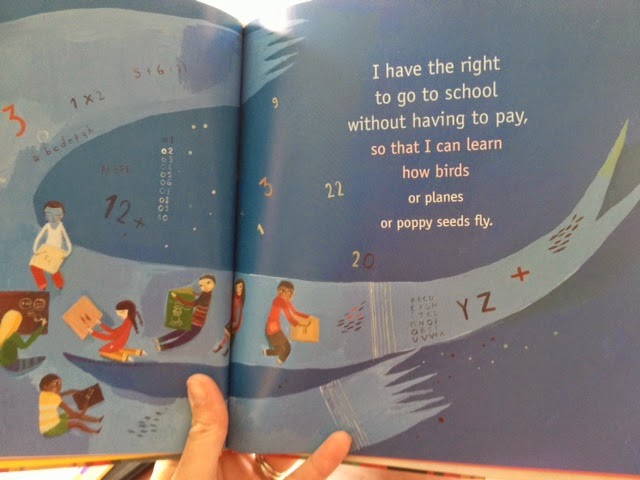
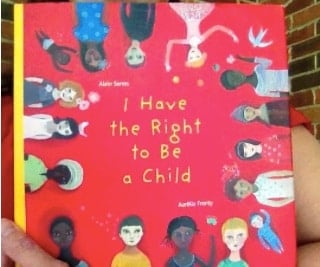
I’ve recently introduced a picture book into my family’s reading time called “I Have the Right to Be a Child” by Alain Serres. With beautiful simplicity, the book provides the author’s interpretation of the United Nations Convention on the Rights of the Child. The Convention includes things like rights to education, gender equality, nutrition, health care, free speech, freedom from child labor, safety, etc. For kids, the book is a conversation starter about human rights. We talked a lot about the question, “What are rights and what are privileges?” For adults, the book is a reminder that these concepts really are not that complicated. It may be complicated in the implementation of granting rights, but when the rights themselves are asserted in the simple language of the children the Convention seeks to protect, it all becomes much more clear.

This is probably the first time my kids saw human rights presented in a way that was meaningful to them. In American museums and text books, the right to vote for women and people of color seems faraway and a “done deal.” They don’t think of those rights as things we continually need to address here and in other countries. My children often help me advocate to give children in developing countries access to school and vaccines, but the language of “rights” isn’t always included in those kinds of discussions.
My youngest really latched on to the page that said,
“I have the right to express myself completely freely, even if it doesn’t always please my dad, and to say exactly how I feel, even if it doesn’t always please my mom.”
We have a lively ongoing debate about how that plays out. If she has the right to express herself completely freely, how might that compete with my perceived right not to be disrespected in my own home or the rights of her other friends and family members?
It might be surprising to Americans to learn that while 194 states in the world have agreed to the Convention, the U.S. has not officially ratified it. In fact, every member of the United Nations except Somalia, the United States, and South Sudan are party to the Convention, having agreed to change or make laws and to develop practices and programs to support it. The U.S. has signed to show support, but hasn’t “ratified” it. Ratification requires being bound by international law and having to report regularly to the UN Committee on the Rights of the Child, which monitors compliance.
Why hasn’t the U.S. ratified? Katie Jay – author of the “Children Deserve Families” blog told me that recognizing that children have a right to a safe and secure permanent family is cutting edge human rights law. The idealistic part of me scoffs at that, saying;
“Really? Cutting edge? To provide security, safety, and nourishment to children is cutting edge?” But the lobbyist part of me knows that it can sometimes be a tricky thing for a country to formally declare something as a “human right.”
Because once you officially do that, then you have to do something about it…or be held accountable by an international authority and possibly give up your moral high ground if you are then seen as a country that doesn’t live up to its own standards. Sadly, from the standpoint of an American citizen who has watched our behavior on international environmental agreements with dismay, I can tell you that Americans generally don’t like the idea of international authority holding us accountable for just about anything.
Has your country ratified the Convention? Take a look at this paraphrased list of rights for children from the book and consider which of them you think are rights or privileges. Are all of them rights? What would be the ramifications for your country to truly grant that right in your country? Internationally? What benefits or problems do you see that could arise if the world embraced the Convention wholeheartedly?
- I have the right to a first name, a last name, a family, and a country that I can call my home.
- I have the right to have enough food to eat and water to drink.
- I have the right to live under a roof, to be warm, but not too hot, not to be poor and to have just enough of what I need, not more.
- I have the right to be cured with the best medicines that were ever invented.
- I have the right to go to school without having to pay.
- I have the same rights whether I am a girl or a boy.
- I have exactly the same right to be respected whether I am black or white, small or big, rich or poor, born here or somewhere else.
- I have the right to be helped by my parents, my friends, and my country if my body doesn’t work as well as other children’s.
- I have the right to be free from any kind of violence, and no one has the right to take advantage of me because I am a child.
- I have the right to go to school and refuse to go to work.
- I have the right to be protected by adults and to be sheltered from disasters
- I have the right never to experience war or weapons.
- I have the right to breathe clean air.
- I have the right to play, to create, to imagine, and also to have friends.
- I have the right to learn about friendship, peace and respect for our planet.
- I have the right to express myself completely freely.
This is an original post written for World Moms Blog by Cindy Levin.
Cynthia Changyit Levin is a mother, advocate, speaker, and author of the upcoming book “From Changing Diapers to Changing the World: Why Moms Make Great Advocates and How to Get Started.” A rare breed of non-partisan activist who works across a variety of issues, she coaches volunteers of all ages to build productive relationships with members of Congress. She advocated side-by-side with her two children from their toddler to teen years and crafted a new approach to advocacy based upon her strengths as a mother. Cynthia’s writing and work have appeared in The New York Times, The Financial Times, the Washington Post, and many other national and regional publications. She received the 2021 Cameron Duncan Media Award from RESULTS Educational Fund for her citizen journalism on poverty issues. When she’s not changing the world, Cynthia is usually curled up reading sci-fi/fantasy novels or comic books in which someone else is saving the world.
More Posts - Website
Follow Me:

by Nancy Sumari | May 28, 2014 | 2014, Africa, Awareness, Home, Humanitarian, Nancy Sumari, Social Equality, World Moms Blog, World Motherhood, World Voice
I was recently asked to be a part of the upcoming UNHCR World Refugee Day in my country. I was asked to put literally myself in the shoes of those individuals who have been forced out of their homes and countries, due primarily to conflicts. I was then invited to contribute my thoughts and feelings through a document that would be shared at a gathering on World Refugee Day.
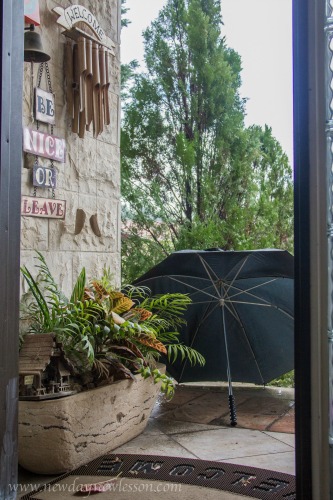
As a mother, I feel that our primal instinct is to protect and nurture, but protection and nurturing that is coupled with nesting. To many of us, a nest may initially bring a picture of “a little bird and a couple of eggs” to mind but in my opinion, a nest brings to mind home. It means having a center, a base, headquarters, in short somewhere to come back to.
That got me thinking. What does this four-letter word, HOME, really mean? To some, not much, because for them it’s something easily taken for granted. To others, it’s a base. A place where you shower, change, nap and get back out there. But, for a lot of people, it’s a residence, it’s family, it’s dignity, it’s freedom. Most importantly, it’s where the heart is. I probably can’t even count the amount of times that I’ve walked in and out of my home, the amount of time I’ve spent time in my home just hiding away from the world in a safe and comforting haven. A lot of those times, I have not really sat and looked around to soak it in and really see what it all means, and certainly not for me, but for my family, until now.
The thought of the loss of this base, this center, a center that helps us be centered, truly breaks my heart. So here I am, thinking about the 5 million people in Tanzania who are currently refugees without ‘A Home’. My heart breaks to think about what that means for the 48% of refugees who are children. I am empathizing with them but also in awe of them all. In awe of their strength. In awe of their resilience.
I wish for a day when every person in this world will have a physical home to house the home each of us carries with us in our hearts.
What does home mean for you?
This is an original post by Nancy Sumari from Tanzania. You can find more of her writing at Mama Zuri.
Photo Credit to Susie Newday.

by Mannahattamamma (UAE) | May 21, 2014 | 2014, Awareness, Cultural Differences, Education, Expat Life, Feminism, Girls, Government, Human Rights, Nigeria, Politics, UAE, USA, Women's Rights
In March, I wrote a post in honor of Gloria Steinem’s birthday, in which I mentioned that when Steinem spoke at my college graduation way back in the 1980s, my friends and I had wished for a speaker who was more “relevant.” In our innocence, we believed that Steinem had won her fight; we were graduating from a women’s college and thought that fight for gender equality had been more or less won.
More than two decades later, I wish I could say that Steinem was irrelevant and that gender inequality is something we only read about in the history books.
When I wrote that post about Steinem, I was thinking about the Common Core curriculum, which relegates women’s contributions to history to the sidelines. Now, of course, we are all confronted with the horror that’s unfolding in Nigeria, and while the plight of those schoolgirls devastates me, it has become, in my mind, another instance in a long list of the ways in which groups (comprised mostly of men) attempt to score political points by seizing control of women’s lives. As an example, think about the Tea Party conservatives in the US, who prove their conservative bona fides in the United States by voting against support for Planned Parenthood, or Head Start, or universal kindergarten, or…
What is so scary about educating a girl? In the middle ages, accusations of witchcraft were often leveled against women who had amassed too much wealth or land, or who in some way differed from those around them. We teach our children that things like the Salem witch trials happened because “people didn’t know better” or because of “mass hysteria” but sometimes I wonder how far we have progressed since those days. What happens to women who challenge the status quo–or who have the potential to challenge the status quo? Don’t they still run the risk of being punished, whether literally or figuratively?
It’s funny to me now, but when I first moved to Abu Dhabi the two most obvious indications that we’d left Manhattan behind—besides the searing heat—were the adhan and the abaya-clad women: religion and covered bodies. I found the abayas more unsettling than the call to prayer, even as I sometimes envied the women their public invisibility. The longer we live here, however, my perceptions have changed so that I no longer see hijab as an automatic symbol of oppression or subjugation or second-class citizenry.
I would imagine, however, that as women here, we’ve all had moments where we’ve felt marginalized, silenced, lesser: the day I trotted down the sidewalk to get in a waiting cab and the cab driver chastised me by saying “women should not run, madam, I will wait, and you should walk.” Or when a guard at the border crossing into Oman looked over at the passenger seat where I was sitting (in long trousers) with one foot propped on the dashboard and told me “to put my foot down, sit like a lady, more properly, sit properly.” When that happened my first impulse was to laugh: surely he couldn’t be serious? But, of course, he was serious. I put both feet on the floor and looked at the map so that I didn’t toss out a few well-chosen swear words. (A general rule regardless of where you are: don’t swear at anyone, male or female, who is wearing a uniform at a border crossing.)
So yes, in that instance, I was silenced as I suppose I was by the cab driver too, who took it upon himself to offer some unsolicited advice. And yes, there is now a slight internal pause before I leave the house as I run through a kind of inner checklist about what I’m wearing: if short sleeves, a long skirt or pants, or vice versa (long sleeves, shorter skirt or shorts); do I have a shawl (equally for frigid air conditioning and bare shoulders); if I’m going to the beach, I make sure that my beach cover-up is more than a ratty t-shirt. There are days where I know I’ve failed the checklist and am too busy or late to care, but overall, I dress more modestly now than I used to and probably that’s not a bad idea: no one needs to see a fifty-year-old woman slopping down the street in cut-off shorts and a tank top.
Am I being repressed, or respectful? Does my feminism mean that I yell at the cabbie, keep my foot defiantly on the dashboard, saunter down the street in a halter top and tight jeans? Or, alternatively, does feminist politics remind us that silencing and the policing of women’s bodies happens—sadly—in almost every culture in the world, including the US? Without making light of the specifics of being female in this region, I’ve come to think of the issues facing women in this part of the world as being differences in degree, not kind, from the problems facing women in other parts of the world.
What do we, as women, do to help other women and girls find their voices–find our own? How do we create strength to silence those who would silence us?
This is an original post to World Moms Blog by Deborah Quinn in the United Arab Emirates of “Mannahattamamma.”
After twenty-plus years in Manhattan, Deborah Quinn and her family moved to Abu Dhabi (in the United Arab Emirates), where she spends a great deal of time driving her sons back and forth to soccer practice. She writes about travel, politics, feminism, education, and the absurdities of living in a place where temperatures regularly go above 110F.
Deborah can also be found on her blog, Mannahattamamma.
More Posts
Follow Me: