by Jennifer Burden | Mar 28, 2014 | 2014, Poverty, Video
This week I joined a group of World Moms Blog contributors who have been trying to live on $1.50 a day for 1 day. One day, turned into the full 5 day challenge for me, and today, Day 5, wasn’t what I expected:
Look out for our collaborative World Moms Blog post on the Live Below the Line Challenge with the Global Poverty Project coming soon…
Click to find out how to donate to UNICEF on behalf of Live Below the Line. Every dollar counts.
This is an original post to World Moms Blog by founder, Jennifer Burden, of NJ, USA.

Jennifer Burden is the Founder and CEO of World Moms Network, an award winning website on global motherhood, culture, human rights and social good. World Moms Network writes from over 30 countries, has over 70 contributors and was listed by Forbes as one of the “Best 100 Websites for Women”, named a “must read” by The New York Times, and was recommended by The Times of India.
She was also invited to Uganda to view UNICEF’s family health programs with Shot@Life and was previously named a “Global Influencer Fellow” and “Social Media Fellow” by the UN Foundation. Jennifer was invited to the White House twice, including as a nominated "Changemaker" for the State of the World Women Summit. She also participated in the One Campaign’s first AYA Summit on the topic of women and girl empowerment and organized and spoke on an international panel at the World Bank in Washington, DC on the importance of a universal education for all girls. Her writing has been featured by Baby Center, Huffington Post, ONE.org, the UN Foundation’s Shot@Life, and The Gates Foundation’s “Impatient Optimists.” She is currently a candidate in Columbia University's School of International and Public Affairs in the Executive Masters of Public Affairs program, where she hopes to further her study of global policies affecting women and girls.
Jennifer can be found on Twitter @JenniferBurden.
More Posts - Website
Follow Me:


by ThinkSayBe | Mar 28, 2014 | 2014, Africa, Communication, Cultural Differences, Culture, Economy, International, Language, Life Lesson, Poverty, Travel, Vacationing, World Motherhood
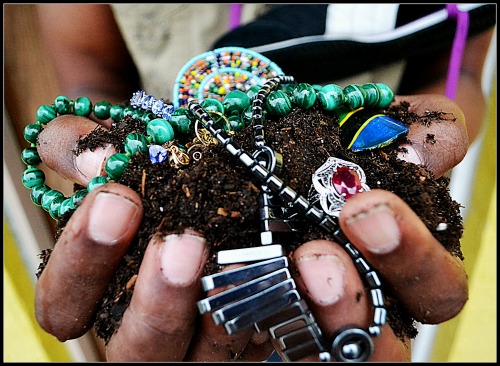 “Hey bro, vipi? How much for these shoes?” I ask the second-hand market vendor.
“Ah! Those, for you, those are $30 U.S.dollars,” he responds with a tone indicating that he’s giving me a deal. He didn’t know I was Tanzanian, maybe because I hadn’t yet spoken more than a few words in Kiswahili. Words that any foreigner who cared to find out would have known.
“$30?! I can get a new pair of shoes in the U.S. for that amount!” I say in return, flabbergasted by the price this man just gave me.
After a few minutes of haggling, going back and forth about the quality of the shoes, and his realization of my nationality, we do not close the sale of these shoes, but commence having a very important conversation about the poverty of Africa.
I will call this man Peter, as I do not recall his name.
As I talked down the price of the shoes, Peter said things like, “You people have money!” and “Come on, you can pay this amount easily.”
When Peter and I started talking (immediately after I decided not to purchase the shoes), I asked him his reasons behind hiking prices up so high for foreigners. He simply said, “Because we are poor here in Tanzania, and in Africa, so I have to try to earn money some way, and you guests have the money.” (more…)
I am a mom amongst some other titles life has fortunately given me. I love photography & the reward of someone being really happy about a photo I took of her/him. I work, I study, I try to pay attention to life. I like writing. I don't understand many things...especially why humans treat each other & other living & inanimate things so vilely sometimes. I like to be an idealist, but when most fails, I do my best to not be a pessimist: Life itself is entirely too beautiful, amazing & inspiring to forget that it is!
More Posts
Follow Me:

by Jennifer Burden | Mar 26, 2014 | 2014, Poverty, World Moms Blog, World Voice
A few months ago, the Live Below the Line of Poverty Challenge contacted World Moms Blog to ask if any of our contributors would like to take their challenge — 5 days of living on $1.50 per day.
According to the World Bank, there are over 1.2 billion people living below the line of extreme poverty in the world, which is defined as living on below $1.25 per day. The Global Poverty Project is challenging everyone to live on $1.50 per day to advocate for the world’s poorest. They state,
“We run Live Below the Line because we believe to really fight poverty, we’ve got to better understand it.”
Well, I had no idea what I was getting into. When the request came around cheerleaded by World Moms Blog Senior Editor, Elizabeth Atalay of Documama, I joined in because some of our contributors REALLY wanted to do this. I remember my friend, Holly Pavlika of MOMentum Nation, completing the challenge several years ago before she left for Tanzania with Shot@Life. We were at a lunch for a Shot@Life Champion event in NYC, and she declined her lunch and chose to eat 2 boiled eggs instead. I, on the other hand, chose the salmon and asked if I could sneak her some. She explained that she wasn’t allowed to take hand outs on the challenge. I was intrigued…
So when the request to live on $1.50 a day came around, I said, “I’ll do it, but just for one day, not five.” Well, here I am on Day 3…
World Moms Blog Editor, Hannah Ashton, suggested that we pool our resources, my $7.50 for 5 days and her $7.50 for 5 days. The plan was that amount would buy enough food for 5 days, and then for the one day of our challenge we would eat a fifth of the food.
My rations included 1 bag of beans, 2 cups of white rice, 2 cups of flour, 1 small bag of carrots, 3 bananas, 5 packs of instant oatmeal with dried apples and cinnamon, 1 jar of tomato sauce, some green tea bags and two onions. We had 12 cents left over each, so we justified a pinch of salt and a tiny bit of oil from our kitchens.
I’ve been sharing my experience on my personal Facebook Page, and I’m going to show you what happened:
Live Below the Line Day 1
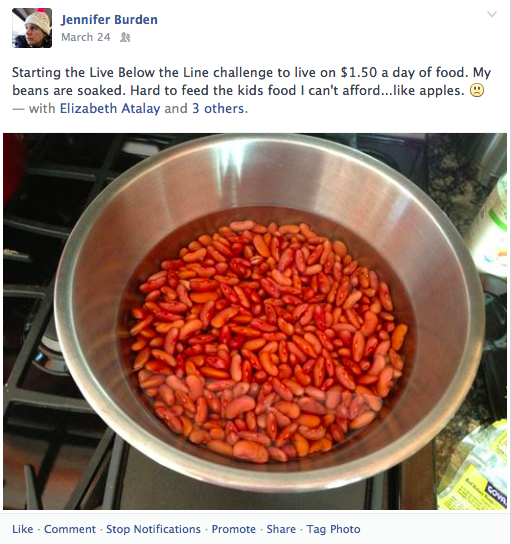
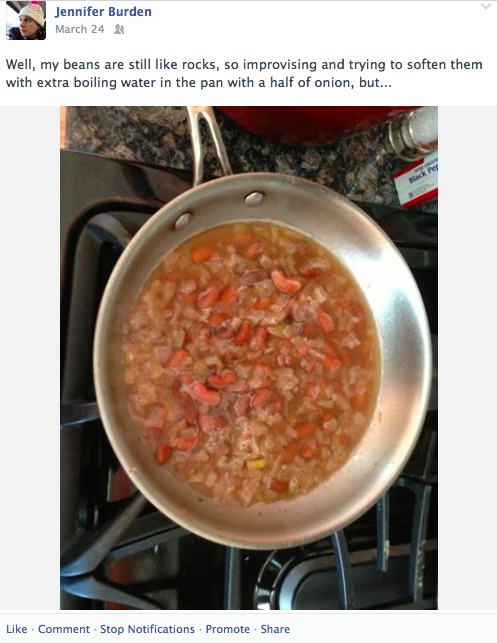
I had two portions of the beans and onions over rice, thinking that I could “anchor” my stomach by filling it. That evening, I had tea and a banana for dinner. But, I was so hungry when I went to bed.
Live Below the Line Day 2
The next morning I woke up, and realized that there is actually a lot of things I do for my kids in the morning, including making their breakfast, before I had mine. I was feeling really hungry while running around and getting the laundry started. When I finally made my way to the kitchen, I realized that my oldest daughter had eaten one of my banana rations. I stopped short.
“Noooooooo!!”, I thought.
But, that’s the point where the transformation began for me. It wasn’t just about feeling hungry, I began to think differently.
“So, this is how it feels for a mom living in poverty?” Her child is hungry, and so is she. I left the banana out within reach, so there was no time to cut and share it.
Next, I made my instant oats with boiled water. My children both wanted to try it. At home, they are used to oatmeal that we mix with flax-seed and a little mini chocolate chips to sweeten the deal with some milk. (For me on the challenge, the flax-seed, chocolate chips and milk were too luxurious today.) So, they were curious. I shared, although my stomach was growling, and since they weren’t doing the challenge, I thought I could direct them to their lovely 5 grain bread and melon. But, I thought, “Ok, keep it real. What would a mother in this situation have to do?” I let them try the oatmeal. They didn’t like it. Relief. I gobbled it up.
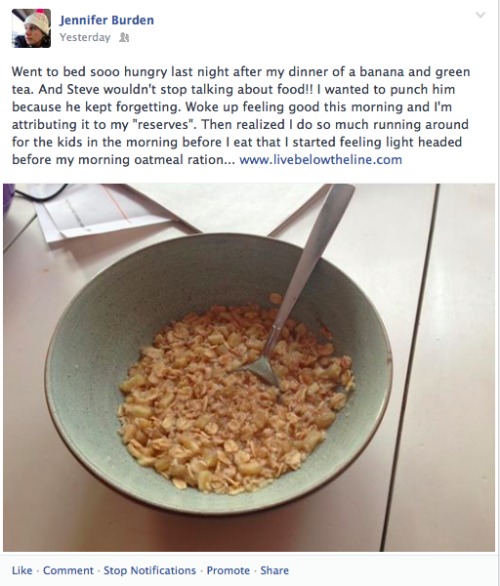
Ok, so I was joking. I really didn’t want to punch Steve, but you know what I mean! He actually wanted to join the challenge at the last-minute, but I told him that I only had rations for one. Maybe the idea was in my head that this could continue? In the meantime, I had to deal with him eating gourmet pizza, while I was chomping on beans.
So, at this point, I thought, “I’ll do it up through dinner. I’m hosting book club tonight, and there’s noooo way, I will be able to get through not snacking with my friends. Book Club is more like “Eat Club”. I was pretty sure that’s where my journey ended. Hey, that’s nearly a full day past what I said I’d do, right? But, I guess something in me didn’t want to stop, so I put the request out, “Do you think I should continue?”
One of my friends suggested that she thought I could do it, but why would I want to?? Her question was a pivotal part in my journey. The challenge was taking a new role. I spent the morning reflecting:
“I’m understanding in more detail things I have already learned, such as how during a trip to Uganda with the Shot@Life campaign, we learned that if a father bought a soft drink, that expense meant the family may go hungry. Last night I was just annoyed that my husband mentioned food. How would I have reacted if I was a mother in the situation with the soft drink in places in Uganda?? I’m understanding by feeling instead of just reading and seeing. The places this experience is taking my mind and my senses is what is keeping me going to want to learn more. I may never know what it’s like to live in extreme poverty, but this challenge is reminding me on another level of why eradicating extreme poverty should be a human priority.
Right now, it’s getting through it and feeling everything, then it will be, “What can I do about it?”.
Live Below the Line Day 3…
So, last night, I made it through Book Club. I had beans with onions and tomato sauce over rice for lunch and dinner. I was too hungry to snap a picture beforehand. I had my dinner later in the day, so I wasn’t hungry in the evening when all of the food was out. My friends were really supportive, nobody held me down and pushed guacamole down my mouth. They had a lot of questions, too.
It wasn’t until my friends left that I began to feel the hunger pangs. I quickly put everything away and left the dishes for the morning. I went to bed last night thinking, “How do people who make very little money in food service get through their day among all the food?”
The ability to understand advocacy on another level — feeling — is what has brought me to day 3 of what was supposed to be only a 1 day project.
I plan to continue to Friday for the full 5 day challenge, and also look out for an article about all the World Moms Blog contributors who are taking the challenge with Deborah Quinn from MannaHattaMamma in the UAE; Hannah Ashton, Elizabeth Atalay of Documama, and Polish Mom Photographer in the USA; Alison Fraser of Mom2Mom Africa in Canada; and Purnima Ramakrishnan of The Alchemist’s Blog in India. I’m curious to hear how the challenge went for them!
World Moms Blog wasn’t expecting to fundraise for the challenge, but after requests from friends on Facebook, we have created a World Moms Blog donation page on the Live Below the Line site. Donations made to our page there will benefit UNICEF, an organization whose great work I observed in Uganda with the Shot@Life campaign.
Want to have an in-body experience to help the world’s 1.2 billion living below the poverty line? How about joining the Live Below the Line challenge, too? Plan now to start between April 28th and May 2nd. There are site challenges in the US, UK, Australia, New Zealand, Canada and Colombia.
You can help the World Moms Blog contributors with their challenge. Share this post to help us spread the word about our Live Below the Line challenge!
This is an original post to World Moms Blog by founder, Jennifer Burden in NJ, USA.
Jennifer Burden is the Founder and CEO of World Moms Network, an award winning website on global motherhood, culture, human rights and social good. World Moms Network writes from over 30 countries, has over 70 contributors and was listed by Forbes as one of the “Best 100 Websites for Women”, named a “must read” by The New York Times, and was recommended by The Times of India.
She was also invited to Uganda to view UNICEF’s family health programs with Shot@Life and was previously named a “Global Influencer Fellow” and “Social Media Fellow” by the UN Foundation. Jennifer was invited to the White House twice, including as a nominated "Changemaker" for the State of the World Women Summit. She also participated in the One Campaign’s first AYA Summit on the topic of women and girl empowerment and organized and spoke on an international panel at the World Bank in Washington, DC on the importance of a universal education for all girls. Her writing has been featured by Baby Center, Huffington Post, ONE.org, the UN Foundation’s Shot@Life, and The Gates Foundation’s “Impatient Optimists.” She is currently a candidate in Columbia University's School of International and Public Affairs in the Executive Masters of Public Affairs program, where she hopes to further her study of global policies affecting women and girls.
Jennifer can be found on Twitter @JenniferBurden.
More Posts - Website
Follow Me:

by Kyla P'an (Portugal) | Mar 24, 2014 | 2014, Awareness, Being Thankful, Childhood, Education, Eye on Culture, Family, Feminism, Inspirational, Language, Life Lesson, Parenting, Preschool, Relationships, USA, Womanhood, Women's Rights, World Mom Feature, World Moms Blog, World Motherhood, Younger Children
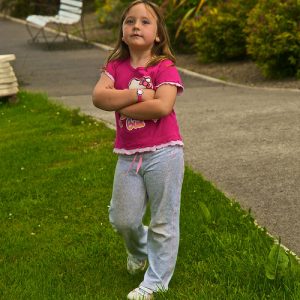 From almost the moment our daughter came onto the scene eight years ago, we knew she had a strong personality. She was one of those incredibly alert and determined babies; the type you could tell was processing her surroundings and trying to figure out what to do about them.
While many babies and toddlers her age were delighted to be pushed in a swing, my daughter would have nothing to do with swings until she was old enough to figure out what made them go. She had no desire to be the passive recipient of being pushed, instead she wanted to be in control; she wanted to conquer it. She took the same approach with toys, puzzles and games. She was an early walker, a determined eater, and an all-around intense little thing.
My husband and I frequently got comments like: “boy, you’ve got your hands full with that one,” or “she’s going to keep you on your toes.”
As our daughter grew, by far her favorite activities involved sorting, organizing and problem solving. I have one vivid memory of her toddler music class, when she was just two years old. About three-quarters of the way through the class, the teacher put out a basket of instruments for the children to choose from and play along with. Our daughter, who was particularly fond of the little plastic eggs filled with beans—which she called shake-a’s—was determined to collect as many of them as possible. Driven by this singular motive, she went around the room delivering alternate instruments to fellow toddlers and parents alike. Anytime she encountered an individual who already had a shake-a, she’d attempt to persuade them with an alternate instrument in exchange until she had gathered a significant cache.
During these displays of self-assured behavior and go-get-‘em spirit, I often found myself shrinking into the background, hoping other parents wouldn’t fault me for having such a pushy, precocious child. At this particular music class, however, a parent approached me afterwards and commended me for having such a “strong child with clear leadership potential.” With her few words of encouragement, this parent liberated me from my deep mommy guilt about having a child with drive.
I was in constant conflict because, even though I am a child of the 70’s—a time when many of our mothers here in the US were breaking down stereotypes and entering the workforce en masse—I was raised by my father, who came from an old-world upbringing and had old-fashioned views of how boys and girls should behave.
I am reluctant to admit that, rather than celebrating my daughter’s inherent leadership qualities, I labeled her as “bossy” and occasionally even criticized her for being too demonstrative.
Bossy, a word inferring that someone is behaving “boss-like,” should be a compliment heralding someone’s leadership skills but ironically, instead it criticizes her for it. It’s a label reserved primarily for girls. You rarely hear it applied to boys. A little girl on the playground, organizing kids into teams and assigning them roles will quickly be knocked down a few rungs by calling her “bossy,” whereas a little boy taking the same actions might be respected and followed.
I’m ashamed to admit, even I supported this stereotype. I was concerned my daughter was too confident interacting with adults, leading activities and organizing groups. I was concerned she wasn’t “girly” enough, lacked empathy and a gentle, nurturing-side. As a modern, liberated and independent woman myself, I still didn’t want her peers to ostracize her or put her down.
Why was I struggling between nurturing and diminishing my daughter’s inner boss? Why was I uncomfortable with her being a leader, or overly-confident or intensely goal oriented? What could I do to help raise this new generation of girl-leaders?
Two weeks ago I got some reassuring answers. They were in the Wall Street Journal, on a full-page, front-of-section article titled, “Don’t Call Us Bossy.” And the women giving the encouragement were the Chief Operating Officer of Facebook, Sheryl Sandberg, and the Chief Executive Officer of Girl Scouts, USA, Anna Maria Chavez.
Sandberg and Chavez’s goal is to redirect our thinking about the way girls lead. To relabel our vocabulary about girls’ take-charge behavior. Instead of bossy behavior, recognize it as executive leadership potential, like CBS television anchor, Norah O’Donnell does. Instead of discouraging ambitious goals, support girls to recognize their inherent ability to achieve whatever goal they set out for.
I think the world would be a very different—and frankly far more pleasant—place to live in if there were more “bossy” women in charge.
Let’s take a stand to have more female bosses in the workplace; Here’s to raising our girls to be the leaders they are capable of being, not the followers our lexicon makes them feel they are supposed to be!
Did anyone ever call you “bossy” growing up? Do you see these qualities in your own child? How do you feel about assertive and confident girls?
For ways to encourage leadership in girls, visit LeanIn.org and BanBossy two of the movements supported by Sheryl Sandberg, Ana Maria Chavez and Girl Scouts, USA.
This is an original post to World Moms Blog from our managing editor and mother of two, Kyla P’an.
The image used in this post is credited to Pat Moore. It holds a Flickr Creative Commons attribution license.
Kyla was born in suburban Philadelphia but spent most of her time growing up in New England. She took her first big, solo-trip at age 14, when she traveled to visit a friend on a small Greek island. Since then, travels have included: three months on the European rails, three years studying and working in Japan, and nine months taking the slow route back from Japan to the US when she was done. In addition to her work as Managing Editor of World Moms Network, Kyla is a freelance writer, copy editor, recovering triathlete and occasional blogger. Until recently, she and her husband resided outside of Boston, Massachusetts, where they were raising two spunky kids, two frisky cats, a snail, a fish and a snake. They now live outside of Lisbon, Portugal with two spunky teens and three frisky cats. You can read more about Kyla’s outlook on the world and parenting on her personal blogs, Growing Muses And Muses Where We Go
More Posts - Website
Follow Me:

by Purnima Ramakrishnan | Mar 11, 2014 | 2014, Brazil, Humanitarian, International, Poverty, Purnima, Social Good, The Alchemist, Travel, World Moms Blog, World Voice, Writing
United Nations Foundation
Sometime back I wrote in my personal blog that I am ‘NOT’ a globe-trotting mama. But here I am getting ready for my next adventure all over Brazil.
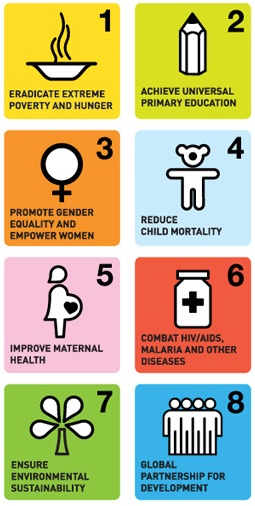
I am honored and proud to officially announce that I have been selected to receive a fellowship in Journalism and will be reporting from Brazil for the International Reporting Project as part of the John Hopkins School of Advanced International Studies. I shall be reporting about reduction of poverty and hunger in Brazil, and how it has embraced the Millennium Development Goals to improve the lives of its citizens.
Here at World Moms Blog, working for the MDGs has been something close to our hearts. And hence this trip is also very close to my heart where I will be learning so much and sharing what we do here at World Moms Blog through media and through the power of mothers. Having launched the Moms4MDGs campaign in Chicago, during BlogHer13 and following up very closely and working with it has made me feel very passionate about this cause.
As I brace myself for a hectic fortnight in the 2nd and 3rd week of April, where we may go back-packing and camping in rural and sub-urban Brazil, one thought comes to my mind – What is it that I am going to achieve, apart from the learning and all the anticipated fun? I really don’t know that yet.
I only know that this trip is going to be very special in so many ways.
I have written posts about the 8 MDGs in the past about a few topics including Environment, Eco-feminism, reducing Infant mortality rate, child-health, Social issues and empowerment of girl child and women. I now also look forward to learn more about reduction of health, poverty, hunger and improvement of the lifestyle of citizens by the sustained effort of various individuals and organizations.
This trip is going to take me places very rugged and rustic like rural villages where connectivity could be difficult, I understand. It makes me a bit concerned, honestly. Not being in touch with my family, especially my son every single moment is going to be difficult. I leave him in good care and support; however this phase sure will be tricky to cope.
We do not have a detailed itinerary yet, but I know that it is going to be exciting. Exciting? Yes, at times, IRP fellows have also met with Presidents/Prime Ministers of the countries they visit. So, it is just not back-packing and camping and reporting from the villages. It is also meeting with the decision makers and understanding how the entire system works.
Anybody want to guess what came in the mail yesterday? A luggage tag featuring the WMB lady, just in time for my travels. Jen, Thank you! I love this so much and as I pack my bags for Brazil, this is something which will always remind me of the love and comradeship of this beautiful group.
Please look forward to my everyday thoughts and stories, and possibly photographs, video posts, blog posts, slideshows, updates on social networks, assuming I have a good internet connection.
You can track my posts from this trip at #Moms4MDGs.You can track all posts from this trip using #BrazilMDGs.
I will be tweeting from both @WorldMomsBlog and @Puma_Vinod. I will vicariously be posting on Facebook both on my personal profile and World Moms Blog profile too.
Please feel free to ask me any questions and leave your comments about this trip. I would also love to read any of your insights on Brazil.
This is the first of the many posts credited to the International Reporting Project (IRP), as part of my reporting from Brazil on this fellowship.
Photo credit United Nations Foundation.
This is an original post written by Purnima Ramakrishnan for World Moms Blog.

by World Moms Blog | Mar 10, 2014 | 2014, Awareness, Bilingual, Communication, Cultural Differences, Culture, Elections, Eye on Culture, Guest Post, Human Rights, Humanity, International, Language, Life Lesson, Living Abroad, Media, Multicultural, Politics, Tragedy, USA, World Events, World Interviews, World Motherhood, World Tour, World Voice
Today, we have a special guest post by a Ukranian mother living in the United States, Olena Centeno, of Bilingual Kids Rock. Olena opens the window and lends us her personal perspective to the current events in Ukraine…
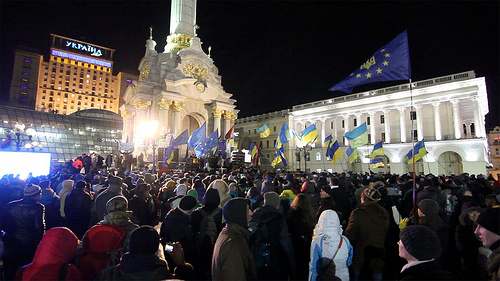
Protest in Kiev, November 2013
What’s it like growing up in Ukraine?
As a Ukrainian, I grew up speaking two languages: Russian and Ukrainian. I ate Ukrainian borsht for lunch and Russian pelmeni for dinner. I love Tchaikovsky’s Sleeping Beauty and Carols of the Bells by Leontovych. I am raising my own children trilingual in English, Russian and Ukrainian. In fact, the two cultures (Russian and Ukranian) are considered so close, that if an Ukrainian abroad says s/he is from Ukraine people often say “Oh, so you are from Russia?”
What’s going on between Russia and Ukraine?
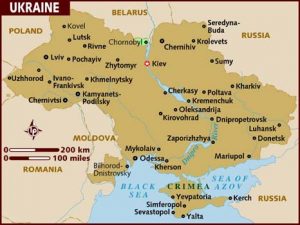
With Russian troops moving across the sea into Ukraine’s Crimean peninsula, a lot of Westerners are starting to ask this question.
The current conflict in Ukraine is more than three months old. It began with a peaceful demonstration on November 21 at Independence Square (Maidan) in Kiev, the capital of Ukraine, when the (now ousted) Ukrainian president (Yanukovich) hesitated to sign an Association Agreement with the EU. This had been one of his major election promises and in breaking it he ignored the desire of millions of Ukrainians.
During the past three months, the “EuroMaidan” demonstration has grown into a much bigger movement. It started as a response to the failed EU deal but then truly turned into a movement against the corrupt government of president Yanukovich, who moved to keep Ukraine in long-lasting and very painful economical ties with Russia.
Then, after the government passed harsh, anti-assembly laws, it became about the basic human right to be able speak and think freely without being punished for it.
More than a hundred lives were lost and thousands injured during violent attempts to remove the demonstrators but people did not leave the cold streets of Kiev. More freedom fighters came from all over Ukraine to support them. Many other Ukrainian cities stood up as well. After three months of struggle, Mr. Yanukovich was impeached and left Ukraine (he refused to sign a resignation; he just ran away). His presidency was considered illegitimate and a new, temporary government was elected.
As Ukrainians were mourning over lives lost and looking into the future with great hope to build their country on principles of trust and freedom, a new enemy emerged: Informational War.
Along with Russia, Eastern Ukraine—where the majority is Russian speaking—is dominated by Russian-language news from the Russian media. Unfortunately, the Russian media coverage of events that have happened over the past three months is falsified [and full of propaganda].
Now, after the armed occupation of Ukrainian territory in Crimea by Russian troops, the reason for their untruthful reporting is understood: Creating social opinion in Russia and Russian-speaking Ukraine justifies military intervention into Ukrainian territories.
Personally, I think Mr. Putin has an imperialistic plan to be the most powerful ruler in modern history—politically and financially—and he will stop at nothing to add Ukraine to his control.
Russian Media Propaganda Uncovered
The following are all lies that have been spread by the Russian media leading up to the invasion of Ukraine by Russian troops:
1. FALSE: Kiev was Overrun by Violent Riots
Despite violent clashes, most of Kiev stayed peaceful throughout the demonstrations. The day-to-day lives of residents were largely unaffected outside of Independence Square and the areas immediately surrounding it. Very little of Kiev or the surrounding countryside was damaged or disturbed by the protests.
I know this because I called my family and friends every day. My nephews were going to school as usual, most of the people attended work on a daily basis, and all shopping malls and grocery stores were working (except for a few in the middle of the protest areas downtown).
2. FALSE: Anti-Russia Fascists Led the Ukrainian Protests
The vast majority of protesters were ordinary citizens tired of a government that they viewed as corrupt and unwilling to listen to the people. There were no fascist elements leading the demonstrations, and there are none leading the new government.
Many of the people I know personally were in Maidan: teachers, IT professionals, doctors, stay-at-home moms, businessmen, university professors, hair stylists and many others. People I worked with and went to school with. And no one will ever convince me that they are fascists. My daughter’s god-father is a surgeon and worked days and nights protecting the health and saving the lives of many.
3. FALSE: The New Government Will Force All Ukrainians to Speak Ukrainian
This is a particularly effective myth for Russian-language media, since it appeals directly to the people who would be most affected. Language has long been a contentious issue in Ukraine. Claims that Russian will be abolished are being used to generate anger against the new government.
The Ukrainian parliament voted to repeal a 2012 law allowing the establishment of minority languages as official state languages in individual provinces on February 23, 2014 but acting President Oleksandr Turchynov vetoed the move. Russian is currently recognized as an official language, is legal for state use in several Ukrainian provinces, and is guaranteed state protection “in all spheres of public life” in Crimea specifically.
I speak Russian and Ukrainian to my children here in the USA. I see language first and foremost as a tool for communication — and shame on any politicians who use it as a reason for war.
4. FALSE: Ukrainian Demonstrators Have Been Attacking Russians or Russian-Speakers
Another unproven and untrue claim widely circulated in Russian-language media is that the Euromaidan protesters were deliberately attacking Russian speakers.
The cruel result is that ordinary Russians – good, wholehearted, educated people – are now eager to help a Ukraine that they think is swamped by fascists! I have family in eastern Ukraine and my god-mother lives in Moscow. They have called multiple times, scared for the lives of my parents in Kiev. They really think Ukraine is in danger.
There is no evidence to support the claim, and nearly all cases of violence during the protest were perpetrated against civilians by security forces. The Euromaidan protests had very little to do with cultural or language issues in general.
While Yanukovych’s perceived obedience to the Russian government was certainly a source of anger in Ukraine, this anger was directed at the President and the actions of the Russian and Ukrainian governments, not to the Russian people or culture.
5. FALSE: The Berkut and Other Security Forces Fought in Self-Defense
Russian news broadcasts have shown extensive footage of the Berkut and other riot police under attack but nearly none of their attacks on civilians. The reality is that security forces attempted to crush peaceful protests with deadly force, and were barely driven back with improvised weapons like clubs and Molotov cocktails. The superior force and aggression were always on the side of the Berkut.
6. FALSE: The Independence Square/Euromaidan Protests Were Organized by Americans
We joke that EuroMaidan is now supported by Americans because my American husband and I made donations to help supply people with warm clothing and blankets during cold winter months.
I am not claiming that on a political level there is no lobbying of interests from outside countries and unions but once again: the politics of the country and the people of the country are two different things.
The vast majority of protesters were native Ukrainians and ordinary residents of Kiev and the surrounding country.
7. FALSE: Fascism Will Spread from Ukraine to Russia
This is another falsehood dependent on the idea that the Euromaidan demonstrators were fascist extremists. It is being used as a justification for Russian invasion. The Russian government claims it is defending Russian-speakers in Ukraine and its own borders from Ukrainian fascists but in reality those fascists do not exist.
What is next?
The military intervention is not over. It is hard to say what is going to happen next. There is a lot of talk going on at a very high, political level involving the EU and the US.
But Ukrainians have already had the biggest win in this struggle: themselves.
They proved to themselves that they care:
- They care about all of our people (amazing examples of collaboration happened during the civil unrest!);
- they care about the future of their country;
- they care about their freedom;
- they care enough to recognize the differences among themselves and to stay united anyway.
The revolution was heartbreaking and tearful but as a result, Ukrainians became true patriotic citizens of their country:
Glory to Ukraine, Glory to Heroes!
слава Україні, слава героїв
(slava Ukrayini, slava heroyiv)
For me, personally, it has been a life lesson in how to raise my own children. I have a clear goal to raise multicultural and multilingual children, who respect other languages and cultures and can see our shared humanity no matter how politicians try to divide us.
This is an original guest post to World Moms Blog by Olena Centeno.
 Olena Centeno is a Ukrainian who lives in USA, a happy mom of three wonderful kids ages 2-9 and a wife to the great. She speaks three languages herself and is raising her kids to be multilingual in English, Russian, Ukrainian and Spanish. She founded Bilingual Kids Rock, where she helps families on their bilingual journey. She also enjoys photography and video making as a way to preserve precious moments of life.
You can connect with her at Bilingual Kids Rock.
Photo credit to Oxlaey. This photo has a creative commons attribution license.
World Moms Blog is an award winning website which writes from over 30 countries on the topics of motherhood, culture, human rights and social good. Over 70 international contributors share their stories from around the globe, bonded by the common thread of motherhood and wanting a better world for their children.
World Moms Blog was listed by Forbes Woman as one of the "Best 100 Websites for Women 2012 & 2013" and also called a "must read" by the NY Times Motherlode in 2013. Our Senior Editor in India, Purnima Ramakrishnan, was awarded the BlogHer International Activist Award in 2013.
More Posts