by Karyn Wills | Nov 4, 2013 | Being Thankful, Brothers, Childhood, Family, Family Travel, Friendship, Home, Inspirational, Kids, New Zealand, Older Children, Parenting, Relationships, Siblings, Traditions, Travel, Uncategorized, Vacationing, World Motherhood, Younger Children
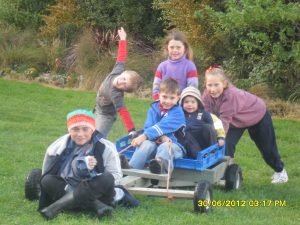 I have three sons and they are a lot of fun. They are also a lot of noise, mess and busyness.
They adore one another most of the time and loathe one another at other times. Needless to say, living in a small house can get a little hectic and the fact that we live a car trip away from most of the boys’ friends—and I don’t always want to drive to fetch or deliver children—means that, from time to time, my boys can have a little too much of one another.
We are one small family and that can make us all tiresome to one another – no matter how strong the love between us.
The healthiness of living in an isolated, nuclear family unit has always bothered me a little. Not that living with my extended family or my in-laws would suit me, or them I suspect, either. But the cousins. Oh my goodness. The wonder of having cousins around – that appeals to me.
With cousins there is the common bond of grandparents and other family members, and the common history and the common family rituals. There is the emotional connection of knowing they all belong together, and the emotional connection of having been all together for their life times.
But, what I really love is the bond I see between our boys and all of their cousins in terms of visible affection and loyalty. When we have been away on holiday together, older cousins have often taken our boys off for adventures or have played with them, especially as babies and toddlers, so I could have a break. Younger cousins provide opportunities for my older boys to teach and help, in their turn. Sometimes it’s just fun to hang out together.
With their cousins, my boys are learning that things their brothers have said to them repeatedly, and they have ignored, are often the same opinions of others – and their cousins are not afraid to tell them so, sometimes bluntly. They are learning a higher level of co-operative skills and greater negotiation techniques, than they get to use with just two others. They are learning to walk away, when they need to walk away, and they are learning when it is appropriate to comment on another’s behaviour and when it is best to stay silent.
Like their brothers, their cousins love them. Unlike their brothers, their cousins are listened to. Like their friends, their cousins enjoy playing with them and will tell them to go away, when they‘ve had enough – but only for a short while. Unlike their friends, they cannot be transient members of their lives. And that last point, in particular, I love.
Do your children have good relationships with their cousins? Do you see a deeper bond between your children and their cousins, than with their friends?
Karyn is a teacher, writer and solo mother to three sons. She lives in the sunny wine region of Hawke’s Bay, New Zealand in the city of Napier.
More Posts

by Jennifer Burden | Oct 18, 2013 | 2013, Education, Family, Health, Home, Human Rights, Humanitarian, Inspirational, Kids, Natural Disaster, Philanthropy, USA, World Events, World Motherhood
When it comes to helping people outside the United States, Former President Jimmy Carter says, “We don’t distinguish.”
In celebration of this week’s World Habitat Day, Carter said last Saturday, “We think the folks [we build housing for] in other countries are just as good and needy as the folks in America.”
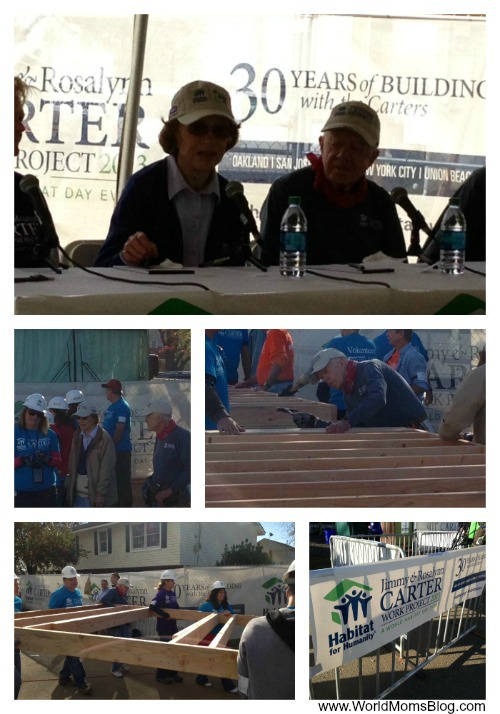
The message that President Jimmy Carter and First Lady Rossalyn Carter brought to Union Beach, NJ, a town that was hit by Hurricane Sandy almost one year ago, was one of hope, for the people there and the people all around the world.
The Carters have spent over 3 decades giving a hand up to families in need of affordable shelter through Habitat for Humanity, a Christian non-profit that builds housing for the people who need it most. And, by the looks of it, they are not stopping. Last week, on the Habitat for Humanity work site in Union Beach, NJ, the President and First Lady, in their work clothes, helped build house framing for over 2 hours. (They are for real, guys.) This was the tail end of the Carter work project this year that went around the United States and ended in New Jersey.
The local branch of Habitat for Humanity in Monmouth County, New Jersey, USA, has completed 40 homes since Super Storm Sandy hit in October of last year. Eighty percent of their service area was affected by the storm from the town of Aberdeen to the town of Ocean.
First Lady Rossalyn Carter stated, “This [worksite] was a special one for us. Super storm Sandy hit, and we’ve been worried about you all ever since.”
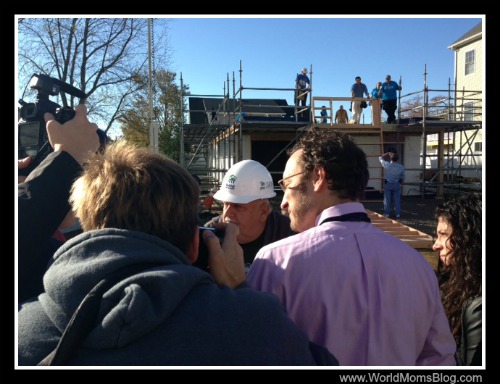
Mr. Lamberson is interviewed by the Press on the Carter’s worksite. That’s his home in the background being rebuilt after Super Storm Sandy damaged it almost one year ago.
The Carters have proved themselves tireless champions of human justice.
“We find that Habitat home owners were hopeless and have never known success. They’ve been promised outside help that never arrived, but Habitat is not that way. Local people decide what kind of houses to build, where and which families. Lots of the homeowners become transformed.” — President Carter.
The Former President also explained that the houses in Union Beach were being raised by 8 feet to withstand any future super storms. He said, “Places have to be prepared for the next natural disaster.”
The Habitat model is not a 100% hand out. Homeowners pay the full cost of the house, and they must put in at least 100 hours of work. However, in most cases, their mortgage is 0% interest.
And the organization requests their volunteers fundraise or pay to help, as well as, dedicate their woman and man hours.
Former First Lady Rossalyn Carter explained that education can be greatly effected when children do not have a home, and she referred to a family in Seattle, Washington, USA who were living in their automobile. After they moved into their Habitat home, their son became top of his class just months after moving into their Habitat home.
The Former First Lady described another mother who previously cringed to answer her door to her substandard housing because it was often the police saying that her sons were in trouble. Her sons were never home. After Habitat arrived and built them a new house, her sons returned home with their friends because they were proud of where they lived and were staying out of trouble.
These are the types of examples that keep the Carters going and using their celebrity to further the cause for adequate housing.
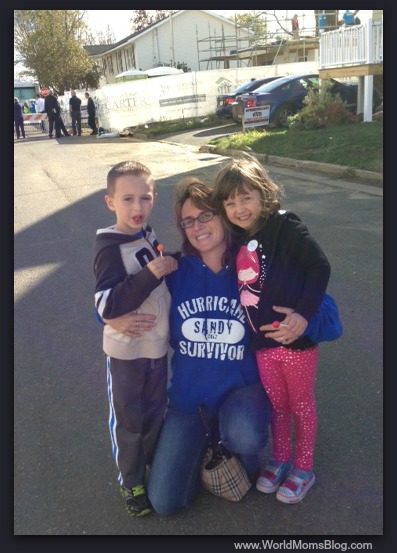
“Hurricane Sandy Survivor” — Kelly is a mom of twins whose home was flooded in Super Storm Sandy last year. Her family is still displaced and waiting for work on their home to be finished almost one year later (not a Habitat home). She came by with her kids to catch a glimpse of the Carters on Saturday.
“When we go to South Africa, South Korea, the Philippines, Europe, Hungary , and 3 times in Mexico, people are the same wherever we go.” — Former First Lady Rossalyn Carter
Exactly.
This is an original post to World Moms Blog by Founder, Jennifer Burden in NJ, USA. Jennifer is no stranger to Habitat for Humanity. As a junior at Villanova University, she spent a week building an adobe-style house in New Mexico, USA for a low-income family through the organization.
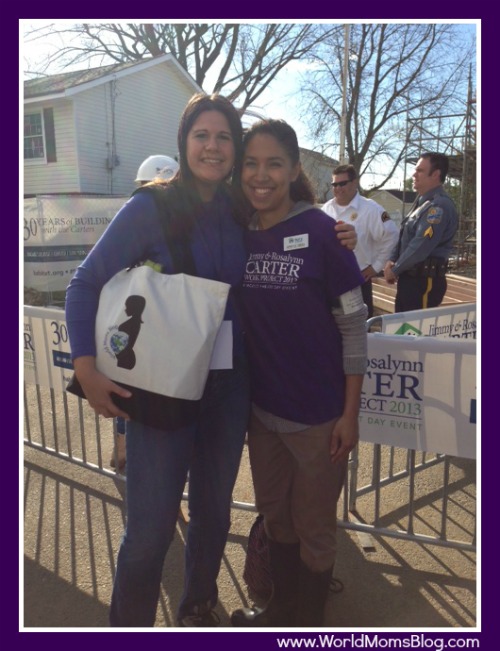
Jennifer Burden of World Moms Blog with Jennifer Sneed of Habitat for Humanity in Monmouth County, NJ at the Carter worksite in Union Beach, NJ on October 12, 2013.
Photo credits to the author.

Jennifer Burden is the Founder and CEO of World Moms Network, an award winning website on global motherhood, culture, human rights and social good. World Moms Network writes from over 30 countries, has over 70 contributors and was listed by Forbes as one of the “Best 100 Websites for Women”, named a “must read” by The New York Times, and was recommended by The Times of India.
She was also invited to Uganda to view UNICEF’s family health programs with Shot@Life and was previously named a “Global Influencer Fellow” and “Social Media Fellow” by the UN Foundation. Jennifer was invited to the White House twice, including as a nominated "Changemaker" for the State of the World Women Summit. She also participated in the One Campaign’s first AYA Summit on the topic of women and girl empowerment and organized and spoke on an international panel at the World Bank in Washington, DC on the importance of a universal education for all girls. Her writing has been featured by Baby Center, Huffington Post, ONE.org, the UN Foundation’s Shot@Life, and The Gates Foundation’s “Impatient Optimists.” She is currently a candidate in Columbia University's School of International and Public Affairs in the Executive Masters of Public Affairs program, where she hopes to further her study of global policies affecting women and girls.
Jennifer can be found on Twitter @JenniferBurden.
More Posts - Website
Follow Me:


by Ecoziva (Brazil) | Oct 14, 2013 | 2013, Babies, Being Thankful, Brazil, Child Care, Childhood, Culture, Domesticity, Eye on Culture, Family, Health, Home, Inspirational, Life Balance, Maternal Health, Me-Time, Motherhood, Parenting, Religion, Spirituality, Traditions, Working Mother, World Motherhood, Younger Children
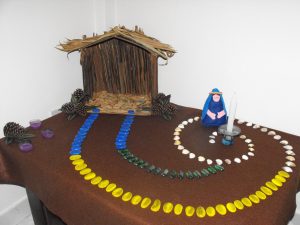 My maternity leave is now coming to an end, but throughout it a typical week day has meant about 12-14 hours alone with the kids.
I usually wake up at 5:20 a.m. and my husband leaves with our eldest around six. I spend my mornings with our 2 ½ year old girl and our six month old baby boy. Our son returns from school approximately 1:30 p.m. Sometimes my husband returns early, but he usually gets home between 6 and 8 p.m. depending on traffic, his schedule, etc.
I love my kids dearly. Yet any mother knows that such a routine is not easy. On the typical day, by 6 p.m. my patience starts to wane. By nature I have a calm personality, but if there is screaming on my side, 90% of the time it will be after 6 p.m.
I once heard that 6 p.m. is one of the most difficult times of the day. On an individual level it is the time when stress peaks and on a collective level it is the time when most crime, car accidents and other such things happen. I don’t know if there is data backing that, but in a way it does make sense.
In my case, it is around 6 p.m. that the less-than-noble feelings will start to take over my mind, such as resentment, self-pity and repetitive worrying about pending work (although I have been legally on leave and have not been teaching, I did choose to maintain some activities from home). Other days I wish I could just stop working and truly be a full-time mother.
One thing that has helped is practicing acceptance and gratitude: A student sent me her research project two weeks ago and I haven’t even managed to open the file. Sorry, I am doing the best I can. My daughter has been screaming for 15 minutes in a temper tantrum. How great that she is healthy and her lungs are working! The kitchen sink is piled with dishes and the whole house is a mess. Things will get better as the kids grow older.
Of course it is easier said than done and one thing I try to do every day is to pray that my patience lasts past the kids’ bedtime.
I recently thought about how in the past it was a custom here in Brazil – a mostly catholic country – for the radios to play the Ave Maria in Latin at 6 p.m. In the small town I lived in when I was little, the Catholic church’s bells also tolled at six.
I haven’t been much of a radio listener for the past few years so I went on the web to check if the custom was still present. I learned it is a practice that has been carried out here in Brazil for the last 54 years. It comes from an old Portuguese tradition that in turn derives from the Angelus [*] – a Christian devotion recited at 6 a.m., midday and 6 p.m., which refers to Mary and the Annunciation. In simple terms, it is a time of prayer and meditation.
While reading about the 6 p.m. devotion and thinking about the emotional condition of mothers who spend the whole day alone with their children, I realized that it was the kind of practice that makes sense in the context of motherhood. After all, regardless of religion or debates on the specifics of Mary’s story, in a greater context she can be seen as a symbol of an inspiring and caring mother.
With that in mind, this week I am experimenting with short “Mary meditations” around 6 p.m. to see if it helps extend and deepen my patience and acceptance.
And you? What strategies do you use to help you face the challenges of the day-to-day motherhood routine?
[*] If there are any Catholics out there reading this and I am explaining this wrong please correct me! I was sort of raised Catholic in a Catholic country but I’m not actually Catholic, so I don’t have in-depth knowledge of the Angelus.
This is an original post to World Moms Blog from our devoted writer and mother of three in Brazil, EcoZiva.
The photo used in this post was taken by the author.
Eco, from the greek oikos means home; Ziva has many meanings and roots, including Hebrew (brilliance, light), Slovenian (goddess of life) and Sanskrit (blessing). In Brazil, where EcoZiva has lived for most of her life, giving birth is often termed “giving the light”; thus, she thought, a mother is “home to light” during the nine months of pregnancy, and so the penname EcoZiva came to be for World Moms Blog.
Born in the USA in a multi-ethnic extended family, EcoZiva is married and the mother of two boys (aged 12 and three) and a five-year-old girl and a three yearboy. She is trained as a biologist and presently an university researcher/professor, but also a volunteer at the local environmental movement.
More Posts

by Fiona Biedermann (Australia) | Oct 7, 2013 | 2013, Being Thankful, Communication, Economy, Family, Health, Husband, Inspirational, Life Balance, Life Lesson, Motherhood, Oceania, Older Children, Relationships, Stress, Teenagers, Working Mother, World Motherhood
 I try to do the right thing most of the time by setting a good example for my teenage / adult children. However, like most mothers, sometimes I’m torn between doing what feels right for me and doing what might be right for the family. I guess that’s because sometimes the two are in direct conflict, or often they seem to be.
On the 9th of August, I walked out of a well-paying job with a company that I’d been with for 12 years. I gave my requisite four weeks’ notice with no job to go to, no immediate plans and only a belief that I had to take the leap because I believed I deserved better.
It was perhaps a little selfish financially in terms of my family, and my husband was totally against me resigning without something else to go to. He had legitimate reasons given that the job market in Australia is considerably flat at the moment, as I’m sure it is in many countries.
I was also worried whether I was setting the right example for my children by just walking away from a good job, I was basically throwing in the towel because things had gotten too hard. My husband is also not a man who likes change, which made my decision even more difficult.
The thing is for many months I felt like I’d been dying inside, I felt like my job was sucking the life out of me. I was working in a company which was under new management and was undergoing massive change and restructuring. The biggest problem was that the importance of change management and communication had gone out the window, things that I hold in very high regard.
Morale had dropped, staff were miserable and were leaving in larger than normal numbers. In the end I decided that my family deserved more than my misery and unhappiness and more than that, so did I. Home was not a happy place for those first few weeks after I resigned, but it hadn’t been for months anyway.
Seven weeks of job searching and plenty of soul searching and I finally have landed the job of my dreams. There are many who voiced their concern and worried about the mistake I was making, those loved ones are now eating their words and telling me that I did the right thing and how brave I was to do it.
My brother recently sent me the following quote, which ironically also arrived in my letterbox in the form of business coaching advertising material in the same week I got the job offer.
“If you always do what you’ve always done, you’ll always get what you’ve always got” Henry Ford
As scary and as uncertain as my decision was, I fully believed in myself and I took the leap. I knew what I wanted and I was determined to find it, plus I was totally prepared to accept whatever might be.
I knew that I may have to take an interim job in the meantime, if that’s what it took to find the right job and still keep my family on track financially.
My decision could have gone pear shaped and turned out badly, but I’m a big believer that sometimes you just have to believe.
The biggest lesson I’ve taught my children is that you have to believe in yourself, fight for what you are worth and be brave enough to follow your dreams. I’m doing exactly that, I’ve landed my dream job with the financial and personal rewards I know I’m worthy of. I’m now excited about going back to work.
What’s the biggest lesson you’ve taught your children and do you back up your words with action?
This is an original World Moms Blog post by Fiona from Inspiration to Dream of Adelaide, South Australia. Fiona can be found writing or reading in every spare moment that isn’t filled up with work and her family.
Image credit Cliparto ID 3130264 – This image is used in compliance with the terms of the Cliparto Standard Royalty Free License Agreement.

Fiona at Inspiration to Dream is a married mother of three amazing and talented MM’s (mere males, as she lovingly calls them) aged 13, 16 and 22, and she became a nana in 2011!
She believes she’s more daunted by becoming a nana than she was about becoming a mother! This Aussie mother figures she will also be a relatively young nana and she’s not sure that she’s really ready for it yet, but then she asks, are we ever really ready for it? Motherhood or Nanahood. (Not really sure that’s a word, but she says it works for her.)
Fiona likes to think of herself as honest and forthright and is generally not afraid to speak her mind, which she says sometimes gets her into trouble, but hey, it makes life interesting. She’s hoping to share with you her trials of being a working mother to three adventurous boys, the wife of a Mr Fix-it who is definitely a man’s man and not one of the ‘sensitive new age guy’ generation, as well as, providing her thoughts and views on making her way in the world.
Since discovering that she’s the first blogger joining the team from Australia, she also plans to provide a little insight into the ‘Aussie’ life, as well. Additionally, Fiona can be found on her personal blog at Inspiration to Dream.
More Posts

by Alison Fraser | Sep 24, 2013 | 2013, Africa, Canada, Childhood, Education, Eye on Culture, Family, Girls, Human Rights, Humanitarian, Humanity, Inspirational, International, ONE, Philanthropy, Poverty, Uncategorized, United Nations, Women's Rights, World Voice

City of Kitchener Councillor, Kelly Galloway-Sealock, and the author’s three daughters at a 2012 International Day of the Girl Child event
Mark your calendars and celebrate October 11th with your families and in your communities! Why you might ask? Well, the reasons are two-fold. Firstly, October 11th is Eleanor Roosevelt’s birthday. Eleanor was a world-renowned advocate for human rights and world peace. She was instrumental in the development and implementation of the Universal Declaration of Human Rights. So, how fitting is it that the United Nations has declared October 11th as the International Day of the Girl Child.
This October 11th marks the second annual International Day of the Girl Child. This day will be celebrated worldwide in an effort to bring attention to the human rights of girls around the world, and to highlight the gender-based struggles that so many young girls face daily.
Forced childhood marriages, rape, and female genital mutilation are just some of the issues that many little girls are forced to deal with at very early ages. In many countries, young girls are not valued and as a result are not invested in, particularly when it comes to schooling. The resulting long-term effects are alarming and have been documented in an eye-opening video by the Girl Effect movement. Please watch this video and share with friends and family – it will change the way you see the world. Girl Effect – the clock is ticking!
Last year, the focus of the very first International Day of the Girl Child was child marriage. This year, the focus will be on education. There are so many wonderful ways that you can participate in this important day. Whether you plan a family event or a community event, we all need to ensure that this very important day is recognized. Spread the word – girls are important and need to be valued, respected and treated as equal partners in our local and global communities.
What can you do to honour this important day? You can host a community screening of the Girl Rising film that is receiving acclaim worldwide. You can act to spread the word about struggles some young girls are facing in the world today. You can talk to your children about these critical issues. You can ask your child’s teacher to discuss this day with their class. You can organize a fundraising event in your office/workplace. Whatever you choose to do, whether it be large or small-scale, YOU can make a difference on October 11th!
Last year, my three young daughters tied pink ribbons in their hair and joined a local city councillor on a hike discussing the importance of human rights for all girls. It was a simple but highly effective way to celebrate this day. So many people asked them why they were wearing the ribbons, allowing them to speak about the day in their own words describing what it meant to them. It was so great to see the passion being shared by a younger generation, especially given that many of these issues are often difficult for them to understand and rationalize!
This year, we are planning a yoga event at a local studio for young boys and girls in the community. We are asking for small donations, which will then be used to support the educational needs of girls in Tanzania. In addition, my two older daughters have done small research projects on the significance of the International Day of the Girl Child, and will be presenting all that they have learned to their classmates on October 11th, thanks to the support of their teachers. I encourage you to plan an event too!Your event does not have to be fancy or sophisticated. Sometimes the smallest and simplest acts can have the greatest impact.
Let’s all celebrate October 11th together – girls are worth it!
As Eleanor Roosevelt once said;
“Where, after all, do universal human rights begin? In small places, close to home – so close and so small that they cannot be seen on any maps of the world. Yet they are the world of the individual person; the neighborhood he lives in; the school or college he attends; the factory, farm, or office where he works. Such are the places where every man, woman, and child seeks equal justice, equal opportunity, equal dignity without discrimination. Unless these rights have meaning there, they have little meaning anywhere. Without concerted citizen action to uphold them close to home, we shall look in vain for progress in the larger world.” – Eleanor Roosevelt
In what way might you celebrate the Day of The Girl Child?
This is an original World Moms Blog post written by Alison Fraser.
Alison Fraser is the mother of three young girls ranging in age from 5 to 9 years old. She lives with her family in Cambridge, Ontario, Canada. Alison works as an Environmental Toxicologist with a human environment consulting company and is an active member of the Society of Environmental Toxicology and Chemistry (SETAC). She is also the founder and director of the Canadian Not for Profit Organization, Mom2Mom Africa, which serves to fund the school fees of children and young women in rural Tanzania. Recently recognized and awarded a "Women of Waterloo Region" award, Alison is very involved in charitable events within her community including Christmas Toy and School Backpack Drives for the local foodbank.
More Posts - Website
Follow Me:


by Sophie Walker (UK) | Sep 18, 2013 | 2013, Being Thankful, Competition, Health, Inspirational, International, Life Lesson, Sophie Walker, Sports, UK, Uncategorized, Womanhood, Women's Rights, World Events, World Motherhood
 Hurrah for Diana Nyad!
In a few short weeks she has overturned long-established ideas about age and ability and strength and given us all a reason to keep swimming.
Nyad, in case you’ve been looking the other way, is the 64-year-old woman who recently became the first person to swim the 110 miles from Cuba to the U.S. without a shark cage, taking almost 53 hours.
This would be a marathon effort at any time, but when you consider that it was her fifth attempt over some forty years; that she had to wear a mask to protect her from jellyfish stings; that she took in so much sea water it caused her to vomit constantly for almost all of that 53 hours; that she arrived finally with face and lips swollen from sun and sea water – well, then her achievement, and her insistence not to be deflected from her aim, would seem to reflect almost superhuman levels of endurance.
The word endurance does not typically bring to mind 64-year-old women. In our culture, it is often used to describe young men – runners, rowers and cyclists at the peak of their profession or pushy capitalists doing extreme sports to fill that adrenaline void when Wall Street is closed.
Google “Endurance” and up come pictures of young, lean, tanned male muscle in a celebration of machismo as traditional now as images of mustachioed weight-lifters once were in Victorian times.
The same web search also shows sepia-tinged photographs of the tall-masted Victorian adventure ship christened Endurance, on which British polar explorer Ernest Shackleton set off for Antarctic expeditions in the last century. (Twenty-first century sailor Ellen MacArthur’s solo circumnavigation of the globe strangely does not feature.)
Nonetheless, I think many women, hearing Nyad’s achievement, will have given a little nod, and maybe a small smile, of understanding. Many more will never hear of her, yet understand without discussion the will that kept Nyad going.
Though they may not be sports fanatics, or travelers with a yen for the toughest destinations, many women set their own personal standards of endurance in their day-to-day existences.
Their marathon may consist of walking for hours to find water and food in conditions of extreme poverty and hunger. Their endurance training may consist of watching their children die for the lack of a cheap vaccine. Their 53-hour record may be for the time worked within a dangerous and miserably uncomfortable factory, to earn a tiny amount with which a family can just about be supported.
For the luckier ones, endurance may just mean a bleak commute, juggling the needs of employers and families and ever-mounting bills. It may mean keeping smiling when a child is in pain, it may mean getting up for the fifth time in one night to attend to small, fevered offspring while knowing that big important morning meeting is looming. It may mean getting over the disappointment when that male colleague got that promotion. It may mean an ability to keep walking with head high when the cat calls keep coming.
Endurance can mean many things. Diana Nyad has reminded us that it is not an exclusively male domain. Already crowds of cynics are assembling to cast doubt on Nyad’s achievement, wondering how an old woman could have completed that swim in that time. Clearly her next endurance test lies just ahead.
But whatever the outcome, she has broadened the parameters of what the will to keep going looks like. And that is no small feat, either.
This is an original post to World Moms Blog from our writer in the UK and mother of four, Sophie.
The image used in this post is credited to Alan Cleaver. It holds a Flickr Creative Commons attribution license.

Writer, mother, runner: Sophie works for an international news agency and has written about economics, politics, trade, war, diplomacy and finance from datelines as diverse as Paris, Washington, Hong Kong, Kabul, Baghdad and Islamabad. She now lives in London with her husband, two daughters and two step-sons.
Sophie's elder daughter Grace was diagnosed with Asperger Syndrome several years ago. Grace is a bright, artistic girl who nonetheless struggles to fit into a world she often finds hard to understand. Sophie and Grace have come across great kindness but more often been shocked by how little people know and understand about autism and by how difficult it is to get Grace the help she needs.
Sophie writes about Grace’s daily challenges, and those of the grueling training regimes she sets herself to run long-distance events in order to raise awareness and funds for Britain’s National Autistic Society so that Grace and children like her can blossom. Her book "Grace Under Pressure: Going The Distance as an Asperger's Mum" was published by Little, Brown (Piatkus) in 2012. Her blog is called Grace Under Pressure.
More Posts