by Jennifer Prestholdt (USA) | May 6, 2014 | 2014, Human Rights, World Voice

It’s the kind of thing that keeps you awake at night.
Even if it is not your own child.
On the night of April 14, dozens of armed men showed up at the dormitory of the Government Girls Secondary school in Chibok in northeastern Nigeria. Dressed in Nigerian military uniforms, they told the girls that they were there to take them to safety and herded the girls into trucks and onto motorcycles. At first, the girls believed them. But when the men started shooting their guns into the air and shouting, “Allahu Akbar,” they realized that the men were militants from Boko Haram and that they were in serious danger.
Nearly 50 girls managed to escape by running away or jumping out of the trucks. But as many as 276 school girls (higher than the initial reports of 234) between the ages of 12 and 17 were kidnapped, disappearing into the night without a trace. Three weeks later, their parents still have no idea where they are. And last week reports began surfacing that the abducted girls were taken across the borders to Chad and Cameroon and sold as brides to Islamist militants for 2,000 naira (about $12). While we still don’t know where the girls are or what has happened to them, these reports remain a chilling reminder of the threat of sexual violence faced by women and girls in conflict zones.
One of the worst things in this truly horrible story is that the girls who were abducted were targeted simply because they were exercising their right to go to school. Throughout the world, there is clear evidence that education is the key to reducing poverty for women and girls.
Access to basic education for girls has remained low in Nigeria; the northern region where these girls lived has the lowest girl child enrollment —in 2008 the net enrollment rate for girls into secondary school was only 22 percent. The girls (who were both Christian and Muslim) at the Government Girls Secondary School in Chibok must each have been determined to get an education in spite of tremendous odds. The fact that these girls were also risking violence to be in school illustrates how important the right to education was to each of them.
For more than two weeks, the Nigerian government failed to take effective action to find and rescue the abducted girls. The lack of government response has provoked outrage in Nigeria. Last week, several hundred participated in a “million-woman protest march” in Abuja, Nigeria’s capital to demand that more resources be put toward finding and securing the kidnapped girls. The protesters in Nigeria are joined on Twitter with a growing movement under the hashtags #BringBackOurGirls, #BringBackOurDaughters and #234Girls. Finally, international media outlets are paying attention to the story.
While it is ludicrous that it took more than two weeks of pressure from both inside and outside Nigeria to finally bring about action, there are signs that the increased international attention is having some effect.
This week, President Goodluck Jonathan met “through the night” with security, school and state officials and issued a new directive that “everything must be done” to bring back the abducted girls.
We at World Moms Blog stand in solidarity with the girls and their families. It’s time to #BringBackOurGirls!
Here’s what you can do:
1. Sign the Petition
http://www.change.org/petitions/over-200-girls-are-missing-in-nigeria-so-why-doesn-t-anybody-care-234girls
2. #BRINGBACKOURGIRLS
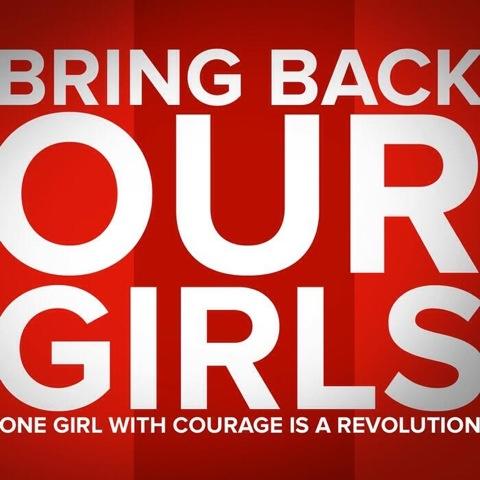
Use social media to spread the word about the situation in Nigeria. Put massive pressure on the government, security forces, and the neighboring governments to spur them to action. Use the hash tag, #BRINGBACKOURGIRLS. Change your profiled picture to Bring Back Our Girls.
3. Get More Information
Read more by World Moms Blog contributor Jennifer Prestholdt in The Advocates for Human Rights post, “Nightmare for Nigeria’s School Girls,” at:
http://theadvocatespost.org/2014/04/30/nightmare-for-nigerias-school-girls/
This is an original post to World Moms Blog by international human rights lawyer, Jennifer Prestholdt, of Minnesota, USA.

Jennifer Prestholdt is a lawyer and the Deputy Director of The Advocates for Human Rights, a volunteer-based human rights organization that works locally, nationally and internationally. Her work in human rights takes her around the world, but she spends most of her time in Minneapolis, MN, where she lives with her children (two sons and one daughter), her husband, an elderly cat and a dwarf hamster.
As Jennifer’s kids are now all in school (1st, 4th and 6th grades), she is finally finding more time to do the things that she used to love to do, especially running, writing and knitting. Jennifer loves to travel and has had the dubious distinction of having been accidentally locked in a bathroom on five continents so far. Australia and Antarctica await!
In January 2011, Jennifer made a New Year’s Resolution to start writing about her experiences in order to share with her children the lessons learned from 15 years of work in human rights. The result is her personal blog, The Human Rights Warrior. The name comes from her son Simon, who was extremely disappointed to learn that his mother is a lawyer, not a warrior.
You can find her on her blog The Human Rights Warrior or on Twitter @Jprestholdt.
More Posts

by Jennifer Burden | May 3, 2014 | 2014, Girls, Human Rights, World Voice

How can this have happened TWO WEEKS ago and no one has intervened yet, and many haven’t heard of it? In northern Nigeria, over 200 girls were kidnapped under the cover of dark last month from their school by a group of men, Islamic extremists who call themselves Boko Haram. Boko Haram translates to “western education is sin.” The men burned the girls school as they left. According to the Washington Post, relatives of the those taken report that there were mass marriages, and the girls were taken into Chad and Cameroon and sold as brides for Islamic militants for $12.
Why has nothing been done?????? Please Sign the Petition to #BRING OURGIRLSBACK:
ALL girls are important!! Please, sign this petition below to show the world that they need to be rescued and brought home. THIS MUST STOP. Time is ticking!! And contact your government officials in your country to ask them what they are doing about this and/or brief them on the subject. Without our help, this CANNOT go on unnoticed.

It takes such a small amount of time to add your voice to something sooo important!!
This is an original post to World Moms Blog by Founder, Jennifer Burden of NJ, USA.
Photo credits to the author.

Jennifer Burden is the Founder and CEO of World Moms Network, an award winning website on global motherhood, culture, human rights and social good. World Moms Network writes from over 30 countries, has over 70 contributors and was listed by Forbes as one of the “Best 100 Websites for Women”, named a “must read” by The New York Times, and was recommended by The Times of India.
She was also invited to Uganda to view UNICEF’s family health programs with Shot@Life and was previously named a “Global Influencer Fellow” and “Social Media Fellow” by the UN Foundation. Jennifer was invited to the White House twice, including as a nominated "Changemaker" for the State of the World Women Summit. She also participated in the One Campaign’s first AYA Summit on the topic of women and girl empowerment and organized and spoke on an international panel at the World Bank in Washington, DC on the importance of a universal education for all girls. Her writing has been featured by Baby Center, Huffington Post, ONE.org, the UN Foundation’s Shot@Life, and The Gates Foundation’s “Impatient Optimists.” She is currently a candidate in Columbia University's School of International and Public Affairs in the Executive Masters of Public Affairs program, where she hopes to further her study of global policies affecting women and girls.
Jennifer can be found on Twitter @JenniferBurden.
More Posts - Website
Follow Me:

by Jennifer Prestholdt (USA) | Jun 11, 2013 | 2013, Human Rights, International, Morocco, World Moms Blog, World Voice
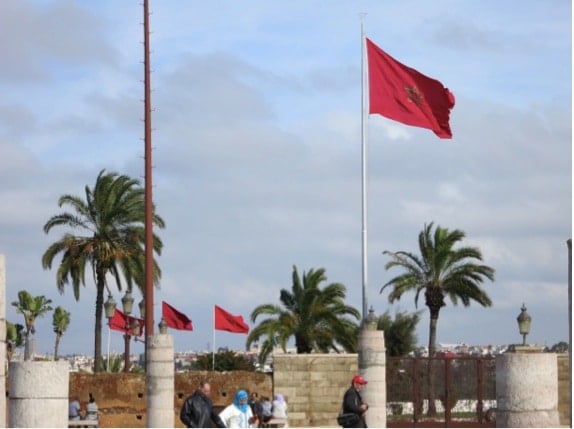
Photo by Jennifer Prestholdt
Hidden Child Labor
While millions of tourists visit Morocco every year, very few are aware of a hidden human rights abuse that is occurring behind closed doors in Morocco’s cities. Morocco has one of the worst child domestic labor problems in North Africa. The International Labour Organization (ILO) has estimated that between 66,000 and 88,000 children between the ages of 7 and 15 – 70% of whom are under age 12 – are working as domestic servants in Morocco.
These children work long hours for little pay and often suffer physical and other forms of abuse. Because domestic work is “women’s work” in Morocco, virtually all of these child domestic workers are girls. In Morocco (a country with a French colonial history), these child domestic workers are called petites bonnes or “little maids”.
I had the opportunity to learn more about the petites bonnes issue during a recent trip to Morocco. The United States Department of Labor’s Bureau of International Labor Affairs describes the problem like this:
Young girls are sent to work as live-in domestic servants, often before they reach age 10. Parents sell their daughters or receive payment of wages in exchange for their daughters’ service. These petites bonnes (little maids) often face conditions of involuntary servitude, including long hours without breaks; physical, verbal and sexual abuse; withheld wages and even restrictions on their movement. Frequently, they are sent from rural villages to more urban areas, and find it difficult to make their way home. Most petites bonnes are denied an education, and illiteracy rates are high among this population.
The Difficult Life of a Petite Bonne
The situation of petites bonnes in Morocco results from a combination of poverty, gender inequality, and lack of access to education. Girls – some as young as my own 8-year-old daughter – are sent to work as petites bonnes to generate income to support their families. They come from poor rural areas to work in cities such as Casablanca, Rabat, Marrakech, Tangiers, Agadir, and Fes. Intermediaries generally broker the arrangement, receiving a fee from the employer. Petites bonnes interviewed by Human Rights Watch reported that their employers frequently beat and verbally abused them, denied them the chance to go to school, and sometimes even refused to provide them with adequate food and sleeping facilities.
In a strange city, separated from their families and often speaking a Berber language instead of the Arabic spoken by a majority of Moroccans, many petites bonnes are extremely isolated and vulnerable. The isolation, along with the privacy of the homes, increases the chance of sexual abuse by male members of their employers’ household. In fact, several studies have found that many unwed young mothers in shelters in Morocco were petites bonnes when they became pregnant.
The difficult life of a petite bonne sometimes ends tragically. The widely reported story of little Khadija, an 11-year-old petite bonnewho was beaten to death by her employer in July 2011, raised calls for the government to take action on the issue. In January 2013, a 17 year old petite bonne in Casablanca attempted suicide by jumping from the fourth floor of her employers’ home. Amateur video of the suicide attempt that was circulated on the internet shocked Moroccans. Most recently, on March 24, 2013, a young domestic worker was taken to the hospital in Agadir with third degree burns on multiple parts of her body. Only 14 years old, she died from the injuries allegedly inflicted by her employers, prompting a UN representative in Morocco to decry child domestic labor by girls as “one of the worst forms of child exploitation” and call on the government to take action. Yet, thousands of petites bonnes in Morocco continue to suffer in silence.
Gaps in Legal Protection
According to NGOs working to help petites bonnes in Morocco, part of the problem relates to gaps in and difficulties with implementation of Moroccan laws. While Moroccan law prohibits employment of children under the age of 15, Morocco’s Labor Code does not apply to domestic work. Therefore, the Labor Codes’ protections for workers regarding hours worked (44 hours per week) and pay (2,333 dirhams or approximately $261 per month) do not apply. Human Rights Watch has documented that petites bonnes work long hours, often seven days a week. They earn an average of 545 dirhams (approximately $61) per month, but some earn as little as 100 dirhans (approximately $11).
In addition, Morocco ratified the Convention on the Rights of the Child (CRC) in 1993 and the ILO Convention No 182 on the Worst Forms of Child Labor. Both international treaties prohibit economic exploitation and employment of children in work that is likely to be hazardous, interfere with their education, or harm their health, safety or development. Unfortunately, neither have been implemented in a way that provides adequate protection to the petites bonnes.
Some Progress in Protecting Children
There is some indication that things are starting to change in Morocco. The government and international human rights organizations report that the number of girls working as petites bonnes is declining. This is due in part to the fact that public awareness about the problems faced by petites bonnes has been raised because of increased media attention to the issue and public education campaigns undertaken by the Moroccan government, NGOs, and United Nations agencies. The Moroccan government has also taken steps to increase school enrollment and this has helped reduce the number of children engaged in child labor.
Yet still more needs to be done. Since 2006, the government has been working on a draft law on domestic work that would for the first time establish a legal framework to better protect petites bonnes, secure rights such as a weekly day of rest and annual leave, and impose sanctions on employers. The Moroccan government has said that the draft Law on Domestic Workers is one of its priorities, but the bill has not yet been considered and passed by Parliament.
Take Action on June 12 – World Day Against Child Labour!
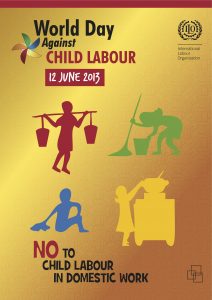 The problem of child domestic workers is not unique to Morocco. In fact, there are an estimated 15.5 million child domestic workers worldwide. The widespread use of children as domestic servants is one of the most hidden forms of child labor.
The exploitation of children, particularly girl domestic workers like petites bonnes, is a serious violation of children’s rights. It perpetuates inequality and inter-generational poverty, and deprives girls of their right to education, health, participation and protection. It also prevents children from acquiring the life skills and education necessary to improve their future.
To draw attention to the issue of child labor, the United Nations has recognized June 12 as the World Day Against Child Labour. In 2013, the focus is on child domestic workers like the petites bonnes of Morocco. On the 2013 World Day Against Child Labour, the international community is calling for legislative and policy reforms to ensure the elimination of child labor in domestic work and the provision of decent work conditions and appropriate protection to young workers in domestic work who have reached the legal working age. In Morocco, the government should:
• Strictly enforce the minimum age of 15 for all employment (including domestic work) and ensure that all children (particularly girls) enjoy the right to free and compulsory basic education;
• Adopt a domestic worker law that ensures compliance with the 2011 ILO Convention 189 on decent work for domestic workers
• Create an effective system for identifying, removing and rehabilitating child domestic workers from illegal or abusive employment.
• Criminally prosecute individuals responsible for violence or other criminal offenses against child domestic workers.
In addition, the World Day Against Child Labour provides the opportunity for all of us to take action to build the worldwide movement against child labor.
Take Action to end child labor. Learn what you can do to inform yourself and raise awareness in your community. The ILO’sSCREAM (Supporting Children’s Rights through Education, the Arts and Media) programme has factsheets, presentations, postcards, poems, and more. The SCREAM education pack is available in multiple languages.
Join the 12to12 to End Child Labour community. Learn more about the issue and join the 12to12 Community Portal, which provides a common platform for experience and knowledge sharing on research, activities and events related to the World Day Against Child Labour.
Find out what kids and teens can do to help. The ILO’s Youth in Action against Child Labour campaign has ideas, information, videos and other resources to help young people take action to end child labor.
Make a pinwheel with your kids. The pinwheel has become the symbol of the international fight against child labor. The pinwheel campaign to raise awareness about child labor began in Brazil in 2004. The five blades of the pinwheel represent the different continents of the world and the wind that makes the pinwheel spin is the will to act and to pass on the message until all countries take adequate measures to end child labor. Download a kit to make a pinwheel to keep the movement going!
This is an original World Moms Blog post written by Jennifer Prestholdt.
Were you aware of the international child labor issue? Does it exist in the country in which you live?
Jennifer Prestholdt is a lawyer and the Deputy Director of The Advocates for Human Rights, a volunteer-based human rights organization that works locally, nationally and internationally. Her work in human rights takes her around the world, but she spends most of her time in Minneapolis, MN, where she lives with her children (two sons and one daughter), her husband, an elderly cat and a dwarf hamster.
As Jennifer’s kids are now all in school (1st, 4th and 6th grades), she is finally finding more time to do the things that she used to love to do, especially running, writing and knitting. Jennifer loves to travel and has had the dubious distinction of having been accidentally locked in a bathroom on five continents so far. Australia and Antarctica await!
In January 2011, Jennifer made a New Year’s Resolution to start writing about her experiences in order to share with her children the lessons learned from 15 years of work in human rights. The result is her personal blog, The Human Rights Warrior. The name comes from her son Simon, who was extremely disappointed to learn that his mother is a lawyer, not a warrior.
You can find her on her blog The Human Rights Warrior or on Twitter @Jprestholdt.
More Posts
by World Moms Blog | Jun 8, 2013 | Feminism, Motherhood, World Motherhood
Today we’re sharing a post from a World Mom living in Laos! If you’re interested in telling your motherhood story on World Moms Blog, email us at contribute2@worldmomsblog.com!
This first “World Mom Feature” is by Miss Pip of Laos…
“Equal to None”
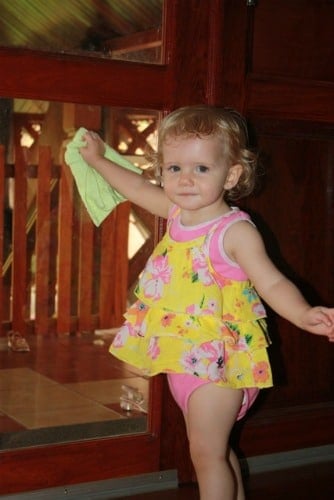
A concerned citizen, upon realizing we had three daughters, recently offered to take my partner ‘upcountry’ to the village to meet the local witch doctor. Apparently, this particular Shaman was able to supply an herbal concoction that would guarantee us a son.
(For the record, we are not having any more children. We are very happy with the ones we already have.)
I am fascinated by how often people feel compelled to tell me that my family is incomplete because I don’t have a son. They remind me that, despite over 100 year of feminism, my three children and I are still considered “LESS THAN” because we were born without a Y-chromosome.
Becoming a mother has enriched my life. I love my daughters, unconditionally. I treasure the opportunity to guide them towards adulthood. Nonetheless, becoming a mother has been a struggle. I have had to fight some very personal demons and have been rather lost and confused along the way. Fundamentally, I have had to redefine myself within the context of being a “Woman”.
Until I had children, I naively defined myself as a “Human” first and a “Woman” second. I studied Feminist Theory at University, but I kind of blew off any notion that MY life was influenced by the patriarchy. I was a kick-ass individual, and I lived my life on equal terms with anyone else.
But becoming a mother made me realize that, in reality, I still live in a world defined by and dominated by men, and my life decisions have been profoundly influenced by that.
My partner and I have been together for 15 years. We got our first jobs together, moved in together, paid the rent together, traveled together – as equals. I was hell-bent on our roles in the relationship being defined equally even though that meant that sometimes, after we have paid our ‘equal’ share of the bills, he still had money to go out, and I didn’t. (Interestingly, even at minimum wage he was paid more than I was!) We shared the chores equally. I NEVER ironed his clothes. I was a proud, fierce and independent woman with my own life and my own career.
But over time things started to change. My business ventures, which had sustained us adequately in early adulthood, became less profitable than his career. He was offered the opportunity to move, first interstate and then overseas. I couldn’t justify preventing his progress just because I was wanted to pursue what was, quite possibly, a pipe dream. Also, I loved him. I was proud of his success. I choose to support him, to follow him. It was my choice.
I could still work, I told myself. I was strong and resilient and very capable. But we moved a lot and, eventually, we reached the point where my income could no longer be relied upon. I was, I realized, financially dependant on my partner.
Becoming a Mother
Then, somewhere along the way, we decided to have children. We talked about it, at length. Having children did not mean ME taking on the only responsibility for caring for the kids and the household. I wanted to work. We would share the responsibilities. Equal opportunity parenting. Yep, sure, sounds like a plan, I am on board, let’s do this.
… Needless to say, that is not quite how things worked out.
My partner now works longer hours and spends more time away then he ever did before we had children. He sometimes feels overwhelmed by what he perceives to be his duty to support and provide for his family.
I now earn less money and spend more time in my house than I ever did before children. I regularly feel overwhelmed by my assumed role as the primary carer, wet-nurse, cook, cleaner, manager, taxi driver, nurse, psychologist, nutritionist, disciplinarian in our family.
My family IS the Perfect Little Patriarchy!
But wait… no it’s not perfect… I forgot… I don’t have a son!
I have three complicated, passionate, articulate, intelligent, determined, manipulative, magnificent GIRLS.
Raising Daughters
One day, my little girls are going to grow up to be WOMEN, how unfair for them and how wonderful for them. They are going to grow up to be HUMANS, what an opportunity for them.
I am their mother and, for me, it’s complicated.
• Shouldn’t I be an example to them, a strong, female role mode
• Have my choices perpetuated the status quo?
• Will they grow up with notions of ‘what women do’ that will go on to influence them as they grow into women themselves?
I am their mother and, for me, it is simple.
• I will practice compassion, identify inequality and I will teach them to do the same. I will continue to grow as a woman and a human because I owe it to them to be the best person I can be.
• I will be proud of my choices – they have given my daughters, a loving and safe home.
• I will encourage my girls to embrace their womanhood. I will teach them that with hard work and dedication they can achieve anything they set their minds to. I will show them they can be the change.
I am their mother. They are my daughters. They are ‘MORE THAN’ anything.
 This is an original post to World Moms Blog by Miss Pip. She lives in Vientiane, Laos with her partner, their three incorrigible daughters (aged 5.5 years, 4.5 years and 16 months) and two well-traveled cats. She says that she used to be fabulous! (We say, she still is!)
Last year Miss Pip turned forty. She says, “That sucked! I had no idea who I was or what made me happy. I was ashamed of who I had become and conflicted about being a mum. It was all very boring, very depressing and was making me, and the people who loved me, miserable.”
So she decided to change. Miss Pip decided to let go of the past, accept her present and embrace a future where SHE IS the fabulous version of herself that she knows she can be. You can also find her on her blog, 44 and a Fourth.
Photo credits to Miss Pip.
World Moms Blog is an award winning website which writes from over 30 countries on the topics of motherhood, culture, human rights and social good. Over 70 international contributors share their stories from around the globe, bonded by the common thread of motherhood and wanting a better world for their children.
World Moms Blog was listed by Forbes Woman as one of the "Best 100 Websites for Women 2012 & 2013" and also called a "must read" by the NY Times Motherlode in 2013. Our Senior Editor in India, Purnima Ramakrishnan, was awarded the BlogHer International Activist Award in 2013.
More Posts

by Elizabeth Atalay | May 28, 2013 | 2013, Birthing, Clean Birth Kits, Contraception, Social Good, Social Media, Women's Rights, World Events, World Moms Blog, World Voice
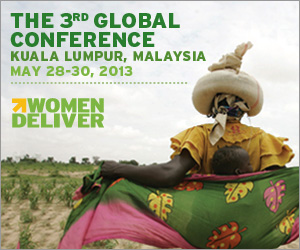
Beginning today in Kuala Lumpur the world gathers at the Women Deliver conference, the third global conference to be held focusing on the health and well-being of girls and women. Starting today and running through May 30th International leaders, policymakers, healthcare professionals, NGO’s, youth leaders, corporations, and media outlets recognize the value of girls and women and take on solutions to issues affecting girls and women around the world. It is becoming increasingly clear that the most valuable investment we can make is in girls and women.
With the 2015 Millennium Development Goal deadline rapidly approaching, the time is now to deliver for girls and women, and Women Deliver 2013 will serve as a global platform for ensuring that the health and rights of girls and women remain top priorities now, and for decades to come.
Luckily we do not have to travel to Malaysia to participate; You can watch the conference livestream or go back to find the sessions that have been recorded that you may have missed. You can chime in or follow using the hashtag #WD2013 on twitter, and get the days re-cap by looking through #WDLive.

The +Social Good community also launched in Kuala Lumpur this week, and was inspired by the Social Good Summit, as a community of innovators, connectors and global citizens come together with the shared vision to make the world a better place. There are many ways to join in on the global conversation this week around women, girls and social good, we’ll see you there!

Elizabeth Atalay is a Digital Media Producer, Managing Editor at World Moms Network, and a Social Media Manager. She was a 2015 United Nations Foundation Social Good Fellow, and traveled to Ethiopia as an International Reporting Project New Media Fellow to report on newborn health in 2014. On her personal blog, Documama.org, she uses digital media as a new medium for her background as a documentarian. After having worked on Feature Films and Television series for FOX, NBC, MGM, Columbia Pictures, Warner Brothers, 20th Century Fox, and Castle Rock Pictures, she studied documentary filmmaking and anthropology earning a Masters degree in Media Studies from The New School in New York. Since becoming a Digital Media Producer she has worked on social media campaigns for non-profits such as Save The Children, WaterAid, ONE.org, UNICEF, United Nations Foundation, Edesia, World Pulse, American Heart Association, and The Gates Foundation. Her writing has also been featured on ONE.org, Johnson & Johnson’s BabyCenter.com, EnoughProject.org, GaviAlliance.org, and Worldmomsnetwork.com. Elizabeth has traveled to 70 countries around the world, most recently to Haiti with Artisan Business Network to visit artisans in partnership with Macy’s Heart of Haiti line, which provides sustainable income to Haitian artisans. Elizabeth lives in New England with her husband and four children.
More Posts