by Elizabeth Atalay | Apr 1, 2014 | Awareness, Being Thankful, Cooking, Food, Health, Humanitarian, International, Life Lesson, Nutrition, Poverty, Social Good, Uncategorized, World Events, World Moms Blog, World Motherhood
www.livebelowtheline.com
One could barely think straight after five days she was so hungry. Another who is pregnant, was sapped of all energy after only one day. Me, I caused a stink at the grocery store checkout over 65 cents, …..yes, we were impacted. I don’t think any of us will think of extreme poverty in the same way ever again.
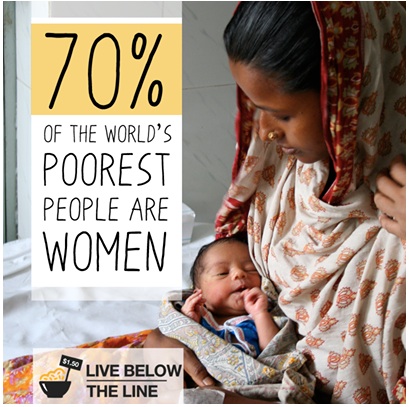
Live Below The Line is a campaign created to change the way that people think about extreme poverty. The World Bank defines extreme poverty as living on under $1.25 per day, something that 1.2 billion people in the world currently survive on. These are the poorest of poor, and to truly understand what it means to live that way, you need to experience it. Five World Moms took on the challenge, and in each of our own words here is what we found:
Hannah Ashton – USA
I’m six months pregnant, which is hard enough in itself, particularly when my day is spent running round after my toddler, Maggie, and I hadn’t been sleeping very well, for just one day, I thought I would give the challenge a go. I could, of course, always stop, unlike the many pregnant women around the world, who sadly don’t have that option.
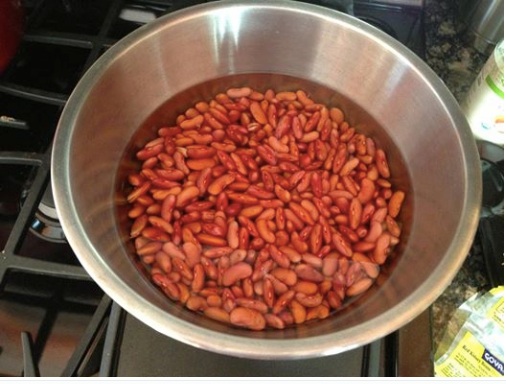
The day started well enough with oatmeal made with water, 2/3rds of a banana and a mug of green tea. I used the tea bag to make 3 more mugs of tea which were like green water by the third and fourth cup. This filled me up until lunchtime which was a kidney bean and carrot burger, using the recipe from “a girl called jack blog”, 1 oz. rice and two flatbreads. Immediately after eating lunch I was still hungry. It was a small amount of food and there was no more food until dinner. I generally eat dinner with my husband when he gets home from work at 8pm. Instead I was too hungry so I ate at 5:30 with Maggie when she ate her dinner. My dinner was a kidney bean, carrot, onion and tomato stew with 2 oz rice. Even though I had soaked the kidney beans overnight, boiled them for 20 minutes and let them simmer in the stew for an hour, they were still very hard, but I ate it all anyway.
Later, as my husband cooked himself a delicious looking steak sandwich, a radish salad and drank a glass of red wine, I cooked up my two remaining flatbreads and made a fresh mug of green tea. “It’s like we’re living in two different worlds tonight,” he commented.
At 3 am I woke up with a splitting headache and was extremely hungry. I came downstairs, took two Tylenol and had a large piece of the blueberry pie that was left over from the weekend. The next day, it is fair to say I really struggled even though the challenge was over. The LBTL diet of the day before had really affected me. I rang my husband at work in tears asking him to please come home from work earlier to help with Maggie’s bedtime routine as I didn’t have the energy to do it by myself (I have a nightly battle with teeth brushing but usually take it in my stride). I had to cancel a play date with a friend and I went to bed at 8:30. It was only by Wednesday, that I felt back to normal.
I’ve not known what it’s like to be really hungry before; I’ve never dieted or not had enough money for food. I can’t say if I was affected by this challenge more than others because I’m pregnant. In a few years, I plan to revisit the challenge and complete the five days. What I can say is the experience has profoundly affected me. No one should have to function on such little calories and the thought of a child having to go through this, especially, is completely heart breaking.
| Item |
Total cost ($) |
Per day ($) |
| 1 lb. dried kidney beans |
1.69 |
0.34 |
| 1 lb. white rice* |
1.07 |
0.21 |
| 24 oz. tomato sauce with basil and garlic |
1.00 |
0.20 |
| 5 instant apple and cinnamon oatmeal* |
0.89 |
0.18 |
| 1 lb. carrots |
0.66 |
0.13 |
| 1 lb. flour* |
0.65 |
0.13 |
| 1 lb. bananas |
0.59 |
0.12 |
| 10 green tea bags* |
0.50 |
0.10 |
| 0.5 lb. onions |
0.33 |
0.07 |
| Total |
7.38 |
1.48 |
*items bought with a friend so we could split the cost.
Deborah Quinn- Abu Dhabi
When I agreed to try living below the line for a day, I mostly had in mind trying to teach my kids about their relative privilege—that their status as “picky eaters” was in fact the ultimate luxury, given that a person only refuses one kind of food if he knows that another sort of food is available. In Abu Dhabi, where I live, $1.50 converts to about 5 dirhams, or about the cost of a large loaf of bread. I had decided that I would make a sort of vegetable, and as I selected one onion from India, one potato still crusted with dirt from Lebanon, two small carrots grown here in the UAE, I wondered whether the people who picked the vegetables were themselves living below the line in those countries.
My “soup” consisted of a chopped carrot, onion, and potato simmered in water with a bullion cube for flavor. I confess that I used my immersion blender to puree the vegetables when they were soft, so that the soup felt a bit thicker and more filling. I used another onion and some dried staples—lentils and rice—to make mejadra, a dish from Ottolenghi’s Jerusalem cookbook. Families all over this region have their own mejadra recipe, each with slightly different proportions of spices, but the dish is quintessential feed-a-lot-of-people-on-not-much: fried onions stirred into lentils and rice. With my soup and my lentils and rice, I wasn’t hungry, but I wasn’t terribly satisfied, either: I wanted sugar, I wanted coffee, I wanted fresh green lettuce and ripe tomatoes.
I thought about the migrant workers in Abu Dhabi, who come from desperately poor towns in places like Goa, Kerala, Islamabad, or Peshawar, who work here for a pittance but are nevertheless making more money than they would at home. What are they filling their bellies with, in order to face another day of work in Abu Dhabi’s broiling sunshine? And given the world’s insistence—and reliance—on global capitalism, with its relentless emphasis on bottom line profits, how will we ever bring about permanent change, so that boullion soup is something you eat only when you have an upset tummy and not because it’s all you can afford?
Alison Fraser- Canada
My first attempt at living below the poverty line was much more challenging than I had anticipated. I had visions of making creative dishes to spread the $1.50 as thin as possible. It didn’t work. The bottom line is that $1.50 doesn’t get you much in terms of food in Canada. My meals consisted of small spooned amounts of peanut butter just to keep me going. I tried to drink lots of water to conquer the hunger, but that didn’t help much either. Fruit and vegetables were much too expensive to include in my meal plan, as winter in Canada results in costly produce.
In the end, my mind kept drifting back to my time in Tanzania where I met women who lived below the poverty line every single day. Some of these women were sick, and were forced to choose between their life and the needs of their children, as many HIV medications can only be taken with food. I can’t even imagine having to make that choice. So unfair.
This was an incredibly emotional experience and next year, I am determined to do it for more than just one day.
Elizabeth Atalay- USA
I could feel the color rising in my cheeks as the cashier called over the store manager. I had $7.50 to spend for my five day Live Below The Line food budget, and the misleading sale sign had just caused my order to ring up 65 cents over my carefully calculated bill. I could see them exchanging exasperated looks as I explained that the (crappy) instant coffee I had purchased was advertised for less than it rang up. The hunger pangs I felt later in the day were not what stuck with me from this challenge, those took place in the privacy of my home. It was the sting of humiliation as the line of people behind me built up while I caused a scene over 65 cents at the grocery store. I was mortified, and imagined having to swallow my pride like this on a regular basis. I can describe the tightening in my chest, the flush of my cheeks, and acid rising in my throat better than I can explain the emotion that moment made me feel…powerless, small, ashamed? The manager explained that the sale was only for purchases of $25 or more. They said they would give it to me anyways since I had told them, without going into detail, that I only had $7.50 to spend, and it was false advertising. As much as I wanted to save face, I certainly wasn’t going to take the time to try to explain that I was doing it as part of the Live Below The Line campaign then, with the impatient crowd waiting for their turn. I plan to take the full 5 day challenge when it officially runs between April 28- May 2nd. After doing it for just one day I can see how impactful it is in deepening empathy, and understanding on the issue of hunger, and what it means to live in poverty.

What $7.50 bought after sales, coupons, and making a scene.
Jennifer Burden- USA
They (LBL) got me. Big time. I’ve read about poverty, tweeted about it, gone to the far reaches of Uganda with the Shot@Life campaign, where I met children who are fed their one and only meal a day at school. I’ve also donated to local food banks, here, in NJ, USA. I felt like I knew how important it is that there are people near and far who go hungry and that 1.2 billion people on the planet live below the poverty line, and that I was doing enough. So, like a “know-it-all teenager” I naively went into this challenge thinking that I wouldn’t really learn much. Boy, was I wrong. Really wrong.
Originally, I signed up for a day of the Live Below the Line Challenge, and then, by Day 2, I had
committed myself to the full challenge — 5 days. I thought I’d be celebrating on Day 5 that I had gotten that far, but there was a whole transformation. Check out my video from Day 5:
Every global health advocate, college student, mom, dad, teen, blogger, journalist, CEO, teacher, living human who is living above the poverty level, etc., should consider experiencing the challenge. The impact on eliminating world poverty would be profound if even more people were involved. It would be incredible. The challenge was a REAL eye-opener and new motivator for me. You’ve gotta do this!!!!!
Visit our World Moms Blog Team Live Below The Line Page to benefit UNICEF, where you can donate to help those less fortunate, or see the impact we’ve already made in the challenge.
The Live Below The Line Challenge will run from April 28th to May 2nd and you can
sign up here as an individual or team.
Will you take the challenge?This is an original post written for World Moms Blog by Elizabeth Atalay, Jennifer Burden, Hannah Ashton, Deborah Quinn, and Alison Fraser.

Elizabeth Atalay is a Digital Media Producer, Managing Editor at World Moms Network, and a Social Media Manager. She was a 2015 United Nations Foundation Social Good Fellow, and traveled to Ethiopia as an International Reporting Project New Media Fellow to report on newborn health in 2014. On her personal blog, Documama.org, she uses digital media as a new medium for her background as a documentarian. After having worked on Feature Films and Television series for FOX, NBC, MGM, Columbia Pictures, Warner Brothers, 20th Century Fox, and Castle Rock Pictures, she studied documentary filmmaking and anthropology earning a Masters degree in Media Studies from The New School in New York. Since becoming a Digital Media Producer she has worked on social media campaigns for non-profits such as Save The Children, WaterAid, ONE.org, UNICEF, United Nations Foundation, Edesia, World Pulse, American Heart Association, and The Gates Foundation. Her writing has also been featured on ONE.org, Johnson & Johnson’s BabyCenter.com, EnoughProject.org, GaviAlliance.org, and Worldmomsnetwork.com. Elizabeth has traveled to 70 countries around the world, most recently to Haiti with Artisan Business Network to visit artisans in partnership with Macy’s Heart of Haiti line, which provides sustainable income to Haitian artisans. Elizabeth lives in New England with her husband and four children.
More Posts

by Sophie Walker (UK) | Mar 17, 2014 | 2014, Being Thankful, Childhood, Education, Girls, Kids, Life Lesson, Motherhood, Parenting, Preschool, Sophie Walker, Special Needs, UK, Uncategorized, World Motherhood, Younger Children
 Betty and I are walking to school in the rain. It is a miserable morning – grey, cold and squally. We are tilting our umbrellas sideways to shield ourselves from the gusts of needles thrown at us as we progress along the avenue. I am forcing bright chatter and thinking of the warm cup of tea I will have when I get home.
Betty’s umbrella is white and pink and round like a daisy. It has pretty little petals and yellow stripes, and a bumble-bee attached to the top. The bumble-bee is looking very sorry for himself this morning, buffeted hither and to. I can’t see Betty’s face but I can tell by the drag of her toes that she is feeling sorry for herself too.
I lean down and enquire: “How are you doing, darling?”
A woebegone voice answers. “Ok.”
Then she asks: “Mummy, did this umbrella used to belong to my big sister?”
I tell her yes, it did.
“And Mummy, did she used to walk to school with it too?”
Again, I aver, she did.
A pause. Then, cautiously: “Mummy, did my sister ever used to not want to go to school?”
I can see where this is going now and I give her hand a sympathetic little squeeze. I say yes, there were days when her big sister didn’t really feel like it either.
At this Betty stops and tips back the rim of her umbrella to look up at me. Her eyes are welling with tears. She asks: “And did she used to worry about making mistakes too?”
Betty started school last September at the age of four. She is now four and a half and a month into her second term. She flew through the first twelve weeks with ease – enthusiastic, inquisitive, and keen to try new things. This term, she has cried often on leaving me in the mornings. Afternoons start with jubilation at being home, then slide slowly from relaxation to upset as night approaches.
As soon as I call her for her bath it is her cue to start an hour-long conversation about whether or not she will have to go to school again in the morning.
Now I look at her, looking up at me, her face a mixture of rain and tears, and I think: She’s far too little for all this. I bend down to her and put my umbrella down and hug her. I tell her: “Everyone makes mistakes. It doesn’t matter about making mistakes. The thing is just to try your best. Have a little go.”
But as I’m saying it, I’m thinking that really, I just want to put her in my pocket and take her home. She is not yet five. She shouldn’t be afraid of new things in case she finds herself unable to do them to a standard that will make her happy.
Last term, she learned phonics – how to make the sounds of the alphabet. This term, she has realised that those phonics are letters and that by putting them together and sounding them out she can both read and write. And it terrifies her.
It is Learning with a capital ‘L’. Every day now she wonders what Learning she will have to conquer next.
The British education system is under huge scrutiny at the moment. The coalition government’s Conservative education minister Michael Gove has decided that it needs an overhaul. There is too much emphasis on coursework, so he has decreed the system should revert to a grand slam of end-of-year exams. There is not enough emphasis on rote learning, so reciting dates and times-tables are back in.
So far I have reacted to Gove’s decisions with horror mainly because of the impact they will likely have on my elder daughter, who has Asperger’s Syndrome, and will struggle even more under a system that removes the chance for her to shine via project work. Gove’s reforms are a disaster for Grace.
Now, looking at Betty, who I had expected to skip through the system, I find myself wondering how she will cope. Recently Gove said he was thinking of introducing formal assessments for four and five-year-olds when they enter school in England, in order to be able to monitor their progress.
I care that my children should progress well through the education system, and flourish in their chosen careers. But as I kissed Betty goodbye in her classroom that morning, and watched her teacher take her gently by the hand to distract her from her upset, I thought: there must be a better way to do this.
So – how do you do it, where you live? And do you think it works?
This is an original post to World Moms Blog from our writer in England, Sophie Walker.
The picture used in this post is credited to Roger McCallum. It holds a Flickr Creative Commons attribution license.

Writer, mother, runner: Sophie works for an international news agency and has written about economics, politics, trade, war, diplomacy and finance from datelines as diverse as Paris, Washington, Hong Kong, Kabul, Baghdad and Islamabad. She now lives in London with her husband, two daughters and two step-sons.
Sophie's elder daughter Grace was diagnosed with Asperger Syndrome several years ago. Grace is a bright, artistic girl who nonetheless struggles to fit into a world she often finds hard to understand. Sophie and Grace have come across great kindness but more often been shocked by how little people know and understand about autism and by how difficult it is to get Grace the help she needs.
Sophie writes about Grace’s daily challenges, and those of the grueling training regimes she sets herself to run long-distance events in order to raise awareness and funds for Britain’s National Autistic Society so that Grace and children like her can blossom. Her book "Grace Under Pressure: Going The Distance as an Asperger's Mum" was published by Little, Brown (Piatkus) in 2012. Her blog is called Grace Under Pressure.
More Posts
by Mirjam | Mar 3, 2014 | 2014, Mental Illness, Netherlands, Post Partum Depression, Uncategorized, World Motherhood
 It has been nearly two years since I asked for help.
Motherhood and life felt like too much of a burden for me. After years of thinking that the problem was me, it finally dawned on me that there might be something wrong.
I started therapy and found out that I had suffered from postpartum depression. Not once but three times. I also found out that the feelings I struggled with in my early teens were not just regular teen struggles. I found out that it was also depression that I had struggled with.
These past two years have been the most intense years of my life. I have experienced tremendous growth. I have opened new doors and have closed old doors behind me.
People talk about therapy lightly. They think therapy is nothing more than paying someone to listen and to give you advice. Therapy is no such thing. Therapy is facing yourself. Therapy is opening doors and looking into the dark corners of your soul. It is work. Hard work that sometimes leaves you exhausted. Being as courageous, as walking into a lion’s den unarmed. Vulnerable. It is raw naked honesty and perseverance. Going down a steep, rocky and sometimes dark road without knowing when you will reach the end of it. It’s knowing that you can decide to leave that road at any moment, yet not giving in to that thought. Because you want to get well.
For the past two years I have been going down this road. To say it has been a roller coaster ride, is to take a devastating hurricane and to call it a warm summer’s breeze. The hardest part? Being a mother at the same time.
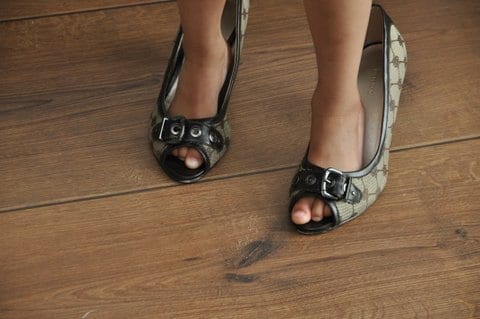
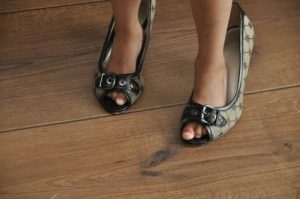
There is no time off. No time to lick my wounds or to take a break. When I come out of therapy I need to step quickly into my mommy shoes. Some days I come out of therapy feeling empowered. I stand tall and firm and switch roles like a pro. Other days I feel delivered, freed from a burden that has been carried for way too long. Those are the days that my mommy shoes feel like dancing shoes. Then there are days that I am exhausted from the hard work and I feel empty with little left to give. On those days my Mommy shoes are put on reluctantly.
Some days the carefully constructed bandages around my heart are ripped from their place and old wounds are exposed. My heart breaks and scatters into a thousand pieces. An hour passes as I work through the pain. When the clock strikes reality, I hastily gather the pieces and put them back into place as best I can. I wear my mommy shoes, and though it is I that longs to be nurtured, it is I that gives the loving smile; it is I that spreads my arms in welcome; I that carries and I that offers warmth and shelter.
On such days my feet struggle to find solid ground underneath my shoes. When my child reaches for me, my grasp is firm. And as I hold her little warm hand softly in mine, the ground underneath my feet gradually feels stable again.
Have you ever experienced something, that made it hard for you to step back into your ‘Mommy shoes’? I would love to hear about it.
This is an original post to World Moms Blog by our author in the Netherlands, Mirjam.
The image used in this post is credited to the author.
Mirjam was born in warm, sunny Surinam, but raised in the cold, rainy Netherlands.
She´s the mom of three rambunctious beauties and has been married for over two decades to the love of her life.
Every day she´s challenged by combining the best and worst of two cultures at home.
She used to be an elementary school teacher but is now a stay at home Mom. In her free time she loves to pick up her photo camera.
Mirjam has had a life long battle with depression and is not afraid to talk about it.
She enjoys being a blogger, an amateur photographer, and loves being creative in many ways.
But most of all she loves live and laughter, even though sometimes she is the joke herself.
You can find Mirjam (sporadically) at her blog Apples and Roses where she blogs about her battle with depression and finding beauty in the simplest of things. You can also find Mirjam on Twitter and Instagram.
More Posts - Website
Follow Me:



by Mamma Simona (South Africa) | Feb 20, 2014 | Parenting, South Africa, Uncategorized, World Motherhood
I clearly remember (as a young first-time mother struggling with my son’s colic and projectile vomiting) being told by other mothers; “Oh, that’s nothing, just you wait until he hits the Terrible Twos!”
That colicky baby turned 21 last month, and I have learnt a few things along the way! First and foremost, children tend to live up to our expectations (even our subconscious expectations). If you’re sure that you will experience the “Terrible Twos” chances are better than fair that you will. The sad thing is that most parents don’t know that it doesn’t have to be that way!
Every child is unique, and every parent-child relationship is different, that’s why there are as many parenting styles and beliefs as there are parents. That said, most parenting sites and blogs tend to reinforce certain ideas (like that of the Terrible Toddler years and Terrible Teen years) so that new parents accept them as being inevitable stages of life.
“Robert Rosenthal brought to public attention a powerful type of self-fulfilling prophecy, in a classic experiment about the expectations of teachers (Rosenthal & Jacobson, 1968). In the experiment, all the students in a class were given a standard IQ test. After the results were scored, the researchers informed the teachers that five students in the class had unusually high IQ scores and would probably be “spurters” who leaped ahead of their classmates during the remainder of the year. In reality, the five children were picked at random. By the end of the year, all the children had gained in IQ, but the five “spurters” had gained much more than other students. Evidently the teachers treated them differently after being told to expect sudden improvement.”
Since 1968 many similar experiments to the one cited above have been carried out.
“Rosenthal notes that the expectancy effect has been documented in business management (where the biasing effect is the expectations of employers about their employees), in courtrooms (where the biasing effect is the expectations about the defendant’s guilt or innocence), and in nursing homes (where the biasing effect is the expectation that a patient will get better or worse).
In all cases, the expectations tend to come true, whether they are based on any objective evidence or not.
Apparently, as a general rule, people make their expectations come true. Rosenthal’s research shows the Pygmalion effect is not only important; it is robust. It is a strong effect that occurs in many situations.”
I believed in the “Terrible Twos” with my son (because I didn’t know any better) and we battled for 2 years! By the time my daughter was born, I’d learnt a lot, and I believed we wouldn’t have any trouble at all … guess what, we didn’t! We also haven’t experienced any of the unpleasantness that some believe is unavoidable during the pre-teen, teen and early adulthood years.
Given the above, I feel that the Terrible Twos and Terrible Teens are only fact if you believe them to be!
Can you think of ways in which your children have lived up to your expectations? Do you believe that by expecting a different result you can create a different result?
This is an original post for World Moms Blog by Mamma Simona from Cape Town, South Africa.






 This is a guest post by Coysie Tan-Gana, from the Philippines.