by Ms. V. (South Korea) | Aug 27, 2013 | 2013, Human Rights, N. Korea, South Korea, Uncategorized, World Voice
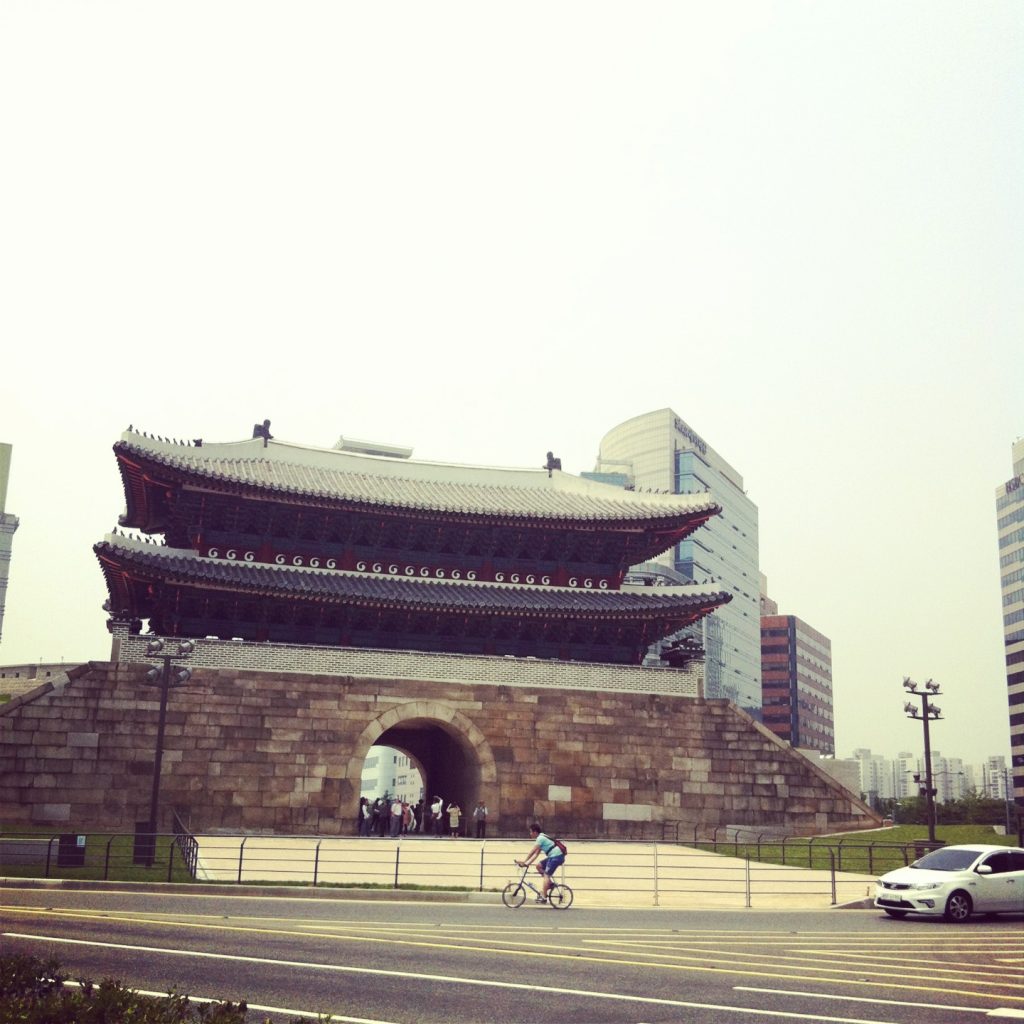
Photo by Ms. V
The third week of August here in Seoul brought some extreme heat, some sun after weeks of monsoon rain, and the first ever United Nations Commission of Inquiry into human rights abuses by North Korea.
The hearings were held at a local university and while the accounts were harrowing – beatings, killings, starvation – they were nothing we haven’t heard before. For some, the fact that the UN was officially holding these hearings was a hopeful sign that the international community is poised to act on behalf of the millions of North Koreans living under that repressive regime. For others, these hearings carry little, if any, weight at all. After all, what will more talking about abuses that have been going on for three generations of the Kim family rule do to stop them?
What I found most surprising about the hearings was the almost complete lack of interest in them here in Seoul. They were very sparsely attended, journalists being the bulk of those in attendance. As an outsider, it is very challenging to understand the complicated relationship that Koreans from the south have with Koreans from the north.
In the period immediately after the war, and for a few decades after, defectors were hailed as heroes and national treasures and were taken care of by the South Korean state. Somewhere along the road, though, attitudes began to shift. As more and more defectors made their way to South Korea, the government changed its policies for handling these North Koreans and South Korean citizens began to see them, not as heroes, but at best a nuisance and at worst a problem.
One must understand the vast differences that exist between these two countries occupying the same peninsula. North Korean defectors are shorter, less healthy, and far less educated, if at all.
Their language and speech patterns are different and they struggle to assimilate into the very fast-paced and highly technology-dependent life in the South. It is not uncommon for South Koreans to believe that North Koreans are lazy drunks and to feel embarrassed by their very existence.
The framework of Confucianism almost always provides some clarity to the cultural nuances that I don’t understand. In this case, the Confucian preoccupation with the “right way” creates an environment where differences, rather than being celebrated, are focused on and seen as inherently bad. There does not appear to be any room in the South Korean culture for an appreciation of the difference in language or mannerisms of the North Korean escapees.
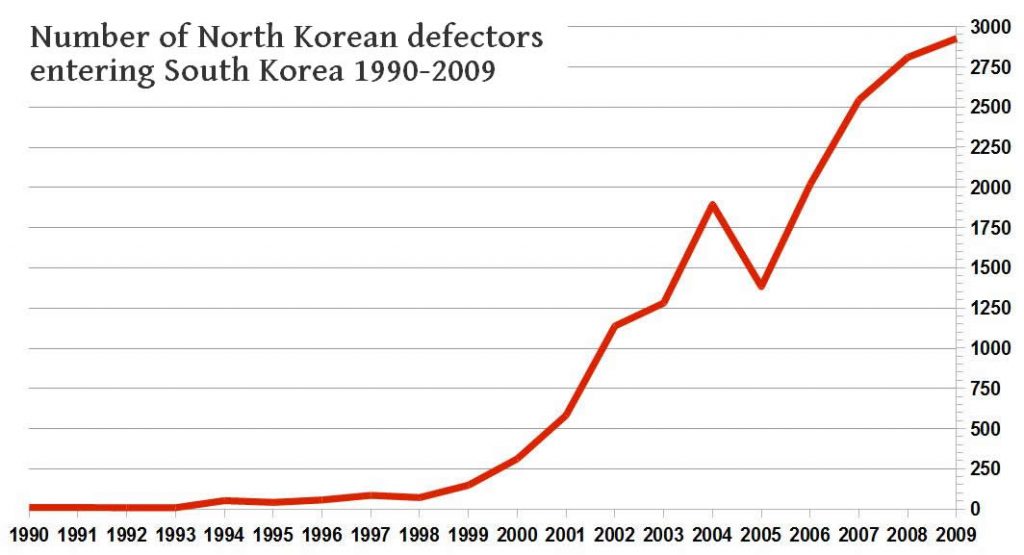
Source: Wikimedia Commons
This focus on uniformity and a belief that there is one right way to do everything is apparent throughout Korean culture, and while I have observed it many times and in various situations, its application to the situation with the North Korean defectors is hard for me to wrap my brain around.
As an outsider and a guest in this country – which I must say has been mostly warm and welcoming to me and my family and a very comfortable place for us to live – my perspective is admittedly limited. Bur from where I stand, I see the heartbreaking reality that those who are courageous enough to do what is necessary to flee North Korea and make it to the south have a largely uphill battle.
South Koreans cannot undo what has been done to those in the north. They cannot erase the trauma or the long-term effects of malnutrition and suppression. What they can do is put an end to the discrimination.
Differences are often threatening at first glance, especially when they are a result of something as terrible as war. Yet, all differences are opportunities for enrichment and growth. It is a shame that the current generation of Koreans is paying for the choices of previous generations and the problem of managing the current flow of defectors, not to mention what would happen were the two Koreas to unite, is beyond overwhelming.
This we know – the North Korean regime is guilty of human rights abuses. The North Koreans who make it to the south have suffered enough and defecting is only the beginning of their very hard road in life. Hopefully the South Korean government and people can create policies that help and cultivate attitudes that heal.
This is an original post to World Moms Blog written by our South Korean contributor Ms. V.
Did you follow the news of the hearings this past week?
For more information about the challenges faced by North Korean defectors, you may want to read this report compiled by CrisisGroup.org
Ms. V returned from a 3-year stint in Seoul, South Korea and is now living in the US in the beautiful Pacific Northwest with her partner, their two kids, three ferocious felines, and a dog named Avon Barksdale. She grew up all over the US, mostly along the east coast, but lived in New York City longer than anywhere else, so considers NYC “home.” Her love of travel has taken her all over the world and to all but four of the 50 states.
Ms. V is contemplative and sacred activist, exploring the intersection of yoga, new monasticism, feminism and social change. She is the co-director and co-founder of Samdhana-Karana Yoga: A Healing Arts Center, a non-profit yoga studio and the spiritual director for Hab Community. While not marveling at her beautiful children, she enjoys reading, cooking, and has dreams of one day sleeping again.
More Posts
Follow Me:


by Elizabeth Atalay | Aug 13, 2013 | 2013, Millennium Development Goals, ONE, Social Good, Third Eye Mom, Uncategorized, World Voice
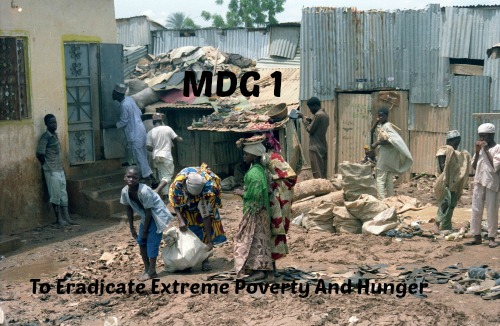 As you know we are a global group of mothers, and we care so much for the children of our world and their future. Our children will inherit what we leave behind, so after participating in the United Nations Momentum 1,000 event to mark 1,000 days until the Millennium Development Goal deadline, we decided that we did not want to stop there.
Last month World Moms blog launched an 8 month Millennium Development Goal campaign to continue to raise awareness around each of the 8 Millennium Development Goals known as the MDG’s.

In 2000, 189 nations made a promise to free people from extreme poverty and multiple deprivations. This pledge turned into the eight Millennium Development Goals, and was written as the Millennium Goal Declaration .- United Nations Development Programme
World Moms Blog kicked off the campaign with a twitter party last month that had the voices of change agents chiming in from all over the globe.
Today we spotlight MDG 1 with World Mom Blog editor and contributor Nicole Melancon on ONE.org . You can then join us in the discussion on MDG 1 at our Twitter party tomorrow night at #Moms4MDGs.
MDG 1 is to “Eradicate Extreme Poverty and Hunger” which is why we so fittingly partnered to share this message with ONE.org, who invites us all to “Join The Fight Against Extreme Poverty”.
The good news about MDG 1 is that the goal has already been met by halving extreme poverty since 1990. The bad news is that according to the most recent MDG Progress report there are still over a billion people in the world living on less than 1.25 dollars a day.
According to the World Bank “The international line of $1.25 a day is the average of the national poverty lines in the poorest 10-20 countries.the average”. Which means there is still a great deal of work to be done.
The second component of MDG 1 is to eradicate Hunger; and according to that same United Nations report 1 in 8 children still go to bed hungry every night; and 1 in 4 of those children facing malnutrition will be stunted in their growth and potential. Our goal with this campaign is to continue to raise awareness and use our collective voices as the mothers of the world to inspire change. Join us at the twitter party tomorrow night, check out Nicole’s blog post today on ONE.org, and help us keep the momentum going to reach the goals.

Join us on twitter tomorrow and head on over to read World Mom, Nicole Melancon’s, post at One.org! (The link to ONE is now live!)
This is an original post to World Moms Blog by World Voice Editor, Elizabeth Atalay of “Documama.”
Photo credits to the author.

Elizabeth Atalay is a Digital Media Producer, Managing Editor at World Moms Network, and a Social Media Manager. She was a 2015 United Nations Foundation Social Good Fellow, and traveled to Ethiopia as an International Reporting Project New Media Fellow to report on newborn health in 2014. On her personal blog, Documama.org, she uses digital media as a new medium for her background as a documentarian. After having worked on Feature Films and Television series for FOX, NBC, MGM, Columbia Pictures, Warner Brothers, 20th Century Fox, and Castle Rock Pictures, she studied documentary filmmaking and anthropology earning a Masters degree in Media Studies from The New School in New York. Since becoming a Digital Media Producer she has worked on social media campaigns for non-profits such as Save The Children, WaterAid, ONE.org, UNICEF, United Nations Foundation, Edesia, World Pulse, American Heart Association, and The Gates Foundation. Her writing has also been featured on ONE.org, Johnson & Johnson’s BabyCenter.com, EnoughProject.org, GaviAlliance.org, and Worldmomsnetwork.com. Elizabeth has traveled to 70 countries around the world, most recently to Haiti with Artisan Business Network to visit artisans in partnership with Macy’s Heart of Haiti line, which provides sustainable income to Haitian artisans. Elizabeth lives in New England with her husband and four children.
More Posts
by Susie Newday (Israel) | Jul 31, 2013 | 2013, Culture, Eye on Culture, Feminism, Inspirational, Interviews, Israel, Life Lesson, Music, Parenting, Susie Newday, Uncategorized, World Events, World Interviews, World Motherhood
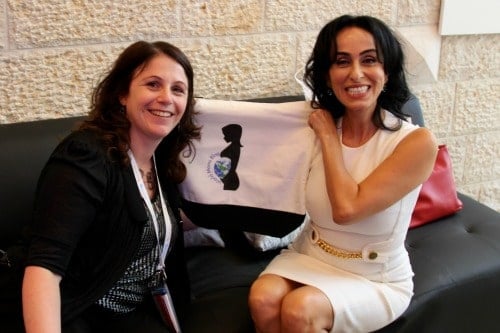
When you’re offered an opportunity to interview the biggest female singing sensation in your country, you jump at it. Last month during the Israeli Presidential Conference I was lucky enough to meet and interview Rita Jahan-Foruz a singer known simply as Rita.
Rita was born in Tehran, Iran and emigrated to Israel at the age of 8. Through hard work and lots of talent she became Israel’s most successful singing artist. For the last 25 years Rita has had an illustrious career both in Israel and abroad. Her latest album “My Joys” is entirely in her native language of Pharsi. That album has become a big seller on the black market in Iran where it is forbidden, along with all other Western music. Some say that Rita’s album would go gold in Iran if it wasn’t banned.
I waited in the VIP room for the interview to start, and I sat there becoming increasingly more nervous as I watched other people interview Rita and a host of other interesting people who were speaking at the conference. I did chuckle a bit to myself when Weili Dai, a top female entrepreneur and the CEO of Marvell (herself an amazing, friendly and gifted woman), came over to have her picture taken with Rita. It wasn’t the photo op that made me chuckle, it was the fact that right before the photo was snapped both of them fluffed their hair. It seems to be a universal quirk all women around the world have before being photographed. I was also quite in admiration how both of them managed to be on their feet all day in their beautiful but really high heels.
Okay, shallowness now aside.
Right before our interview started, a young man who was a waiter at the event came over, sat down on the couch next to Rita and started talking to her. It was spontaneous on his part and graciously received on her part. It was only after I had tweeted a picture of them talking and commented on how friendly Rita was that someone tweeted me back saying that the waiter is connected to an organization called OneFamily (a non-profit organization that rehabilitates, reintegrates and rebuilds the lives of Israel’s thousands of victims of terror attacks) which is a cause dear to Rita’s heart.
When it was my turn I came over, said hello and introduced myself. I sat down trying to look put together, which I can tell you is not an easy task when you are lugging a knapsack, a telephone, a tape recorder, notebook and ipad.
Before I even started asking questions, I gave Rita a World Moms Blog tote bag that Jennifer Burden, the founder of World Moms Blog, had sent me to gift to her. Rita loved it, and right away started putting all her things into it.
I then handed her a little gift from myself, a keychain that said in Hebrew “Music is the language of angels.” She loved that too, and you could see that her reaction was genuine and not just polite. She right away pulled out her keyring from her bag. It had lots of keys and other keychains, including one with a picture of her daughters and she clipped my gift right on. She even proudly showed it off to others.
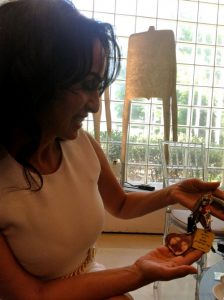
As I was about to start asking her questions, I blurted out, “I’m a bit nervous.” She looked at me in surprise and said, “Nervous? Really? Why?” as if the concept was completely foreign to her that someone would even be nervous speaking to her. That put me completely at ease, and the interview, or should I say more of a conversation, started. When I watched some of her videos later I was able to once again see her natural friendliness and charm shine through. This video of Rita recording one of her songs in Pharsi is a good example of her being down to earth and approachable.
I offered to do the interview in English or Hebrew, but Rita wanted to practice her English so we started off in English but moved back and forth. I could tell how passionate she was about certain subjects (which was often) because that was when she moved back into Hebrew in order to be able to express herself so much more freely.
Susie: World Moms Blog represents mothers from around the world. Right now we represent 20 countries including Morocco, Saudi Arabia, UAE, Egypt and many others. We write about motherhood, culture, social good, about connecting people through what they have in common.
Rita: Wow. Do you have a writer from Iran?
S: No, but if you know someone, we would love to have them on board.
I think that what you’re trying to do with music is what we at World Moms Blog are trying to do through writing, which is to bring the world together one person at a time. (Rita nodded her head at that.)
Do you see yourself as an ambassador of peace between all countries or just between Israel and Iran?
R: I think with my own existence I represent the Iranian and Israeli connection but I would love to represent as much as I can. I think that as women we have a unique way of connecting.
The male and female species are in essence two opposites. You need them both in the world, like Ying and Yang, day and night. It’s a little bit like our reproductive organs. The male behavior, like the male anatomy is surging forward, conquering, moving on with energy that is outward facing.
A woman’s energy is like our wombs. It’s meant to contain/include* and to embrace what there is no matter what. We first embrace and bring things close. We need to be able to see the strength in this, we need to influence and to realize that the place of “containing/including*” others is our strength.
It’s like a a mother who is always the center of the house. Everyone in the family comes and goes, they go a bit nuts. They cry but in the end they always come back to the middle, to the center and the nature of women is the center.
We are mothers and what happens to our children, and to the world they will inherit is important to us. We have to use our natural strengths of connecting to make sure we do what is best for them.
(*There is no great English translation for the word Rita used. The closest I got was contain but it is somewhere between contain and include with maybe a little bit of absorb.)
S: What would you suggest to women to do in order to empower themselves?
R: Not everyone can sing or dance or act or write books, but I think that each and every one of us can influence by connecting. One person connects with another and they connect with someone else from someplace place and so on. We all have to try to connect to others.
(Note: Rita is not only the best selling Israeli singer of all time, she also dances, acts and has published a children’s book. She received The Israeli Academy Award for Best Actress in 1989 for her role in The Thousand Wives of Naftali Siman-Tov, as well as the 2011 Best Actress award at the San Francisco International festival of Short Films for Ben returns Home. Her children’s book “The Girl With A Brave Heart” has been translated into English from Hebrew.)
S: That is something really close to my heart. That’s how I got to blogging, by connecting with other mothers though a forum overseas, getting to know them and having them get to know me. We were all from different cultures but we were all mothers.
One of the things which touched me was listening to you talk about how you got the love of music from your home and that your parents were very supportive of you.
R: They were supportive in their love. They didn’t understand what I was doing, going from class to class, learning acting, dancing and taking voice lessons. They didn’t understand anything about that.
S: But what I’m hearing from you is that they didn’t criticize either?
R: No they didn’t.
S: You have two daughters ages 12 and 21, right? Do you think parent/child relationships today are different then they were when you were growing up?
R: Of course. Of course. I think that back then children were not so important in what they said. They were children. Nowadays, we don’t look at children as children. They are much more important than us. We listen to them more, we are more attentive and sensitive to them. I don’t think it was like that back when I was growing up. Kids were kids. You ate and grew. No?
S: I don’t know. What I see is that kids these days are less connected to their parents than we were, at least on a daily basis. They have a lot more outlets than we had.
R: The world is changing. In this age of the television and computers, the “outside” world has more influence whereas once the “inside” world, the inner circle, had more influence.
I think that these days we give our kids so much love that maybe we spoil them too much. We are more protective of them than anyone was of us. Right?
S: I think that these days we have more to protect our children from.
R: Yes, you’re right.
S: Has fame affected your family relationship and your relationship with your daughters?
R: Of course.
S: In what ways?
R: I’m not talking about fame because fame didn’t affect anything. I am talking about not having the privacy to go for instance with my daughter to the beach. People constantly come and want to take pictures with you and you can’t possibly have privacy with your family and children outside of the house. Of course it’s something that affects you.
S: What do your children have to say about it?
R: I think they don’t like it. They are much more sensitive to people passing by and looking at them or photographing them. They are very sensitive to that.
S: Do you think your children feel any advantages of your fame?
R: Of course. They come to the concerts. They have a different type of life. Once, my daughter Meshi came home laughing at a question that someone had asked her. “What is it like to be Rita’s daughter?” She said I don’t know, I haven’t experienced anything else.
S: It sounds like she has a great sense of humor.
R: Yes, she’s amazing.
S: What is your wish for world mothers?
R: I wish for all us mothers to have the power, strength and wisdom to protect our children until they themselves have the ability to protect themselves.
I think that the most painful thing in the world is knowing that children are raped or abused and that we are not really able to protect them. That is what I am most sensitive to, knowing that somewhere out there, there is a child that is helpless and there is no one to protect him.
S: Sadly, things like that happen even to children who have people looking out for them.
R: It’s even worse when the people who are supposed to be protecting the children are the ones who do terrible things and do them harm.
S: Do you have one particular defining moment that you remember as a child?
R: Yes, yes. In Iran, my mother had a hair salon in the house. All kinds of women used to come to her. Once, a women who was almost completely bald came. All she had was wisps of hair. My mother shampooed her hair and while she was doing her hair she kept telling her you’re so beautiful, look how beautiful you are, you’re so wonderful.
I was 6, and my sister who is four years older than me was 10. My mother was working in our bedroom like she always did because that was also her work room. When the woman left, my sister said to my mother, why are you such a liar? How could you tell her she was beautiful? She was bald, she almost didn’t have any hair.
My mother then asked my sister, why do you think I was lying? My sister said, you told her how beautiful she was, what beautiful eyes she has, but she was bald. My mother then gently asked my sister, but did you look at her eyes? Her eyes were very beautiful.
And that’s the lesson I quietly learned there.
S: It seems to me that that is exactly what your book teaches, to look past the outer and see the beauty and kindness that is in each person.
R: That’s what I learned my whole life from my mother. When she looks at someone, first and foremost she looks for what’s beautiful in the person. That’s the way she sees people. That was a very big life lesson for me.
Every time I tell this story I still have goosebumps.
S: I find it amazing that I didn’t even know about your book until one of the other World Mom Bloggers told me that you had written one and it had been translated to English.
R: The book is gaining incredible momentum.
S: It should. It’s a great book with a great message and great illustrations.
(Note: The book is called The Girl With a Brave Heart. I read it in Hebrew and I love the many messages in it including the fact that people don’t always know how to ask for what they need and that we should let our hearts lead the way.)
Of course that’s when I pulled out the two copies of her book that I bought along for her to sign. I handed her a pen but she searched her bag because she has a special marker for signing books.
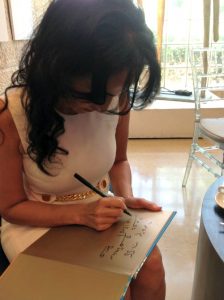
There is something so nice about talking to someone who is famous, who has performed for world leaders, who has bought so much joy to others through her music, yet still makes you feel no less important than she is. Maybe one day I will get to speak to her again because I really enjoyed our conversation.
I really hope Rita has unparalleled success in bringing people and countries together through her music. My wish for her is that one day she will get to perform in her native country of Iran, something that will mean that peace and acceptance has finally come to our world.
Before Rita’s performance at the UN’s main assembly hall, secretary-general Ban Ki Moon told Rita that many revolutions started from music and that it’s a place that politicians can never enter.
What do you think? Do you think music and musicians can help bring about change and be a conduit for peace?
This has been an original post to World Moms Blog by Susie Newday of Israel. You can find her positive thoughts on her blog, New Day New Lesson.
Photo credit to the author.
Susie Newday is a happily-married American-born Israeli mother of five. She is an oncology nurse, blogger and avid amateur photographer.
Most importantly, Susie is a happily married mother of five amazing kids from age 8-24 and soon to be a mother in law. (Which also makes her a chef, maid, tutor, chauffeur, launderer...) Susie's blog, New Day, New Lesson, is her attempt to help others and herself view the lessons life hands all of us in a positive light. She will also be the first to admit that blogging is great free therapy as well. Susie's hope for the world? Increasing kindness, tolerance and love.
You can also follow her Facebook page New Day, New Lesson where she posts her unique photos with quotes as well as gift ideas.
More Posts - Website
Follow Me:


by Shaula Bellour (Indonesia) | Jul 18, 2013 | Childhood, Communication, Family, Grandparent, Indonesia, Relationships, Shaula Bellour, Twins, Uncategorized, USA
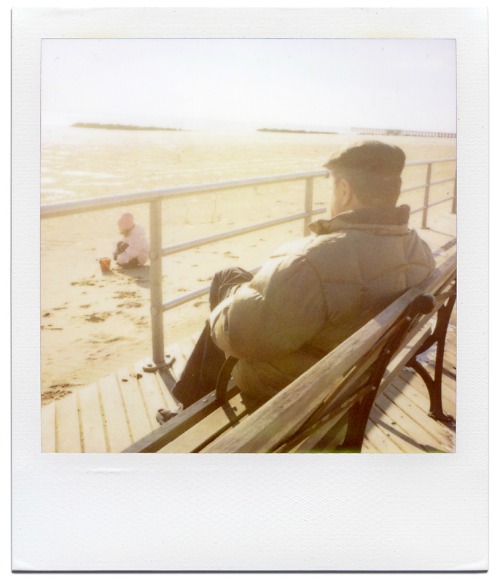 Out of the blue, my daughter recently asked “Mommy, who is your Daddy?” “My Daddy is Grandpa”, I said. “Do you remember him? We visited him in the desert.” “No, Mommy. Can we go to the desert again, so I can remember him?”
This breaks my heart.
Growing up, I always had a close relationship with my Dad. We are kindred spirits in many ways, and he has had a big influence on the shape of my life.
When I was 14, my parents separated, and my Dad moved to San Francisco. I loved visiting him there and experiencing the world beyond my suburban life – touring the city together while he listened, offered perspective and treated me like the adult I was becoming. After my friend backed out of our planned graduation trip to France – my first overseas experience – my Dad encouraged me to go by myself. Buoyed by his confidence, I took the leap…and thus began my traveling life.
Over the years he expressed only enthusiasm for my far-flung travel plans and showed up to philosophize over wine in Paris and fresh roasted coffee in Eritrea. Between adventures (and sometimes jobs), his home was a welcoming safe haven.
I always thought my Dad would make a wonderful grandfather. He is a gifted storyteller, seems to know everything about everything and even has a Santa Claus look about him – white hair, smiling eyes and a jovial laugh.
However, until now he has played a very hands-off role in my children’s lives.
In the years after the twins were born, we visited each other a handful of times. As a new mom, I had less time for keeping in touch – and my adventure tales were decidedly less riveting – but he was still just a phone call away, and I often took advantage of my rare alone time (usually while walking the dog) to give him a ring.
After moving to Asia 3 years ago, communication has dwindled. These days we might get an occasional email, but there are no skype chats, phone calls, letters, or birthday presents to unwrap. When you live far away from family, these are the things that keep us close – the quick IM exchanges, silly video chats, emailed notes and drawings, and slightly dented packages with exciting postmarks.
Luckily, my Mom and my British in-laws make a great deal of effort to keep in touch and up to date on our daily lives, which I am so grateful for. Our kids know, love and miss them and it’s a joy to watch their relationships grow and thrive despite the miles between us.
Three out of four grandparents isn’t bad, yet, I still feel disappointed by the Grandpa gap in our lives.
Everyone is missing out ,and I feel sad that my fantastic kids don’t know my equally fantastic Dad and that he doesn’t know them. Ultimately, though, their grandfather-grandchild relationship belongs to them. I can encourage this special bond, but I can’t create their connection or force them to know and love one another.
I also feel disappointed in my Dad’s hands-off role in my own life since having kids. Just because I am now a parent doesn’t mean that I don’t still need my own parent. Though I’m now living in the big wide world that he encouraged me to explore, all of the same advice applies. And sometimes I still need it.
In a few weeks we will drive our little family to the desert to visit my Dad for the first time in 2 years.
My hope is that my Dad and my children will have time to get to know each other and create some special memories during our short visit. For myself, I hope to reconnect with an open heart and commit to communicating better going forward.
Life is simply too short.
How do you maintain relationships with family when living far away? Has your relationship with your parents changed since you became a parent?
This is an original post to World Moms Blog by Shaula Bellour in Jakarta, Indonesia. Her blog, Notes From a Small World, is currently on hiatus but she promises to return to blogging soon.
Photo credit to Kihoon Park. This photo has a creative commons attribution license.
Shaula Bellour grew up in Redmond, Washington. She now lives in Jakarta, Indonesia with her British husband and 9-year old boy/girl twins. She has degrees in International Relations and Gender and Development and works as a consultant for the UN and non-governmental organizations.
Shaula has lived and worked in the US, France, England, Kenya, Eritrea, Kosovo, Lebanon and Timor-Leste. She began writing for World Moms Network in 2010. She plans to eventually find her way back to the Pacific Northwest one day, but until then she’s enjoying living in the big wide world with her family.
More Posts


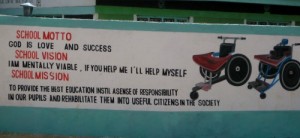 In the US, people with physical disabilities focus on fighting stigma, on being viewed as people who can do almost anything despite of their physical limitations, and on fighting for the world to make appropriate accommodations in order to even the playing field.