by Nihad | Sep 29, 2016 | 2016, Africa, Africa and Middle East, Education, Egypt, Middle East, School, World Motherhood

One of the most challenging decisions faced by families in my country is choosing a career path and a college for their child. The journey starts during the second year of high school, when students choose between a scientific or literary curriculum. Later, in their final year, pupils who chose the scientific section must choose between mathematics-focused or biology-focused studies. Both children and parents struggle for support during this journey – and none is given. Most importantly, children’s strengths are rarely assessed or taken into account when considering the different choices. But do we as parents have the right to choose our children’s career path?
Many factors and beliefs affect this choice. Some career paths are more prestigious than others. Some colleges are suitable for males but not females, and vice versa. Graduates of some colleges get hired immediately after graduation while others are less likely to find jobs quickly. Some families believe that children must follow their parents’ career path of their parents, or realize their parents’ own dreams. Most importantly, if the child does not get high enough scores they will not be accepted to their college of choice.
I admit that at this young age, most children are not mature enough to make such choices on their own. Even if they are interested in a certain field, most children are still unable to assess their own strengths and capabilities as they relate to the real world. As a result, many students simply comply with their parents wishes.
During a school seminar I once conducted, I met a girl whose mother forced her to select the literary course because she believed that scientific studies required too much work. The girl loved science, but her mother discouraged her from following her passion. By the end of the year, the girl was miserable and the mother regretted her decision. Another student’s father wanted her to join the pharmacy college, although the girl wanted to study arts. Many students shared their stories, lamenting that their parents were forcing them to join specific career paths.
I remember my own experience many years ago when I graduated from high school and wanted to join the faculty of engineering to study computer science, because I loved mathematics. My father wanted me to go to the faculty of commerce because he, himself, was a banker. I, however, insisted, and made my own choice. By the end of my third year of college I knew this course of study was not for me, but unfortunately I couldn’t make a change. I did not know what else to do and no one would allow me to follow a different course. On the other hand, I never regretted because the choice was my own.
Just six years ago I decided to shift my career from software engineering to life coaching. All my colleagues and family were against me. They still consider me foolish to leave a prestigious position for a complete change and an unknown career. I believe in what I am doing, I believe in its power, and what difference it made in my life. Sometimes I wish I had done it earlier.
Choosing a career path that provides fulfillment and satisfaction to our children and suits their capabilities and strengths is the most important choice in their lives. It is true that making a career shift is possible now, but not all people are courageous enough to take such a risk. In addition, why should they waste their time and energy on an inappropriate path while we can help them avoid it? With support from specialists, we can better understand our children’s strengths and preferred way of learning, and we can allow them to try different activities and fields to discover their real passion. Most importantly, we should not impose our own choices on our children. They must make their own decision, with support and guidance from us as parents. With our help, they can learn how to make the best choice for themselves.
Do you have any experiences with helping your children to choose a career path? Are assessment tools used in your country to help the students make the right choice? Would you impose a certain field of study on your child just because you believe it suits them even if they do not like it?
This is an original post for World Moms Network by Nihad from Alexandria, Egypt. Nihad blogs at Aurora Beams Life Coaching.
Image via Stuart Miles, FreeDigitalPhotos.net

Nihad is an Egyptian woman, who was born and has lived her whole life in Alexandria, Egypt. She says, “People who visited this city know how charming and beautiful this city is. Although I love every city in Egypt, Alexandria is the one I love the most.”
She is a software engineer and has worked in the field for more than twenty years. But recently she quit her job, got a coaching certificate and she is now a self employed life and career coach. She says, “I believe that women in this era face big challenges and they are taking huge responsibilities. That's why I have chosen my niche -- women looking for happiness and satisfaction. I help and support them in making whatever change (career change, life change, behavior change, belief change…) they want to bring more satisfaction and happiness in their lives.”
Nihad is a mother of two lovely boys, 15 and 9 years old. She states, “They are the most precious gifts I have ever had. I madly love them, and I consider them the main source of happiness in my life.”
Our inspiring mother in Egypt can also be found at Aurora Beams Life Coaching.
More Posts
by Ibtisam Alwardi | Sep 15, 2016 | 2016, Africa and Middle East, Awareness, Babies, Caring, Domesticity, Gender, Ibtisam Alwardi, Middle East, Motherhood, Oman, Parenting, Post Partum Depression, Pregnancy, Pregnancy, Traditions, World Moms Blog

The moment I saw the title of the book, I knew what the author meant. It was as if it was written for me. Black Milk by Elif Shafak, renowned novelist from Turkey, is a memoir described as ‘a thoughtful and incisive meditation on literature, motherhood, and spiritual well-being.’
Although I enjoy reading, I am not good at writing book reviews. As a lover of books, I can talk about what I read with friends, who, like me, are still amazed by the creativity of authors. I find it easy to talk about my favorite books, and the stories that stick with me, ones that I will never forget. However, writing an objective book review is something I find very challenging. Yet with Black Milk, I believe I owe mothers out there. I owe them sharing what I gleaned from reading this groundbreaking book.
Shafak wrote about herself – but it could have been about me. Me, a mother who experienced postpartum depression; a new mother who felt at a loss, and who thought that she should not feel this way; a woman who stopped doing things for herself and thought that motherhood should be more than enough; a mother who experienced fluctuations in her feelings 100 times a day; a woman who did not really understand what was going on.
Black Milk describes those ups and downs encountered by many new mothers, especially those experiencing anxiety about the huge change they’ve embarked upon – those mothers who overthink things and believe that they should be able to control the world, and not stop and ‘relax’ for a moment and ‘blend’ with the world.
In the book, Shafak has many inner conversations with her ‘Thumbelinas,’ who each represent aspect of herself. These tiny ladies are constantly fighting, trying to overcome one another to be the dominant part of her personality. Shafak is very objective in writing about them, and instead of hating them, you feel the opposite. In writing about the competing characteristics within, she seeks to find some kind of unifying identity for herself.
Shafak writes about western female writers as well, including Sylvia Plath, Virginia Woolf, Simone de Beauvoir, and Alice Walker. She explores their lives, the way they found balance between being writers and mothers, or the way some of them chose one role over the other. In these women’s lives, Shafak seeks balance between her life as an artist, and her new life as a mother.
Being a mother and a writer means seeking some sense of self, besides the role of motherhood. The same applies to any personal career or decision a mother takes. Such a choice was not common in the West until recently, and it is still not acceptable in many eastern societies to this day. Thus this subject, though some might consider it a personal issue, is more of a political one that is affected by patriarchal societies. Elif Shafak does not make judgements, and why should she – this is a subject that has no right or wrong to it. The ability to choose and be respected for whatever choices you make should be totally acceptable.
Shafek’s book touched me, as a mother, a writer, and a woman. I really identified with her struggle, her experience with postpartum depression, and her personal crisis as she adapted to motherhood.
How do you find balance between your own personal well-being and the demands of motherhood? What books have inspired you on your journey?
This is an original post for World Moms Network by Ibtisam Alwardi of Oman.
Photo courtesy of Raúl Hernández González / Flickr.
Ibtisam (at Ibtisam's musings) is an Omani Mom of three, living in the capital city of Oman ,Muscat.
After working for ten years as a speech and language therapist in a public hospital, she finally had the courage to resign and start her own business. She had a dream of owning a place where she can integrate fun, play and 'books', thus the iPlay Smart centre (@iplaysmart) was born.
Currently she is focusing on raising awareness through social media about parenting, childhood, language acquisition. She started raising awareness on (the importance of reading) and (sexual harassment) targeting school-aged children.
Ibtisam enjoys writing, both in Arabic and English, reading and working closely with children.
She plans to write children books (in Arabic) one day.
Contact Ibtisam at ibtisamblogging(at)gmail.com.
More Posts - Website
Follow Me:


by Karen Williams | Sep 8, 2016 | 2016, Africa and Middle East, Expat Life, Family, Middle East, Relationships, UAE, World Moms Network, World Motherhood

Recently, we went back home for a visit due to family circumstances. We hadn’t been home in almost a year, and I was unsure how my 3 year-old daughter would react to our family and friends. After all, she is a completely different toddler from the one who visited Singapore in December.
She has changed immensely in the past six months; on some days she’s more clingy, on others she’s everyone’s best friend and sends flying kisses to all. There are also (many) days when she’s grumpy beyond belief especially when she’s tired. Sometimes she just charms the socks off everyone including her extremely gullible parents. She definitely has a feisty personality and never hesitates to opine that a person is silly, funny or wonderful.
As I packed for the trip, I felt a mounting apprehension about how she would be with the family. At 15 months old, she moved away from Singapore, where she was born. Since then, she has spent more of her life overseas than she has in her home country. Much of her extended family is scattered all over the world, in countries like Australia, New Zealand, America, UK, France and Canada. In fact, as I type this, we are visiting my in-laws who are currently residing in Oman. Our life is truly an expat life.
All these factors left me with many questions about our return. Would she remember her cousins, aunties and uncles? Or would she think of them as strangers? Would they think she was too different from what they knew her as before? What if there was a gulf that time and space had created? Has her expat life separated her from her roots?
To be honest, these are questions that frequently run through my mind. I often wonder whether my daughter will be able to have strong ties to her family. Will she have sufficient permanence in her life? I fret over her emotional stability because we often move every few years for my husband’s job. He grew up as an expat kid too, moving every few years between Singapore and postings to other countries. As he got older, he kept to himself increasingly as the reality of leaving close relationships behind became more evident and painful. While this survival approach to an expat life may be pragmatic, I’m not quite sure if I’d want my daughter to do the same, either with friends or family.
So the questions remain – how do we maintain close relationships despite the differences in time and space; how can I help her to keep that bridge open? And I know that a huge part of this responsibility belongs to me, particularly because she’s so young right now and I need to help her establish a lasting basis for these relationships.
And what I learned during our trip?
That this is a pertinent issue that requires greater deliberation, and which we need to keep talking about because it is one of the biggest challenges of being an expat family.
However, it also became clear to me that it’s not going to be as tough as I thought. Firstly, I’ve noticed that my daughter seems to have an innate connection to her family, and she possesses a desire to know more about everyone. She constantly asks questions about them, and remembers their encounters, especially when we look at photographs together or when we come across a gift that someone has given her.
And very importantly, our families make such an effort to connect with her. They constantly engage with her, and treat her not as a child, but as a little person with her own personality. In the short time we were home, I feel that she has built a strong relationship with many of our family. Naturally, they have left very deep impressions on my young child, and she must feel that they are important because she keeps talking about them. So half the battle is already won. Now we just have to keep on building on those strong foundations.
Do you lead an expat life? If so, how do you ensure that your family relationships remain strong?
This is an original post to World Moms Network by Karen in Abu Dhabi, United Arab Emirates.
Photo credit to the author.
Karen is a Singaporean with an 8 year-old daughter who’s a little fire-cracker version of herself. She’s spent the last 15 years in her various roles of supportive trailing spouse, mother, home-maker and educator. Having experienced six international moves alternating between overseas postings and her home country of Singapore, Karen considers herself a lover of diverse foods and culture, and reckons she qualifies as a semi-professional packer. She is deeply interested in intercultural and third-culture issues, and has grown immensely from her interactions with other World Mums.
Karen is currently living in Brunei with her family.
More Posts
by Maryanne W. Waweru | Sep 1, 2016 | 2016, Africa, Africa and Middle East, Babies, Being Considerate, Culture, Kenya, Marriage, Pregnancy, Relationships, World Motherhood

There’s a reality that’s been gnawing at me for a long time. I’m talking about the pressures that face women – unwanted pressures from society.
As soon as you hit the age of 25, people start asking, “When will you get married?” After your wedding they will ask, “When is ‘our’ firstborn arriving?” If your firstborn child is a baby girl, they will ask, “So when are you giving ‘us’ a boy?” And if your firstborn is a boy, they will ask you, “When are you giving ‘us’ a second child?” Even if you are lucky enough to give them all of that, they will demand a third, fourth and fifth child, because you must give them a namesake. In my African culture, we name our children after our relatives. It is a great honor to have a child named after you. Therefore, every relative will constantly put pressure on you to have more children so that you can give them a namesake.
In my country, there is a certain celebrity news anchor who recently married an equally famous gospel musician. The wedding was in December of last year, just eight short months ago. Since then, the public has been DEMANDING that the lovely couple give them a child. The public reacted horribly when the woman recently shared an old photo of herself on social media. It was a throwback photo of herself as a teenager in high school, reminiscing of the good times she had in her youth. The photo somehow made it to a popular online entertainment and gossip site, and the comments that followed the post were shocking.
“Stop showing us photos of your past, we want to see photos of you pregnant!” the commentators yelled.
“So now you are showing us photos of when you were a girl? Why not of now? Are you trying to hide something? Are you barren?” another asked.
“Give your husband a child now otherwise he will go looking elsewhere,” another said.
“If you’re having problems getting pregnant, inbox me. I’ll sort you out,” another offered.
Hundreds of comments followed, all of a similar nature.
It made me sad. Why does society put so much pressure on people? On couples? On women? What if the couple is not able to have a child? Or if they have been trying, unsuccessfully? What if they have suffered pregnancy loss – something they may not want to openly talk about? Or if they do not even want a child in the first place? Is it the public’s business? Society’s business? Their relatives’ business? Or is it between the husband and wife?
Seriously, as women, we have a lot to deal with, and we do not need societal pressure adding to our nightmares. Unfortunately, that is exactly what we face. In a society where a woman’s worth is valued by her reproductive prowess, it is indeed sad. In my culture, a woman may have achieved many notable feats and broken the glass ceilings over her head, but if she is not married (or, even worse, does not have a child), then she may just be nothing. Society will be harsh on her. That is, if they even recognize her.
But you know what else is interesting? Who is this society that we are talking about? Who are these people?
It is you and me. Us. We are the society. We are the same people who, when we meet a friend who got married over a year ago, will, while shaking her hand, be staring at her belly, trying to catch a glimpse of how swollen it is. Or whether it is swollen at all. Sometimes we do it consciously, sometimes we don’t even notice we are doing it. It just comes naturally. And then we talk with our other girlfriends saying “Lucy is not getting any younger, I wonder when she’s planning to start having babies.” That’s the pressure I’m talking about.
We all need to be a lot more sensitive to what fellow women go through. I hope you and I can make the difference.
This is an original post for World Moms Network by Maryanne W. Waweru of Mummy Tales in Kenya.
Photo courtesy of Frank Douwes / Flickr.
Maryanne W. Waweru, a mother of two boys, writes for a living. She lives in Nairobi, Kenya with her family. Maryanne, a Christian who is passionate about telling stories, hopes blogging will be a good way for her to engage in her foremost passion as she spreads the message of hope and faith through her own experiences and those of other women, children, mums and dads. She can be found at Mummy Tales.
More Posts - Website

by Kirsten Doyle (Canada) | Aug 25, 2016 | Culture, Expat Life, Global Citizenship, Identity, International, Living Abroad, Relocating, South Africa, The Americas, Travel, World Motherhood
 In 2000, I packed my life into checked baggage and travelled from Johannesburg to Toronto. I left behind my family and friends, my cat, most of my belongings, and everything that I was familiar with. All I had was two suitcases, a job offer, and a street map of a city I knew very little about.
Sixteen years later, Toronto is my home. I am a Canadian citizen with a Canadian husband and Canadian children.
I have made friends, paid taxes and acquired some belongings. I have worked for Canadian employers and started my own business. When I travel, it is with a passport that says “Canada” on the front.
And yet there is a part of me that is still firmly rooted in South Africa. I follow news stories from South Africa and celebrate the victories of its people. I take immense pride in the fact that I was born in the same country as people like Nelson Mandela and Caster Semenya.
You see, even though I made the choice to leave South Africa, and even though I now identify as a Canadian, South  Africa will always be the land of my birth and a part of who I am. Although my children have never left the continent of North America, African blood runs through their veins.
When the world looks at South Africa, it sees a deeply troubled country with corrupt politics and a high crime rate. But South Africa is made up of more than its problems. It is unlikely to ever be an economic or political powerhouse on the world stage, but it is great in its own way.
I try to keep these things alive in my children’s lives through stories, pictures and videos. Thanks to the Internet, I can bring parts of South Africa right into my living room in Canada. It is my hope that someday they will get to experience these things in person, just as I did during a visit last year.
 Here is my top five list of things that I feel make South Africa a unique and wonderful country.
- The people. When you see news coverage of South Africans trashing city streets and destroying schools, you are seeing the minority. Most South Africans are very nice people. Their friendliness has a spontaneous quality that is not seen in a lot of other places. They don’t hold back on their smiles, and when they say “Have a nice day” they genuinely mean it. South African people are incredibly generous with their good cheer.
- The natural beauty. South Africa is one of the most stunningly beautiful places on earth. Pictures do not do justice to the wildness of the oceans, the harsh beauty of the Karoo desert, the brilliance of Cape Town sunsets, and the majesty of the mountains.
- The weather. OK, Cape Town weather is a little iffy, but you can’t really expect anything else from a city that has mountains on one side and ocean on the other. The weather in Johannesburg, however, is as close to perfect as you can get. Hot dry temperatures in the summer, and mild temperatures in the winter. The summers also include magnificent thunderstorms. I’m not talking about the odd bolt of lightning or rumble of thunder. I’m talking about nature’s own sound and light shows.
- Unity. At times, South Africa is sharply divided along racial lines, with the different ethnic groups all blaming each other for the problems in the country. But during some pivotal moments in South Africa’s history – the release of Nelson Mandela from prison, South Africa’s first democratic election, the rugby World Cup victory and more – the people have come together under the single banner of humanity. It is the kind of unity that is not only seen in pictures, it is felt in the heart. It is during those moments that the country is at its strongest.
- Dance and music. I absolutely love traditional African dance and music. It does not merely entertain, it tells a story. It is powerful and creative, and it beats to the rhythm of your heart. I can’t copy the dance moves or sing along to the music, but I can bask in the emotion and humanity of it.
 What are the things you love most about your country? If you are an ex-pat, what do you miss most from home?
This is an original post to World Moms Network by Kirsten Doyle of Toronto, Canada.

Kirsten Doyle was born in South Africa. After completing university, she drifted for a while and finally washed up in Canada in 2000. She is Mom to two boys who have reached the stage of eating everything in sight (but still remaining skinny).
Kirsten was a computer programmer for a while before migrating into I.T. project management. Eventually she tossed in the corporate life entirely in order to be a self-employed writer and editor. She is now living her best life writing about mental health and addictions, and posting videos to two YouTube channels.
When Kirsten is not wrestling with her kids or writing up a storm, she can be seen on Toronto's streets putting many miles onto her running shoes. Every year, she runs a half-marathon to benefit children with autism, inspired by her older son who lives life on the autism spectrum.
Final piece of information: Kirsten is lucky enough to be married to the funniest guy in the world.
Connect with her on Facebook, Twitter and Instagram.
Be sure to check out her YouTube channels at My Gen X Life and Word Salad With Coffee!
More Posts
Follow Me:


by Aisha Yesufu | Aug 18, 2016 | 2016, Advice, Africa, Africa and Middle East, Family, Humor, Husband, Marriage, Nigeria, Relationships, World Motherhood
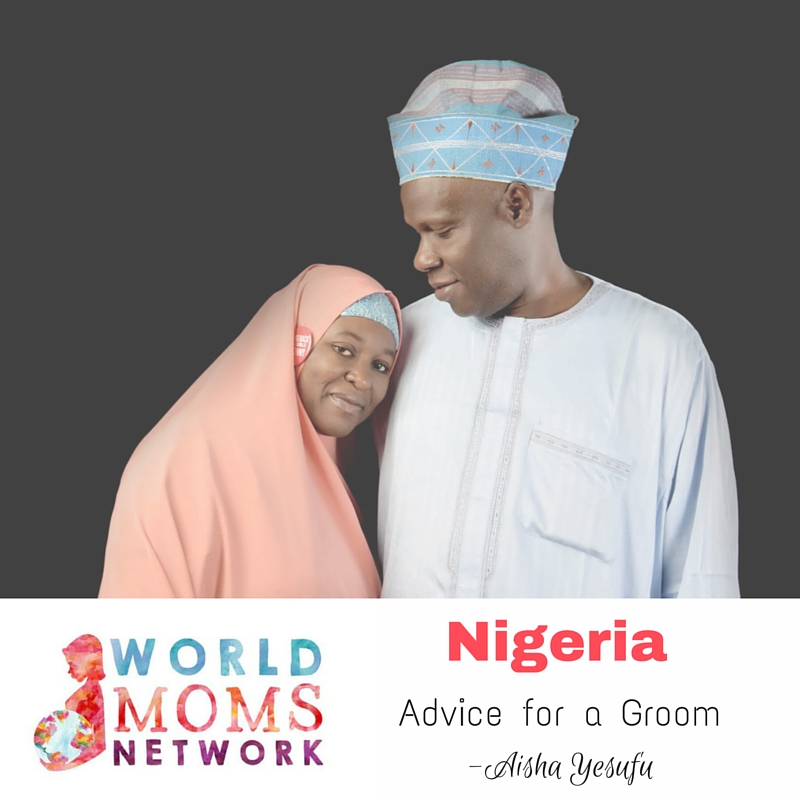
I recently attended a wedding and observed one of our local customs that gave me pause. In a Nigerian wedding, there it is tradition for elders to offer marital advice to the new couple during the ceremony. Interestingly, in most cases, all the advice is directed to the bride. Is this because people believe that a man is hardwired with knowledge of how to make marriage work? Or because they feel there is no reason for a man to know anything about making marriage work? Or is it simply because most of the wedding attendees who give advice happen to be women? I watched as speaker after speaker gave the couple advice, consistently directed only to the bride.
Since the groom at this particular wedding received no advice, I thought I would offer some, just for grooms.
- Don’t be afraid to say I AM SORRY. Your wife may forgive easily, but this is no reason to keep offending her deliberately. Apologies should be sincere, and you should never apologize just for the sake of it.
- Make your wife feel important. Treat her like she matters, and be considerate of her feelings. Respect begets respect. My husband once said to me, “We are not just spouses we are friends.” Be sure to build a strong friendship with your spouse.
- Make family decisions together. Communication is key in every marriage! Don’t try to shield your wife from troubling situations. Instead, let her know what is going on whether with work, and let her share your burden.
- Be grateful. Appreciate your wife for all that she does, and never ever take her for granted. Always recognize her for her contribution to the family, work and household.
For marriage to work beautifully, I believe that BOTH parties must make a conscious effort. Most of all, the couple must set goals together, and review them regularly.
What advice would you give to a groom? Is it the same advice you would give to a bride? What are the wedding customs where you live?
This is an original post written for World Moms Blog by Aisha Yesufu in Nigeria.
Photo credit to the author.