There are some causes that are tricky to rally people around: not everyone wants to ban fur coats, for instance; not everyone thinks that restaurants should post calorie counts on their menus. There are other causes, though, that seem pretty much no-brainers: access to clean water, for instance. Is anyone really going to say “yeah, dirty water, I’m a big fan!” Or saving children. Is anyone really going to say (publicly, anyway) that it’s not a good idea to save children?
Even if we all agree that children should be saved, however, we know that all over the world there are children who need saving, in places where governments and infrastructure don’t seem capable of doing what needs to be done. That’s where organizations like Save the Children step in: they help stitch together the services that can help families survive and give governments a much needed hand.
Save the Children came out with its annual “State of the World’s Mothers” list, which uses five metrics to determine where it’s good to be a mother (and a child). The metrics – maternal health, children’s well-being, educational status (of mothers), economic status, and political status— are combined to give an overall score, which determines where a country falls on the list. Of 179 countries, there are the usual suspects at the bottom of the list—countries where war, natural disasters, and poverty combine in a perfect storm of catastrophe: places like Haiti, or Sudan, or Pakistan.
But there are surprises, too, like the fact that the United States doesn’t even crack the top twenty. Nope, the good ol’ US of A pulls in at 33.
Thirty-third in the world, for a country whose overall wealth and education trumps pretty much everywhere else. The US was beaten by, among others, Slovenia, Belarus, Croatia, and the Czech Republic, as well as all those Scandinavian countries that consistently outperform everyone else when it comes to quality of life issues.
You know what most of these places have that the US does not? A significantly higher percentage of women in government. I suppose a statistician would say that fact is not causal but correlative, and I’m sure that some people would insist that just having women in government won’t automatically make things better for women and children (and thus society), but maybe we should try, and then see what happens?
I live at the moment in Abu Dhabi, in the United Arab Emirates, another wealthy country that doesn’t crack the top twenty on this list. I suppose that for many Westerners, it might seem impossible any Middle Eastern country would score well on a list having to do with women’s lives, but the statistics on this list might help defuse those stereotypes. According to this index, 17.5% of seats in UAE government organizations are held by women, compared to 19.5% in the US; in terms of lifetime risk of maternal death, it is better to be a woman in the UAE: 1 in 5800 versus 1 in 1800 in the US. Women in the US average about 16 years of schooling, women in the UAE about 13; and women in the US tend to be wealthier than women in the UAE (53K for the US, 38K for the UAE).
The Save the Children list doesn’t index maternity leave policy, but that offers another interesting point of comparison.
Women in the UAE only receive 45 days of maternity leave, which isn’t enough, obviously, as any woman who has given birth understands. Women in the US get twelve weeks of maternity leave (although I had to call it “disability” leave in order to ensure that I got the requisite number of days). Twelve weeks, that is, of unpaid leave. John Oliver brilliantly skewered this policy on Mother’s Day, pointing out that the United States aligns with Papua, New Guinea, as the only two countries in the world with no paid parental leave policy. In the UAE, if a woman has a medical certificate that attests to her need for more time at home, she can take up to 100 days of additional (unpaid) leave.
Organizations like Save the Children do invaluable, back-breaking work among desperate populations, but their work raises a question that those of us who live with more privilege should be asking–loudly–of ourselves and our communities: why aren’t we all tied for first place? What has to happen to force “resource-rich” countries take care of its most vulnerable citizens? Why aren’t we doing better?
Where does your country rank in this list? And how do you think your country can do better? Any thoughts?
This is an original post to World Moms Blog by Deborah Quinn in the United Arab Emirates of “Mannahattamamma.”
After twenty-plus years in Manhattan, Deborah Quinn and her family moved to Abu Dhabi (in the United Arab Emirates), where she spends a great deal of time driving her sons back and forth to soccer practice. She writes about travel, politics, feminism, education, and the absurdities of living in a place where temperatures regularly go above 110F.
Deborah can also be found on her blog, Mannahattamamma.
This week our Senior Editor of World Voice Column, Elizabeth Atalay, interviewed our Senior Editor of Africa and Middle East Region, Purnima Ramakrishnan, about Heartfulness Meditation in relation to the International Day of Yoga.
Elizabeth Atalay: What is Heartfulness Meditation?
Purnima Ramakrishnan: Heartfulness is to feel the already existing deep inner connection of the human being with the heart. It means to experience every single aspect of life in a natural way of the heart. It means to live life in the best way possible.
EA: Why Heartfulness?
PR: We are all connected with each other only though our hearts. In any relationship, personal or professional, in any decision making process, in any life altering situations, in any thing which ever matters or commences or ceases, it is the heart which matters. We feel in our hearts to do or to be or to exist.
We always listen to our hearts. We need this deep connection with our hearts. That is the core of our existence. That is what matters for us, as human beings, in our lives, to be happy and joyful and to be able to follow our hearts. So Heartfulness is a way to do this with a deeper and more connective consciousness with the heart.
EA: Is Heartfulness a type of meditation?
PR: I personally feel “meditation” is a very over-rated word in today’s world. When you close your eyes and think for some time to make a decision, are you contemplating, are you meditating on that aspect? When you sit down silently, by the mountains and close your eyes and feel the peace all around you, do you call it meditation?
When you hug your baby and feel that beautiful joy of a hug, which you would continue to prolong for as long as your baby lies still, is it meditation or is it just an experiencing of joy/love? That is Heartfulness indeed. That is meditation too, if you call it that way. We are meditating every single day, every minute on something or the other. Our hearts are always “working” on something, at times even on stillness.
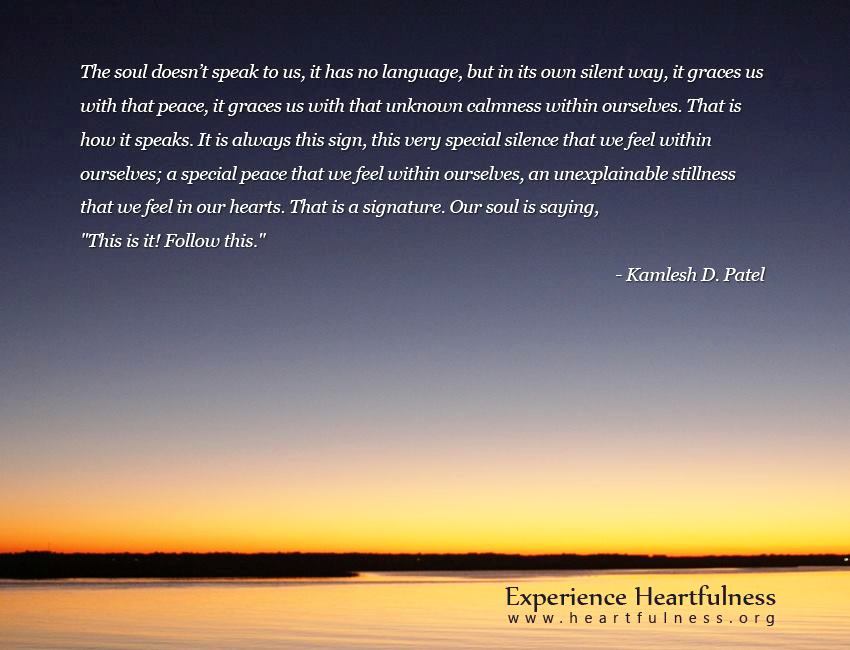
www.Heartfulness.org
EA: So do you practice this Heartfulness meditation? If yes, how?
PR: I sit down, close my eyes, and suggest connecting to my heart. I am aware of my heart. Sometimes a few mundane thoughts come along the way – everyday thoughts about everyday life situations. But I still continue with my connection, I continue to feel the brightness in my heart, the stillness in my heart. I feel the joy and peace there, I try to tap into it. And it feels good.
EA: As a #WorldMom of World Moms Blog, how do you think this is useful for mothers?
PR: As a #WorldMom, I say, we mothers are the care-takers of this world, care takers of our babies, children and of our families, which make the structure of the society. It helps mothers stay balanced, stay happy, spread the joy in the family. Personally, it helps me be more connected and intuitive to my child’s needs and well-balanced in my mind for my own personal happiness and development.
EA: Is this something which everyone can participate irrespective of their religious and social/national constructs?
PR: Can everyone (irrespective of their beliefs) go to the doctor when they are unwell? Of course! Taking care of one’s body is a primary duty.
But very often we ignore the cry of help from our own hearts and minds. And to meditate everyday, to feed the soul, to take care of the soul, to enrich the heart, is a duty.
Once I started doing it, I felt it gave me a lot of strength, joy and well-balanced, holistic, emotional and mental life.
EA: Would you be able to help the World Moms with an experience of this?
PR: Yes, definitely. We could have it over skype if our contributors and readers would like to join or I could also suggest local centers where they can go and experience it.
EA: Lastly, how is this Heartfulness Meditation related to the Intenational Day of Yoga?
PR: Ah! Here comes that aspect, where all this discussion started!
India has always been a hot destination for spiritual seekers. From the time of Paul Brunton, India has always been a mystic place with seekers coming here for spirituality. And recently too, the Prime Minister of India, Honorable Mr. Narendra Modi has been instrumental, in the UN’s declaration of 21st June as the International Day of Yoga. Indians have been yogis always, India has been the house of meditation.
All the yogic postures and breathing exercises are fundamental to train the body to be able to sit in meditation for hours together.
The yogis meditated for centuries together, in the jungles and in Himalayas.
Everything they did is for this final act of being able to meditate effectively. However today, we are easily offered this way of the heart, to be able to meditate effectively, to connect with our hearts, for short moments during the day whenever we feel a need, whenever we feel the want, and to experience the joy. So, yes, yoga evolves into meditation, eventually in an aspirant’s journey.
Everywhere in India on June 21st, (including Rajpath where the Presidential Residence is present) and all across the world, different schools of Yoga and meditation are organizing Yoga demonstrations and meditation sessions.
Here at World Moms Blog, we would like to invite the contributors, readers and fans of World Moms Blog for a meditation session on Heartfulness.
Venue: Here on World Moms Blog
Time: Check in any time on June 21st for a video here on World Moms Blog to guide you through heartfulness meditation with Purnima.
Edited on 21 June, 2015, International Day of Yoga:
There is a video below about Heartfulness Meditation. If you are interested, please try to do this in the following way.
1. Gently close your eyes. Relax your body. Empty your mind.
2. Suppose that the Source of Light in your heart is attracting you from within your heart.
3. Rather than trying to visualize it, simply tune in to your heart and be open to any experience that you may have.
4. Do this for as long as you can. It could be 30 minutes. It could be longer or shorter than that too.
5. If your mind wanders and ‘thinks’, gently bring your attention back to your heart.
If you like to do this often, then please do it everyday. It rejuvenates your heart and mind and you feel so ready to take on the world. Please leave your comments in this page and/or contact me through this page – here.
Would you like to try on the next advanced stage after a few days? Let me know and I shall help you with a few more resources and contacts. Or you can do it through this page here too.
Above Video and photo credit to www.Heartfulness.org
World Moms Blog is an award winning website which writes from over 30 countries on the topics of motherhood, culture, human rights and social good. Over 70 international contributors share their stories from around the globe, bonded by the common thread of motherhood and wanting a better world for their children.
World Moms Blog was listed by Forbes Woman as one of the "Best 100 Websites for Women 2012 & 2013" and also called a "must read" by the NY Times Motherlode in 2013. Our Senior Editor in India, Purnima Ramakrishnan, was awarded the BlogHer International Activist Award in 2013.
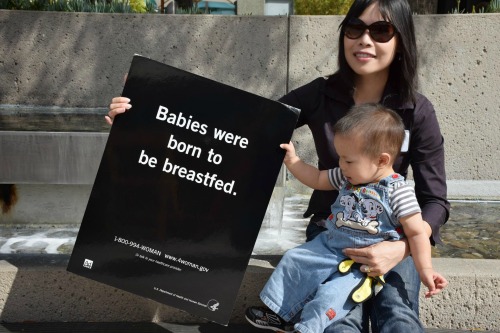
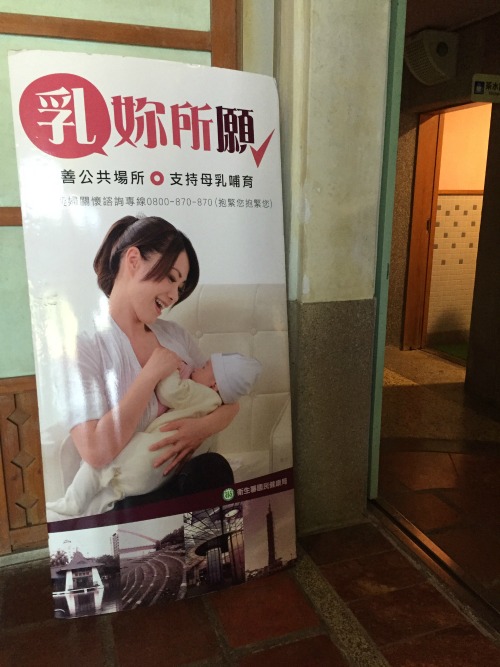
I recently met with a Huffington Post columnist at Howard Plaza Hotel in Taipei. She is writing a book that tells the story of how culture has influenced the breastfeeding controversy. She asked me what is it like to breastfeed in Taiwan.
I thought carefully when answering her question. Today’s Taiwan seems to be a very breastfeeding friendly society: Taiwanese government adopted International Code of Marketing of Breast-milk Substitute in 1992 and then started to promote Baby-Friendly Hospital Initiative in 1998. Today, there are nursing rooms literary everywhere in Taiwan. From big cities to small towns, nursing rooms can be found in government buildings, in shopping malls, in libraries, in banks, in metro stations, in parks, and in restaurants. (more…)
Former TV reporter turned freelance journalist, children's book writer in wee hours, nursing mom by passion. To-wen blogs at I'd rather be breastfeeding. She can also be found on Twitter and Facebook.
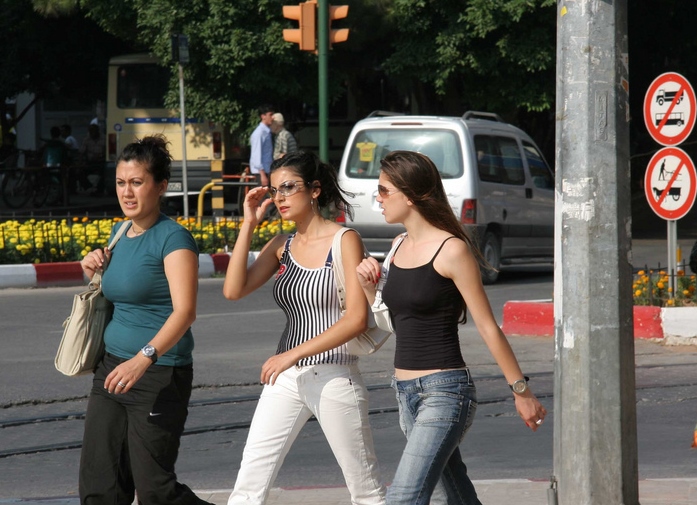
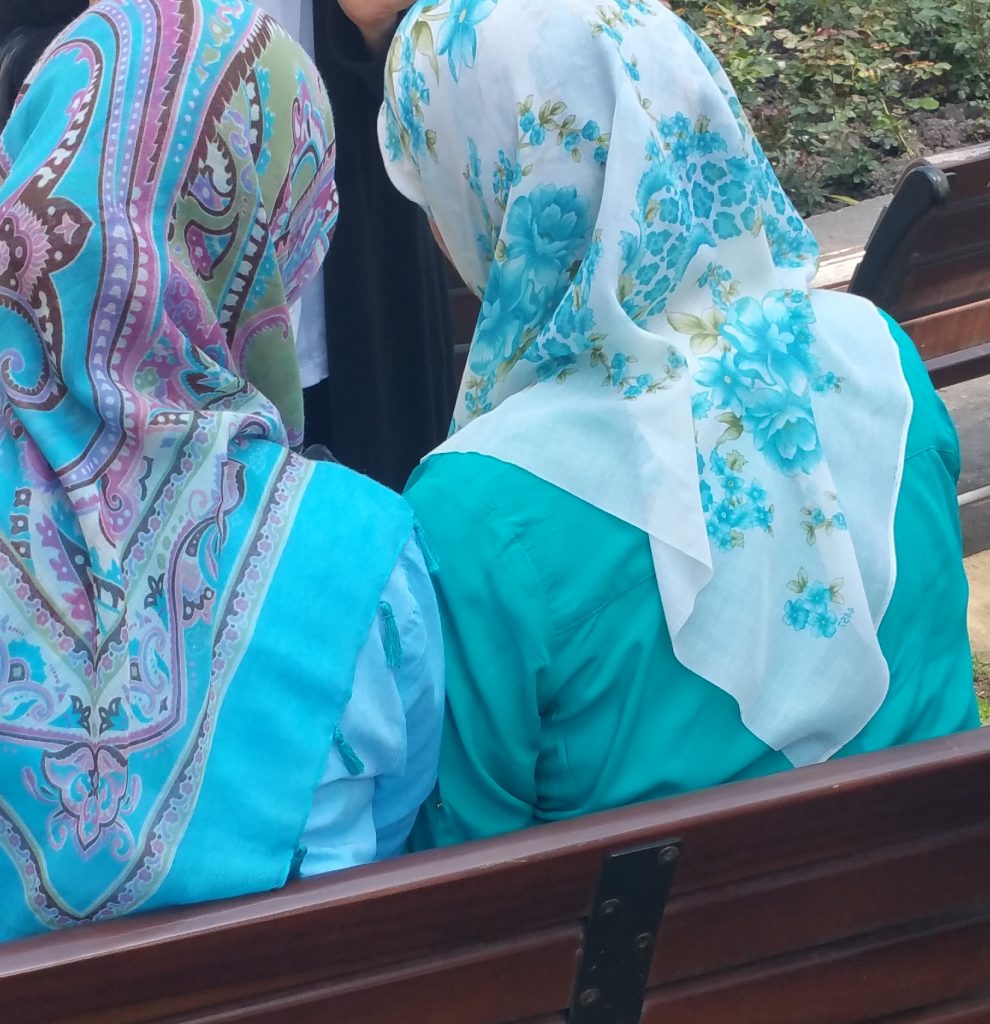
I had the privilege of visiting Turkey recently and found myself marveling at the women. As a predominantly Muslim country, I assumed women wore head scarves, burkas or tesettür (a headscarf and light cover-all topcoat) even in warm climates. However, I was surprised to see women and girls dressed in mostly European styles while shopping, or enjoying an evening out with family and friends.
Until late 2013 the head scarf had been outlawed in Turkey in public buildings and universities. More recently the law has been relaxed, and a small percentage of women still wear them. Turkey is considered to be a more western leaninig, secular country. Therefore, in many areas European style prevails over traditional Muslim attire. It was easy to find women dressed in jeans and casual wear as well as skirts and dresses.
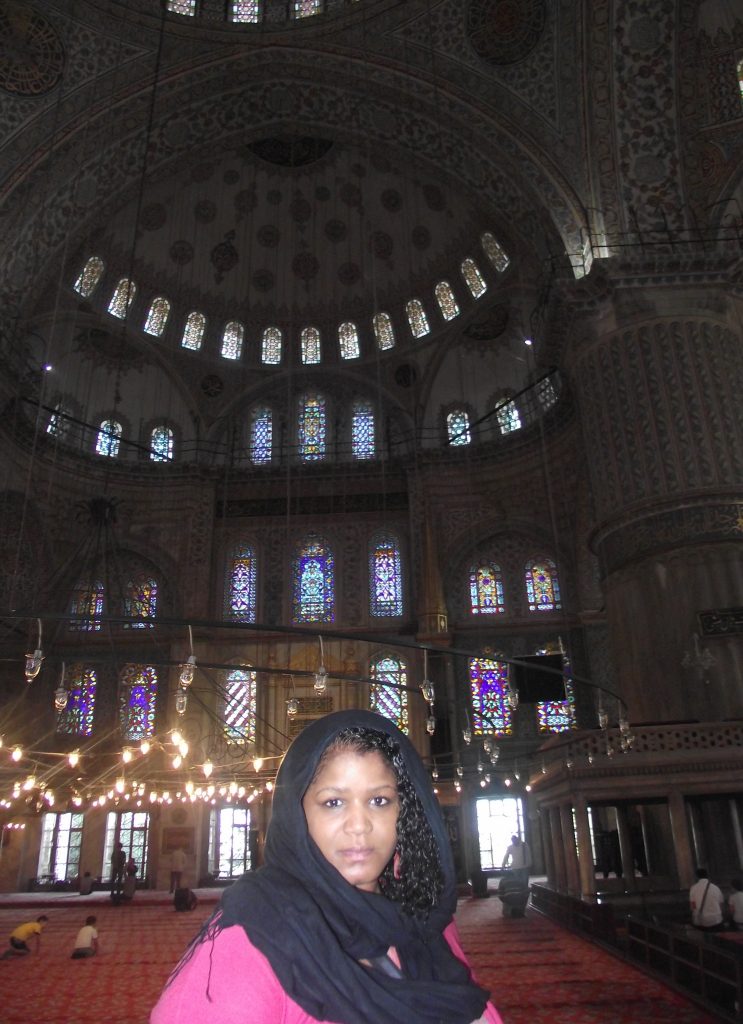
The point of departure for me came when entering a mosque for worship or observation. In this case, all women and girls were required to enter with a head scarf. Some mosques had scarves available and required women to use them if they do not bring their own. A fellow travel friend of mine liked her scarf so much that she donated money to the mosque to keep her scarf. If skirts were above the knee, an additional wrap was provided to cover them, creating a longer length.
The author at the Blue Mosque in Istanbul, Turkey
In my experience I found that the Turkish people are quite accepting of most styles of dress, no matter your country of origin or cultural background. However, it is customary in the less urban areas for women to be dressed more modestly with sleeved tops, slacks or knee-length dresses or skirts.
What does your attire say about you?
This is an original post written for World Moms Blog by La Shaun Martin of shootiegirl.
LaShaun Martin is National Director of Social Media and Community Service for Mocha Moms, Inc. a national 501(c)(3) support group for stay-at-home mothers of color. LaShaun currently works to manage and promote community service programs for the organization to include teen mentoring, Boys Booked on Barbershops literacy program, America’s Promise, MomsRising, Moms Clean Air Force, U.S. Environmental Protection Agency, and U.S. Department of Education. She is a frequent guest of the White House for events focused on women and girls including tea with First Lady Michelle Obama.
LaShaun holds a Bachelor of Science degree in Business Administration. LaShaun spent 20 years with the State of California, the State of Maryland Department of Corrections managing public education, research, FBI programs and later Hewlett Packard. LaShaun now serves as CEO and Designer of her own company, Shootie Girl™ Custom Rhinestone Apparel and Shootie Girl™ Blog – Positive Messages for Women and Girls. Shootie Girl™ designs have been featured with CNN’s Soledad O’Brien, Sherri Shepherd of The View, Carol’s Daughter, Clinique Cosmetics, Jack and Jill of America, Inc., Still Standing Movie, Dr. Sherry Blake of Essence Magazine and Aja Dantzler of R&B singing couple Kindred and the Family Soul and Blogalicious.
LaShaun is passionate about giving back and ensures her company reflects a heart for service by donating many “t-shirts for a cause” to Heart of Haiti, the women of Zimbabwe and The United Nations Foundation Shot@Life Campaign. She also serves on the Advisory Board of MOMentumNation and the Epilepsy Foundation.
LaShaun’s greatest passions are her husband, two lovely daughters and music.
Blog: http://www.shootiegirl.net
Custom Rhinestone Apparel: http://www.shootiegirl.com
I grew up in a family full of dynamic, resourceful, and strong women. My grandmothers were both widowed and had to raise their children (one had 6 children, the other 9) with nothing but agricultural produce and handcrafts. My mother and aunts displayed the same tenacity in their lives, and I witnessed similar characteristics in other women in my neighborhood and social circles.
This sparked a debate in me. I was baffled: “With such a healthy heritage of Basotho women, why do we have so few in leadership?”
My personal search for an answer to this question led me to explore avenues commonly considered to be reserved for men. I wanted to be a medical doctor like my father and grandfather, which led to me compete with my male counterparts from primary school through to university. I managed to earn a number of over-achiever certificates, but my dream of being a medical doctor did not materialize. I ended up with a Bachelor of Science degree with a double major in biochemistry and psychology.
After graduation, I entered the telecommunications field. I soon learned that the corporate world, like school, tended to reserve certain roles for men–including most senior offices, despite the high level of educated women in our country. Of course, this is not unique to Lesotho, but a global phenomenon.
Perhaps not surprisingly, there is a gender gap in mobile phone ownership in developing countries as well. (Men own more of them.) When I was presented with a project to reduce the mobile phone gender gap, I ran with it! With the eradication of the mobile gender gap, women will be enabled to participate in the global economy while improving their livelihoods.
The project focuses on women working for the company, women in the community, and the company’s female clients. Internally, a network of women was formed in order to inspire leadership, achievement and accountability among women. The Sisters’ Circle meets monthly and holds quarterly workshops to work towards this.
Externally, I am very excited about the creation of an internship program. Our goal is to give female graduates work experience, build a talent pool for the company, and help to bridge the skills gender gap that might otherwise hold these women back.
I wish to see more, if not all, major employers in the country adopt a similar projects so that our women believe in themselves and realize that that they have what it takes to lead organizations and governments. Ideally, empowering females should start in the classroom, so our daughters know and believe that they are equally able as our sons to become doctors, telecommunications executives, or whatever their heart and head desire.
What does your place of work do to empower women?
This is an original post to World Mom Blog by guest writer Mho Mosotho in Lesotho. She is a colleague of WMB contributor Dee Harlow.
World Moms Blog is an award winning website which writes from over 30 countries on the topics of motherhood, culture, human rights and social good. Over 70 international contributors share their stories from around the globe, bonded by the common thread of motherhood and wanting a better world for their children.
World Moms Blog was listed by Forbes Woman as one of the "Best 100 Websites for Women 2012 & 2013" and also called a "must read" by the NY Times Motherlode in 2013. Our Senior Editor in India, Purnima Ramakrishnan, was awarded the BlogHer International Activist Award in 2013.
Former TV reporter turned freelance journalist, children's book writer in wee hours, nursing mom by passion. To-wen blogs at I'd rather be breastfeeding. She can also be found on Twitter and Facebook.








 I had the privilege of visiting Turkey recently and found myself marveling at the women. As a predominantly Muslim country, I assumed women wore head scarves, burkas or tesettür (a headscarf and light cover-all topcoat) even in warm climates. However, I was surprised to see women and girls dressed in mostly European styles while shopping, or enjoying an evening out with family and friends.