by Mirjam | Jan 13, 2014 | 2014, Being Thankful, Childhood, Competition, Family, Kids, Life Balance, Me-Time, Motherhood, Netherlands, Parenting, Relationships, Siblings, Stress, World Motherhood, Younger Children
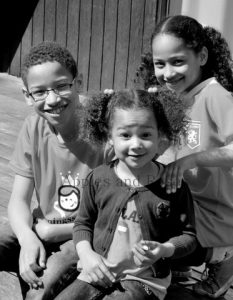 My husband has a brother and a sister. I have two sisters. So we both grew up in a family with three kids. To us it was just a normal situation, not too big, not too small. I don’t think I ever gave it much thought, except when I watched the Cosby show. I thought our family wasn’t big enough. I desperately wanted an older brother and I thought it would be great if I had that many kids later in life.
Now that I am a mother, I am positive that 5 children would be the death of me. I have absolute respect for those that are able to pull it off. I am a mother of three, and I had absolutely no idea what I was getting myself into when I started this adventure.
Sure, I realized that we were going to need a bigger car, a bigger house and that it was going to be busy but the reality of mothering three kids is not at all what I expected.
Being a Mom of three is sometimes like an episode of ER. The camera zooms into a touching scene. Soft music is playing, the surroundings are faded, then suddenly you’re being swept away into utter chaos with the passing of a stretcher.
A lot of my days are like that. One moment I sit and cuddle at night with my youngest, the next I am a referee in a heated discussion between siblings. I get yelled at by my oldest and at the same time my youngest passes me dancing and twirling in a princess dress.
I congratulate my daughter for passing her swimming exams and take my other daughter for her first swimming lessons. I gradually loosen the reins around my son as he gets older, while I pull my daughter extra close as we cross the street. I dance to a song on Sesame street with one kid and listen to the other kid calling it childish.
My days are full, my days are never the same. Some days are harmonious, filled with routine, smiles, kisses and singing in my head. Some days are heavy, burdened and feel like a group of giant rocks rolling over me the moment I get out of bed. Some days are loud. I yell, my kids yell, they stomp the stairs like a herd of elephants, something falls, something breaks, doors get slammed and voices are raised.
Most days are hectic, dropping off kids, picking up kids, cooking cleaning, planning, running around.
None of my days are dull.
I do have a chance to read a magazine or to simply sit down with a cup of tea, but that mostly happens when the kids are away or asleep. My husband and I run a tight organization. We plan and schedule, there are doctor’s visits, sports, school meetings, swimming lessons, all times three. When one of the kids gets sick, our entire schedule is disrupted and the whole house quickly turns to chaos.
Date night is a rare thing for us. We mostly watch a DVD together and try not to fall asleep before the movie ends. You are probably shaking your head right about now. And I haven’t even told you about the finances yet.
But there is another side.
There are moments my husband and I pause to look at each other, silently agreeing that we have the best kids in the whole wide world.
When I wake up Saturday morning and all three of them are snuggled in one bed reading stories to one another. When I put on music and they do silly dances together. When we sing songs in the car on our way home. When they play self invented games together. When one of my kids jumps in, to help another kid before I get a chance to. When I watch them watching TV, hanging upside down on the couch. When one of the kids says or does something silly and we laugh until our bellies hurt. That is the other side. A moment that takes my breath away, times three.
How many kids do you have? What are your challenges, and what are your blessings?
This is an original post to World Moms Blog from our writer in the Netherlands and mother of three, Mirjam.
The photograph used in this post is attributed to the author.
Mirjam was born in warm, sunny Surinam, but raised in the cold, rainy Netherlands.
She´s the mom of three rambunctious beauties and has been married for over two decades to the love of her life.
Every day she´s challenged by combining the best and worst of two cultures at home.
She used to be an elementary school teacher but is now a stay at home Mom. In her free time she loves to pick up her photo camera.
Mirjam has had a life long battle with depression and is not afraid to talk about it.
She enjoys being a blogger, an amateur photographer, and loves being creative in many ways.
But most of all she loves live and laughter, even though sometimes she is the joke herself.
You can find Mirjam (sporadically) at her blog Apples and Roses where she blogs about her battle with depression and finding beauty in the simplest of things. You can also find Mirjam on Twitter and Instagram.
More Posts - Website
Follow Me:


by Katinka | Dec 5, 2013 | 2013, Adoption, Adoptive Parents, Being Thankful, Belgium, Childhood, Cultural Differences, Culture, Education, Eye on Culture, Family, International, Kids, Life Lesson, Motherhood, Multicultural, Netherlands, Parenting, Penguin and Panther, Politics, Siblings, Traditions, Turkey, United Nations, World Events, World Motherhood, Younger Children
 As an adoptive mother of an Ethiopian Panther, I’ve grown an extra pair of antennas when it comes to racism.
Truly, a lot of really nice people distinguish my daughter from other children, based on her color. Even if it is meant to defend her, like calling me disgusting for letting her carry the groceries, it basically still is hidden racism. Should I tell her that people believe she shouldn’t be helping me out because it reminds them of slavery while her white brother is allowed to do the same chores? I’d rather have people call me names than let them wreck my daughter’s self esteem.
However, as I’m writing this, there is a HUGE racism debate going on in Belgium and even worse in The Netherlands, where it all started. And despite my racism antennas, I just can’t fully agree with the racism-yellers this time. Not even if they yell all the way from some United Nations office.
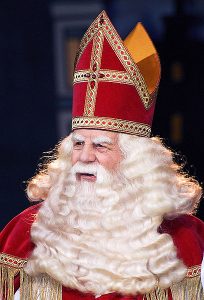
The debate is all about the ancestor of Santa Claus: Sinterklaas. You can read here about how Santa Claus evolved from our Sinterklaas, or Saint Nicholas, who is actually believed to be Turkish, who resides in Spain, has a white horse called Bad-Wheater-Today (Belgium) or Amerigo (The Netherlands), and celebrates his December birthday by coming over to our countries and surprising children with presents.
In the Netherlands he comes over on the evening of December 5th. Later that night, he comes to Belgium and delivers toys and sweets to be found in the children’s shoes on the morning of the 6th. It’s really a children’s celebration, full of magic and anticipation. You will bump into him just about everywhere during November.
Now, because Sinterklaas is getting old and forgetful, and has a lot of work to do within 24 hours, he has helpers. These helpers are all black, and hence all called ‘Black Peter’ (Zwarte Piet).
And that’s where all the accusative fingers point.
Indeed, this tradition can be seen as offensive. I, for a fact, believe it is partly based on a slavery and stereotype-loaded past, and a lot of people agree with me. Black Peter has long been depicted as a bit slow, barbaric (kidnapping and hitting the naughty children), dressed in clownish clothes, with stout lips and being submissive to his white boss.
Of course I agree this is an awful, insulting picture to brainwash our children with during the big Sinterklaas-Awaiting-Month-of -November. I also agree an outsider would be shocked, when he meets Sinterklaas and his Black Peters for the first time, especially if oblivious to the folklore. And I honestly understand and feel the offense people take.
For me personally, Sinterklaas has me cringing with bittersweetness ever since I found out about his racist taint. I’m not even particularly fond of the Sinterklaas tradition anymore.
However, I also don’t agree that we are teaching our children racism, nor paying ode to slavery by honoring this tradition every year. Not any more, that is.
Since the 1990’s, we have a children’s holiday special on TV portraying the real story. Children are elegantly taught Black Peter is black – and not brown/colored/african – because he came down the chimney. No more, no less. Nobody really tries to explain why his clothes didn’t get black during his journey down the chimney.
It is just part of the mystery, just like Bad-Wheater-Today walking on rooftops or Sinterklaas having this enormous book in which the good and bad behavior of every single child is listed. It doesn’t make sense, but children buy it anyway.
In this TV-special, Sinterklaas is depicted as a bit senile. In fact his Black Peters are now the smart ones, all with different names according to their function or character. A bit like the Smurfs, and everyone likes the Smurfs, right?
For the past 20+ years, this special comes on every November. Along the way, children started to grow more afraid of this very strict and grumpy old man than of his joyous, candy throwing helpers. The Black Peters became the true friends of our children. And every Belgian child you ask about Black Peter’s color now, will patiently tell you the chimney-story.
To me, this shows our tradition is evolving from, I admit, a racist past, towards a new story. Just like it evolved into Santa Claus overseas—who, by the way, appears to imprison a whole lot of innocent, little people in a Siberia-like, harsh environment without paying them for their round-the-clock labor.
Therefore, I trust society may even evolve towards a tradition of White Peters in a few more years or decades. After all, with more and more houses being built without huge chimneys, we will sooner or later find out that Peter’s color is fading, won’t we?
I’m hoping that by the time this post runs, all the petitions –pro and con–the social media frenzy, any UN investigations and any public manifestations, will be over and done with. I truly hope no-one got hurt along the way, and that both camps have reached a certain level of understanding towards each other by the time Saint Nicholas wants to celebrate his birthday.
Because, you know, my children are already expecting Sinterklaas to send one of his Peters down our chimney on the 6th of December. Especially my very dark daughter is impatiently awaiting. I’d hate to disappoint her if he decided not to come this year, because he’s afraid to be called a racist. She would definitely not understand, mainly because she doesn’t see any resemblance between Black Peter and herself.
I’m confident Sinterklaas will make it, though. We are both alike, Sinterklaas and me. We’re already used to people calling us racist slave handlers. And we both know better than that.
Did you know about Santa Claus’s European past? How would you feel if he had black helpers instead of elves?
This is an original post to World Moms Blog by K10K from The Penguin and The Panther.
The picture in this post is credited to Sinterklaas Himself, who published it on Wikipedia, while undercover as Gaby Kooiman, under GNU Free Documentation License.
If you ask her about her daytime job, Katinka will tell you all about the challenge of studying the fate of radioactive substances in the deep subsurface. Her most demanding and rewarding job however is raising four kids together with five other parents, each with their own quirks, wishes and (dis)abilities. As parenting and especially co-parenting involves a lot of letting go, she finds herself singing the theme song to Frozen over and over again, even when the kids are not even there...
More Posts

by World Moms Blog | Sep 16, 2013 | 2013, Adoption, Adoptive Parents, Africa, Being Thankful, Cultural Differences, Discipline, Ethiopia, Family, Guest Post, Health, Humanity, Humor, Inspirational, International, Kids, Motherhood, Multicultural, Netherlands, Parenting, Special Needs, Uncategorized, World Motherhood, Younger Children
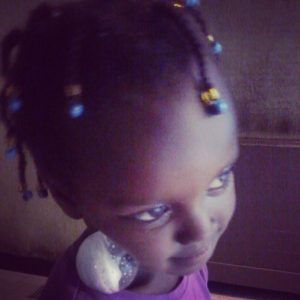 Sometimes I’m really weary of explaining. To grannies in the supermarket. To teenage girls at the playground. To fellow mums at school.
My daughter is clearly adopted, yes. She’s from Ethiopia, yes. She’s had a rough start, yes. She’s lost part of her eyesight, yes. And she’s got some countless more issues, yes.
But she’s still a four year old. And I’m her mother. I’m raising her my way. Just like I’m raising her big brother, who is blond and looks a bit too much like me.
The big difference between raising my daughter and raising my son, is that people seem to feel a kind of responsibility towards my girl. It feels like adopted children are in a way public.
I do understand how we stand out, in our not so worldly little town. We are getting used to the extra attention she brings with her, although I admit I have been thinking to teach her to growl when a stranger touches her hair and skin unasked.
We were prepared for all this. We knew we were going to feel like we have arrows flashing around our heads when taking her out. Now that she’s been with us for two years, we’ve all grown a thick skin, filled with humor. We have a series of catchy replies to go with all the ridiculous questions. The next one who dares to ask me what we feed her, will be answered ‘grass’, without even a blink.
But I still can’t really cope with all the unwanted ‘advice’ we get about raising her. When my son was little, I never ever had some stranger giving him candy or cookies. I never had to explain myself in the supermarket when I refused to let him take everything he wished for. And I certainly didn’t have to listen to people telling me how neglectful I was for letting him cry out a tantrum.
With my daughter, I do have those encounters. This one time in the supermarket, I was truly abashed. I had just taken away some nasty sugar bombs from my daughter’s hands and put them back, much against the little miss’s wishes. An elderly lady came over, took the candy and handed them over to my girl again. I was confused, believing she misunderstood. So I explained I didn’t want to buy that rubbish for her. At that moment she cursed me for being so horrible towards that poor little black girl that has been hungry all her life. She put the candy in my cart, ordered me to buy it, and took off while nodding her head.
At such encounters – yes, plural – I have the urge to scream.
For one thing. She’s NOT a poor little girl. She’s in most ways an ordinary four year old preschooler. She can throw the worst tantrums I ever witnessed, just because I can’t peel an apple while driving my car or because I can’t make the Easter bunny magically appear in August. The last one was about having only six colors of nail polish to choose from. Poor girl indeed.
But most importantly, I’M THE ONE raising that ‘poor little girl’. Of course we are aware of her issues, mostly the ones regarding attachment and anxieties. We try to give her everything she needs, truck loads of patience and care which unfortunately aren’t always replenished in time. But she doesn’t need everything she wants. Just like any other child doesn’t. Unless you plan to end up with a spoiled brat that demands a yellow sports car at age eighteen.
Spoiling her will not make right all the things she missed out in the first two years of her life. Maybe that sounds harsh and loveless, but I can assure you it isn’t meant that way. I cry with her when she mourns her lost heritage, when she is homesick. I’ve swallowed away rivers of tears all those times I had to explain her history to medical doctors and hospital professors.
But I can’t raise my daughter based on pity alone.
This is a first-time, guest contribution to World Moms Blog from our friend and mother of The Penguin and the Panther in Belgium, Katinka. Her Flemish blog is in transition over to an English-only blog. Stay posted to World Moms Blog for more from Katinka.
The photograph of the author’s daughter used in this post is credited to the author.
World Moms Blog is an award winning website which writes from over 30 countries on the topics of motherhood, culture, human rights and social good. Over 70 international contributors share their stories from around the globe, bonded by the common thread of motherhood and wanting a better world for their children.
World Moms Blog was listed by Forbes Woman as one of the "Best 100 Websites for Women 2012 & 2013" and also called a "must read" by the NY Times Motherlode in 2013. Our Senior Editor in India, Purnima Ramakrishnan, was awarded the BlogHer International Activist Award in 2013.
More Posts

by Olga Mecking | Sep 12, 2013 | Multicultural, Netherlands, Preschool, Technology, Uncategorized, World Moms Blog, World Motherhood
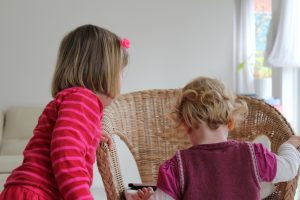 I am raising digital natives and I love it. Technology is a big part of our lives. My brother-in-law once jokingly asked: “Is there a pen in this highly digitalized household?”
“iPad” was among my now 2-year old’s first 50 words. When we Skype with my parents, sometimes my 4-year old gets tired and tries to swipe my father’s image away because she thinks that my laptop has a touchscreen.
There are many ways to approach digitalization. Some parents, bloggers and researchers focus on the negative impact digital technology (and technology in general) can have on our lives. They give tips on reducing screen time, warn against oversharing and treat technology as something that needs to be tightly controlled.
Others are amazed by the opportunities that technology offers us. They mention the community- building aspects of social media platforms, the opportunity to access information everywhere and at any time, and remark that our lives have been made much easier by digital technology.
Where do I stand on this? More in the technology-is-awesome camp.
As an expat, I appreciate the possibilities to not only hear my parents’ voices, but to also see them- and they can see the children. I can use my iPad to do yoga with the children, and to connect with them that way. We don’t have a TV, but instead we use our computers to watch TV series and movies, and read the news. I love taking pictures and I have a digital SLR. That way, I can take tons of photos to choose the very best. And I haven’t even touched on the great advantages I get from blogging. My hands rebel when I try to draw or paint, but my computer allows me to do just that.
I view technology as a tool that can be used to our advantage without taking control over our lives. I think that there is a time and place for everything. I love the term “digital natives”. Just as our children can teach us how to speak another language, we can learn to use all these wonderful devices and find delight in using them.
On the other hand, we can teach children to use technology and social media responsibly. I also think that we can teach them the world of paper books and sounds without a picture, and the world outside of the house rather than the world inside of their devices.
To me it is obvious that technology has much to offer in terms of education and play. But I believe that through technology we not only can connect with a device, but with our children (and grandchildren!) as well.
What is your approach to modern technology? Do you love it or hate it?
This is an original post to World Moms Blog from our writer and mother of two in the Netherlands, Olga Mecking.
The photograph used in this post was taken by the author.
Olga is a Polish woman living in the Netherlands with her German husband. She is a multilingual expat mom to three trilingual children (even though, theoretically, only one is trilingual since she's old enough to speak). She loves being an expat, exploring new cultures, learning languages, cooking and raising her children. Occasionally, Olga gives trainings in intercultural communication and works as a translator. Otherwise, you can find her sharing her experiences on her blog, The European Mama. Also take a while to visit her Facebook page .
More Posts - Website
Follow Me:


by Mirjam | Aug 26, 2013 | 2013, International, Interviews, Living Abroad, Motherhood, Multicultural, Netherlands, Parenting, Working Mother, World Interviews, World Moms Blog Writer Interview, Writing
 Where in the world do you live? And, are you from there?
I live in the Netherlands but I was born in Surinam.
What language(s) do you speak?
I speak Dutch, English and Surinamese and I also have a rudimentary knowledge of German and French.
When did you first become a mother?
I became a mother almost eleven years ago, when I gave birth to my son Jason.
Are you a stay-at-home mom or do you work?
I was a stay at home Mom but for the past couple of years I have been working one day a week. I still feel like a stay at home Mom, though.
Why do you blog/write?
I started to blog because I needed an outlet for my creativity and a space where I could express myself. Once I started, it became so much more: a document for my kids; a report of my journey and struggle with depression; a place to inspire and encourage others; a special spot on the internet to honor my soul and mostly a mirror in which I could see myself in a positive way.
How would you say that you are different from other mothers?
This is such a tough question to answer! I think I am different because of my background. I had some difficulties early in life that have permanently influenced my personality. I choose not to say damaged because I find, as a result, I can still grasp the concept of childhood. I still completely know what it feels like to be a child. That makes it easier to place myself in the shoes of my kids. And that is a big part of the way I parent my kids.
What do you view as the challenges of raising a child in today’s world?
It is my opinion that society nowadays encourages self-centeredness. It is all about self-fulfillment, self-development. I want to raise my children to be compassionate. I would like for their lives to be a blessing to others, that they not only live for themselves.
How did you find World Moms Blog?
I found World Moms Blog via Twitter.
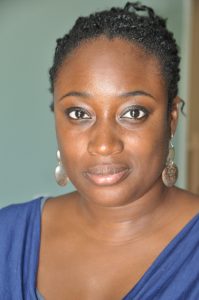
This is an original interview and our second post from our new writer in the Netherlands and mother of two, Mirjam.
Mirjam was born in warm, sunny Surinam, but raised in the cold, rainy Netherlands.
She´s the mom of three rambunctious beauties and has been married for over two decades to the love of her life.
Every day she´s challenged by combining the best and worst of two cultures at home.
She used to be an elementary school teacher but is now a stay at home Mom. In her free time she loves to pick up her photo camera.
Mirjam has had a life long battle with depression and is not afraid to talk about it.
She enjoys being a blogger, an amateur photographer, and loves being creative in many ways.
But most of all she loves live and laughter, even though sometimes she is the joke herself.
You can find Mirjam (sporadically) at her blog Apples and Roses where she blogs about her battle with depression and finding beauty in the simplest of things. You can also find Mirjam on Twitter and Instagram.
More Posts - Website
Follow Me:

by Olga Mecking | Aug 19, 2013 | Family, Netherlands, World Motherhood
 I am always amazed by how many similarities there are between my husband’s family and my own. Our mothers have the same name (even though the spelling and pronunciation are slightly different). Our parents are teachers, his at school, mine are University professors. Both families share a love and admiration of the French culture and good food. Just recently, however, there is one more thing that we now share: we have both lost our grandmothers.
This is, however, where the similarities end. My husband lost a beloved grandmother, a crucial member of his family. Me? Due to a family misunderstanding, I haven’t seen my grandmother for 20 years. The other grandparents had died when I was little, so I don’t really remember much about them.
However, I never felt that I missed anything. I liked having a small family consisting of my parents and my brother. I enjoyed the privacy and the alone time at home. I could never understand my friends when they told me how much they loved their grandparents. Neither could I understand fellow expat parents when they worried that their children wouldn’t see their grandparents much.
Maybe to you, the title seems rather obvious. You may say: “Of course, they’re important!” But to me, it wasn’t always that way.
I felt my mom was important to my children because she is my mom, and I did struggle with the concept of my mother-in-law being close to my children.
It didn’t help that while my own mom has been simply amazing, I felt that anything my MIL translated into: “You’re doing this wrong, and I can do it better”.
But now it doesn’t matter. While I was raised without grandparents, I can understand my husband’s pain of losing a beloved, close member of his family and my MIL’s pain of losing her mother. I decided to give my mother-in-law a break. One of the reasons is that I realized that while I felt she was being critical, I was being critical as well, which, let’s be frank, is not a good base for communication. But there is a more important reason.
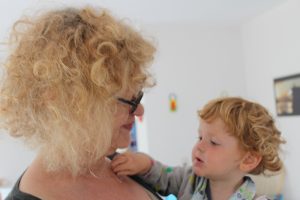
Because children love their grandmas. Both of them. My eldest always asks me when we will visit grandma in Germany to sing songs and grandma in Poland to make uszka (pronounced “ooshka”, it means little ears. They’re tiny dumplings filled with wild mushrooms, eaten with borsht for Christmas). We Skype a lot with both grandparents. They read books and sing to the children. In fact, they’re doing a great job of staying connected to their grandchildren.
If you ask me, I’d tell you I still believe in my right to parent my children the way I see fit. I don’t believe in “sucking it up” for the sake of the children. I do also believe in picking my fights. I believe that both my in-laws and my parents make fantastic grandparents, and this is what matters.
If you ask me, I’d tell you that grandparents aren’t a necessity. I know from my own experience that a child can be raised without grandparents and thrive.
But I’d also tell you that grandparents are a luxury — one that I am gladly letting my children indulge in. Because grandmothers are important, and while I am sad it took losing my own to realize this, I am happy that my children have two wonderful, caring sets of grandparents.
How have grandparents influenced your life? How do your own parents influence the lives of your kids?
This is an original post to World Moms Blog from Olga in the Netherlands.
The image used in this post is credited to the author.
Olga is a Polish woman living in the Netherlands with her German husband. She is a multilingual expat mom to three trilingual children (even though, theoretically, only one is trilingual since she's old enough to speak). She loves being an expat, exploring new cultures, learning languages, cooking and raising her children. Occasionally, Olga gives trainings in intercultural communication and works as a translator. Otherwise, you can find her sharing her experiences on her blog, The European Mama. Also take a while to visit her Facebook page .
More Posts - Website
Follow Me: