by Maman Aya (USA) | Mar 14, 2014 | 2014, Awareness, Communication, Education, Kids, Milestones, Motherhood, Parenting, Preschool, Special Needs, USA, World Motherhood, Younger Children
 My son is eight months old and clearly utters his first word, and quickly starts to add more words into his daily speech and quickly starts to put them together to form ‘sentences’…in multiple languages! At 9 months old I start to potty train him, and he understands what I am trying to teach him.
‘This child is brilliant’, all the adults in his life agree.
My son is about a year and a half. He goes to play at a nearby kids gym which has an area to climb and slide, a Lego area, an area to jump, balls, puzzles, magnets and blocks, etc. So many fun things for a toddler to do. Most kids are so excited. They run in and start playing with all of the toys. But not my son. He walks in and stands off to the side to observe the other children and watch what they do. To understand what is expected, I suppose. Once he understands what the other kids are all doing and how he is expected to behave and play with them, he joins the fun – and he has a blast – never wanting to leave.
When he is 18 months – 3 years old he takes ‘mommy and me’ classes on subjects he enjoys, like construction, art, French, music and cooking. He is tentative and does not participate straight away. It takes some time for him to warm up and I (or my mother, who is his daytime caretaker while I am at work) have to do most of the activity for him until about 10 minutes before the end of the 40 minute classes, week after week.
He is almost 3 and has started ‘school’, a few times a week, 3 hours at a time. The teachers comment that he would rather talk with them (and his vocabulary is amazing for a 3 year old – he started talking at 8 months after all), than play with his friends. He watches his friends and directs them (tells them if they are breaking a rule, or shows them how to do something), but does not easily go and play with them. He is more like one of the teachers than one of the 2 or 3 year-olds. I also notice that he doesn’t recognize, or confuses his letters (like mixing M and W), like other 3 year-olds.
This trend continues, although he does get better at socializing. He does get better at playing with other children, but only because he mimics their actions (good or bad). He doesn’t realize when an action is” not good”, because someone else did it before him, so it must be okay.
At 4 years old he starts having tics. His pediatrician tells me it’s normal for boys, there is nothing wrong with him. I take him to an eye doctor (one of his tics involves rolling his eyes), and he does need glasses, but the opthalmologist tells me that the tics are normal. I take him to a neurologist, who tells me nothing is wrong with him. Over the years I continue to express my concerns to the pediatrician. We realize that the tics are caused when he is stressed or excited.
“Nothing wrong,” says the doctor. This is not very reassuring.
I speak to his teachers over the years who assure me he is incredibly bright. He is mature. His vocabulary and speech are well ahead of his age, yes he is still mixing up letters, but the teachers assure me that it is within a normal range. He is indeed a very special child, teacher after teacher says.
But all of the reassurances in the world do not stop me from thinking that my son is different.
I watch to see if the other kids shun him…. they don’t seem to, but he is not choosing the friends that I would like him to have. That is to say, the nicer, gentler boys. I am afraid that he may be choosing the rowdier friends because he is over compensating. He is trying to fit in.
Fast forward to this past September. He started first grade as a normal 6 year-old. He was given a reading assessment (as were all of his classmates) and no red flags. About two months into the school year his teacher noticed that he was not doing as well as she would like, so she had him assessed even further. This time there were warnings. He is having problems reading (which I had asked his teachers about previously). He starts to spend one-on-one time with the reading specialist in his school and he has been making some progress, but there is some concern. I mention to the reading specialist that personally, I believe he may be dyslexic. She agrees that he does in fact have a “reading disability” (apparently dyslexia falls under that category these days), but that she is not qualified to be able to properly diagnose him.
That conversation was a few weeks ago. I feel relieved and worried. We have to keep working the system visiting specialist after specialist until I get an actual diagnosis. I don’t want to frighten him by taking him to see these specialists, but I do want to get an understanding of what I should do. And once I get a diagnosis, what should I do with it? How can this affect the rest of his learning, his education, and ultimately his life? What if the other kids make fun of him or shun him? How is this the same child who scored in the 90th + percentile on his kindergarten entrance exam on vocabulary, conversation and comprehension? (Yes they actually administer this test in NYC.) What if we decide to move, and have to change his school…will he have the help he needs to succeed? I have so many unanswered questions, and feel overwhelmed and not sure where to start…
Does you child have a learning disability? How did you find out? How have you helped your child learn to cope?
This is an original post to World Moms Blog by Maman Aya and was inspired by fellow WMB contributor Sophie Walker’s post, The Book I Never Thought I would Write.
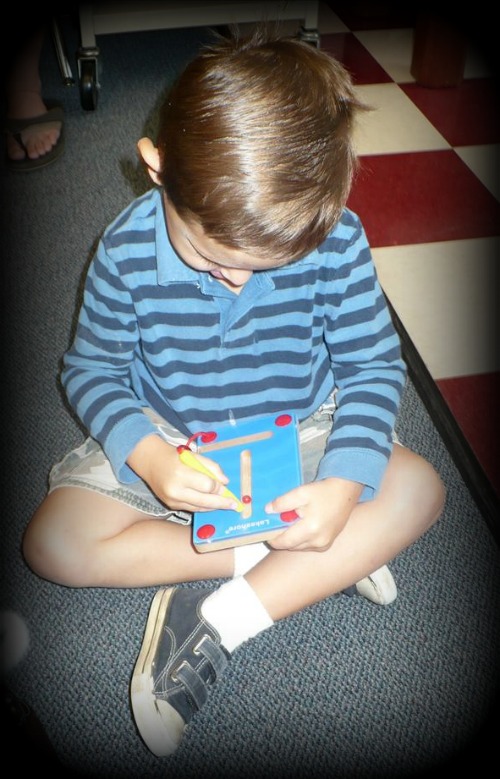
Photo credit to Lesley Show. This photo has a creative commons attribute license.

Maman Aya is a full-time working mother of 2 beautiful children, a son who is 6 and a daughter who is two. She is raising her children in the high-pressure city of New York within a bilingual and multi-religious home.
Aya was born in Canada to a French mother who then swiftly whisked her away to NYC, where she grew up and spent most of her life. She was raised following Jewish traditions and married an Irish Catholic American who doesn’t speak any other language (which did not go over too well with her mother), but who is learning French through his children. Aya enjoys her job but feels “mommy guilt” while at work. She is lucky to have the flexibility to work from home on Thursdays and recently decided to change her schedule to have “mommy Fridays”, but still feels torn about her time away from her babies. Maman Aya is not a writer by any stretch of the imagination, but has been drawn in by the mothers who write for World Moms Blog. She looks forward to joining the team and trying her hand at writing!
More Posts

by World Moms Blog | Mar 10, 2014 | 2014, Awareness, Bilingual, Communication, Cultural Differences, Culture, Elections, Eye on Culture, Guest Post, Human Rights, Humanity, International, Language, Life Lesson, Living Abroad, Media, Multicultural, Politics, Tragedy, USA, World Events, World Interviews, World Motherhood, World Tour, World Voice
Today, we have a special guest post by a Ukranian mother living in the United States, Olena Centeno, of Bilingual Kids Rock. Olena opens the window and lends us her personal perspective to the current events in Ukraine…
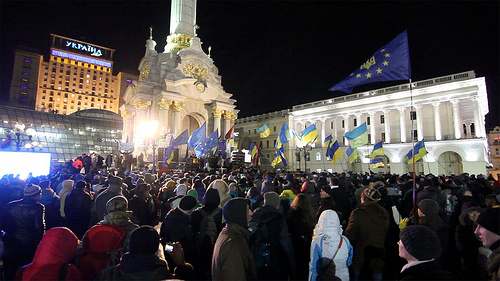
Protest in Kiev, November 2013
What’s it like growing up in Ukraine?
As a Ukrainian, I grew up speaking two languages: Russian and Ukrainian. I ate Ukrainian borsht for lunch and Russian pelmeni for dinner. I love Tchaikovsky’s Sleeping Beauty and Carols of the Bells by Leontovych. I am raising my own children trilingual in English, Russian and Ukrainian. In fact, the two cultures (Russian and Ukranian) are considered so close, that if an Ukrainian abroad says s/he is from Ukraine people often say “Oh, so you are from Russia?”
What’s going on between Russia and Ukraine?
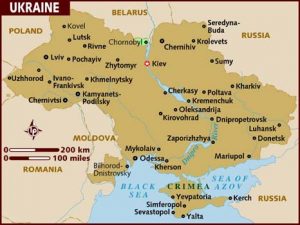
With Russian troops moving across the sea into Ukraine’s Crimean peninsula, a lot of Westerners are starting to ask this question.
The current conflict in Ukraine is more than three months old. It began with a peaceful demonstration on November 21 at Independence Square (Maidan) in Kiev, the capital of Ukraine, when the (now ousted) Ukrainian president (Yanukovich) hesitated to sign an Association Agreement with the EU. This had been one of his major election promises and in breaking it he ignored the desire of millions of Ukrainians.
During the past three months, the “EuroMaidan” demonstration has grown into a much bigger movement. It started as a response to the failed EU deal but then truly turned into a movement against the corrupt government of president Yanukovich, who moved to keep Ukraine in long-lasting and very painful economical ties with Russia.
Then, after the government passed harsh, anti-assembly laws, it became about the basic human right to be able speak and think freely without being punished for it.
More than a hundred lives were lost and thousands injured during violent attempts to remove the demonstrators but people did not leave the cold streets of Kiev. More freedom fighters came from all over Ukraine to support them. Many other Ukrainian cities stood up as well. After three months of struggle, Mr. Yanukovich was impeached and left Ukraine (he refused to sign a resignation; he just ran away). His presidency was considered illegitimate and a new, temporary government was elected.
As Ukrainians were mourning over lives lost and looking into the future with great hope to build their country on principles of trust and freedom, a new enemy emerged: Informational War.
Along with Russia, Eastern Ukraine—where the majority is Russian speaking—is dominated by Russian-language news from the Russian media. Unfortunately, the Russian media coverage of events that have happened over the past three months is falsified [and full of propaganda].
Now, after the armed occupation of Ukrainian territory in Crimea by Russian troops, the reason for their untruthful reporting is understood: Creating social opinion in Russia and Russian-speaking Ukraine justifies military intervention into Ukrainian territories.
Personally, I think Mr. Putin has an imperialistic plan to be the most powerful ruler in modern history—politically and financially—and he will stop at nothing to add Ukraine to his control.
Russian Media Propaganda Uncovered
The following are all lies that have been spread by the Russian media leading up to the invasion of Ukraine by Russian troops:
1. FALSE: Kiev was Overrun by Violent Riots
Despite violent clashes, most of Kiev stayed peaceful throughout the demonstrations. The day-to-day lives of residents were largely unaffected outside of Independence Square and the areas immediately surrounding it. Very little of Kiev or the surrounding countryside was damaged or disturbed by the protests.
I know this because I called my family and friends every day. My nephews were going to school as usual, most of the people attended work on a daily basis, and all shopping malls and grocery stores were working (except for a few in the middle of the protest areas downtown).
2. FALSE: Anti-Russia Fascists Led the Ukrainian Protests
The vast majority of protesters were ordinary citizens tired of a government that they viewed as corrupt and unwilling to listen to the people. There were no fascist elements leading the demonstrations, and there are none leading the new government.
Many of the people I know personally were in Maidan: teachers, IT professionals, doctors, stay-at-home moms, businessmen, university professors, hair stylists and many others. People I worked with and went to school with. And no one will ever convince me that they are fascists. My daughter’s god-father is a surgeon and worked days and nights protecting the health and saving the lives of many.
3. FALSE: The New Government Will Force All Ukrainians to Speak Ukrainian
This is a particularly effective myth for Russian-language media, since it appeals directly to the people who would be most affected. Language has long been a contentious issue in Ukraine. Claims that Russian will be abolished are being used to generate anger against the new government.
The Ukrainian parliament voted to repeal a 2012 law allowing the establishment of minority languages as official state languages in individual provinces on February 23, 2014 but acting President Oleksandr Turchynov vetoed the move. Russian is currently recognized as an official language, is legal for state use in several Ukrainian provinces, and is guaranteed state protection “in all spheres of public life” in Crimea specifically.
I speak Russian and Ukrainian to my children here in the USA. I see language first and foremost as a tool for communication — and shame on any politicians who use it as a reason for war.
4. FALSE: Ukrainian Demonstrators Have Been Attacking Russians or Russian-Speakers
Another unproven and untrue claim widely circulated in Russian-language media is that the Euromaidan protesters were deliberately attacking Russian speakers.
The cruel result is that ordinary Russians – good, wholehearted, educated people – are now eager to help a Ukraine that they think is swamped by fascists! I have family in eastern Ukraine and my god-mother lives in Moscow. They have called multiple times, scared for the lives of my parents in Kiev. They really think Ukraine is in danger.
There is no evidence to support the claim, and nearly all cases of violence during the protest were perpetrated against civilians by security forces. The Euromaidan protests had very little to do with cultural or language issues in general.
While Yanukovych’s perceived obedience to the Russian government was certainly a source of anger in Ukraine, this anger was directed at the President and the actions of the Russian and Ukrainian governments, not to the Russian people or culture.
5. FALSE: The Berkut and Other Security Forces Fought in Self-Defense
Russian news broadcasts have shown extensive footage of the Berkut and other riot police under attack but nearly none of their attacks on civilians. The reality is that security forces attempted to crush peaceful protests with deadly force, and were barely driven back with improvised weapons like clubs and Molotov cocktails. The superior force and aggression were always on the side of the Berkut.
6. FALSE: The Independence Square/Euromaidan Protests Were Organized by Americans
We joke that EuroMaidan is now supported by Americans because my American husband and I made donations to help supply people with warm clothing and blankets during cold winter months.
I am not claiming that on a political level there is no lobbying of interests from outside countries and unions but once again: the politics of the country and the people of the country are two different things.
The vast majority of protesters were native Ukrainians and ordinary residents of Kiev and the surrounding country.
7. FALSE: Fascism Will Spread from Ukraine to Russia
This is another falsehood dependent on the idea that the Euromaidan demonstrators were fascist extremists. It is being used as a justification for Russian invasion. The Russian government claims it is defending Russian-speakers in Ukraine and its own borders from Ukrainian fascists but in reality those fascists do not exist.
What is next?
The military intervention is not over. It is hard to say what is going to happen next. There is a lot of talk going on at a very high, political level involving the EU and the US.
But Ukrainians have already had the biggest win in this struggle: themselves.
They proved to themselves that they care:
- They care about all of our people (amazing examples of collaboration happened during the civil unrest!);
- they care about the future of their country;
- they care about their freedom;
- they care enough to recognize the differences among themselves and to stay united anyway.
The revolution was heartbreaking and tearful but as a result, Ukrainians became true patriotic citizens of their country:
Glory to Ukraine, Glory to Heroes!
слава Україні, слава героїв
(slava Ukrayini, slava heroyiv)
For me, personally, it has been a life lesson in how to raise my own children. I have a clear goal to raise multicultural and multilingual children, who respect other languages and cultures and can see our shared humanity no matter how politicians try to divide us.
This is an original guest post to World Moms Blog by Olena Centeno.
 Olena Centeno is a Ukrainian who lives in USA, a happy mom of three wonderful kids ages 2-9 and a wife to the great. She speaks three languages herself and is raising her kids to be multilingual in English, Russian, Ukrainian and Spanish. She founded Bilingual Kids Rock, where she helps families on their bilingual journey. She also enjoys photography and video making as a way to preserve precious moments of life.
You can connect with her at Bilingual Kids Rock.
Photo credit to Oxlaey. This photo has a creative commons attribution license.
World Moms Blog is an award winning website which writes from over 30 countries on the topics of motherhood, culture, human rights and social good. Over 70 international contributors share their stories from around the globe, bonded by the common thread of motherhood and wanting a better world for their children.
World Moms Blog was listed by Forbes Woman as one of the "Best 100 Websites for Women 2012 & 2013" and also called a "must read" by the NY Times Motherlode in 2013. Our Senior Editor in India, Purnima Ramakrishnan, was awarded the BlogHer International Activist Award in 2013.
More Posts

by Ana Gaby | Mar 6, 2014 | 2014, Communication, Family Travel, Home, Indonesia, International, Kids, Living Abroad, Motherhood, Parenting, Travel, World Motherhood, Younger Children
 Not too long ago, my four-year-old started understanding the concept of fairness vs. unfairness. To him, life is unfair, oh so many times ,during the day. To me, the fact that he can express his frustration over a denied chocolate treat before dinner or being sent back to sleep in his room when he tries to sneak into mom and dad’s bed, is just another sign of my toddler becoming a big boy.
Evan has not only learned to voice his frustration but has become a strong little boy with convictions. He will call my husband and I out on our mistakes and let us know how he believes what we are doing is not fair and shouldn’t be done. Sometimes I just chuckle, but sometimes my heart just skips a beat. For Evan, unfairness is represented by tangible things he cannot have or those few extra minutes in front of the TV that he wasn’t allowed. I feel so blessed that, so far, this is all the unfairness he has had to face. (more…)
Ana Gaby is a Mexican by birth and soul, American by heart and passport and Indonesian by Residence Permit. After living, studying and working overseas, she met the love of her life and endeavored in the adventure of a lifetime: country-hopping every three years for her husband’s job. When she's not chasing her two little boys around she volunteers at several associations doing charity work in Indonesia and documents their adventures and misadventures in South East Asia at Stumble Abroad.
More Posts

by Meredith (USA) | Feb 28, 2014 | 2014, Communication, Family, Kids, Life Lesson, Motherhood, Parenting, World Motherhood, Younger Children
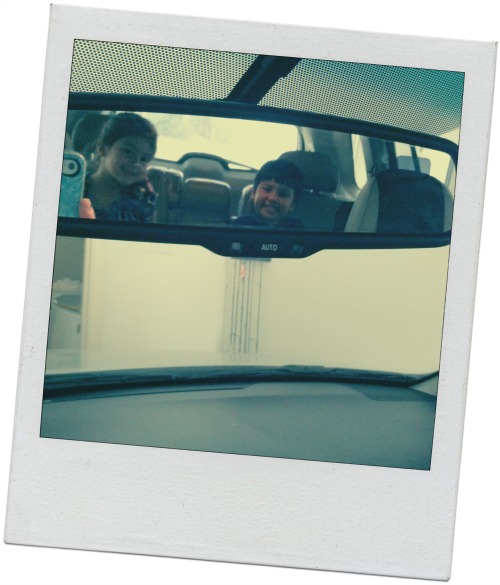 It happens every night when I lay my head on the pillow. I replay many of the day’s events back over in my mind. “Was I good friend, wife, sister, daughter, etc.? Was I good mother to my children? Did I set a good example?”
However, the events which have been playing over in my mind more and more frequently are the times I am not sure if I really listened to my children. “What was it my daughter was telling me about a friend of hers at school as I was hurriedly sending a text to my friend? What was my son showing me that he learned on his new video game as I nodded and pretended to see him play it while I sent an email?”
I know we all get caught up in this thing called life, but are we really present for our children?
At any one minute during the day, I feel like I have a laundry list of things to get done. A lot of times, I find myself sitting listening to my daughter read, and I am making a mental list in my mind of what I need to get from the grocery store. When I’m driving the kids to school, and they are in the backseat laughing, I am thinking of the things I need to get done that day while they are in school. What were they laughing about? I don’t know because I wasn’t really listening. And, that makes me a little sad.
I know one day, I’ll look in my rear-view mirror and they will be in junior high and then high school and they won’t be my little children anymore.
I have read so many articles and talked to so many friends about our kids being able to pay attention to what we, as parents, say. We have talked and discussed how too much time on electronics isn’t good for their attention. What about us as parents? It became crystal clear to me a few weeks ago when I took my children to the park. My son was on the swing, and I received a text from a friend. I was replying to her text while my son was saying something to me and I remember nodding and saying “Okay.” It turns out that he asked me if I would pay him a quarter for every time he jumped off the swing. You can imagine how surprised I was when he told me I had to pay him $4.50 for jumping 18 times!!!
These past few weeks, I have been thinking about how I have approached mothering, and I think I had something wrong. For some of you this may not be earth shattering, but for me it was ground breaking. And here it is…I will never be done with a grocery list, laundry list, cleaning, cooking, etc. There will always be broken things which need fixing and plants needing to be watered.
I was approaching things in my mind as things to check off like a list. I was thinking of my days as a destination, and that just isn’t how life is. In my head I thought if I get that grocery list done, then it is complete. If I finish this load of laundry, then it is done. But, the truth is, neither of those tasks are ever done, and unfortunately, I feel that I have wasted some of my precious time with my children using that approach.
I have started to look at my life as a journey and to try to enjoy it more along the way.
Coming to this realization has freed me to sit with my daughter and just listen to her read for 20 minutes without my phone right next to me. I don’t have to answer texts right away. I am able to watch my son play his new video game and show me his new trick because the laundry will always pile up, and I can get to it after I take 10 minutes to listen to him. I am waking up 10 minutes earlier to get lunches packed so I can talk to my kids in the morning while they are eating breakfast. I am taking a little of the pressure off myself to get everything done. I am getting most things done, and the things I don’t get to can wait until tomorrow if it means I can have some extra special moments with my kids.
I have found that slowing down my mind and my “to-do” list have made me a bit more calm, and in turn, it has helped me to be in the moment with my kids. Every night, we have dinner together and there is a “no toy and no electronics rule” at the table. It’s a time for our family to really listen to each other and make sure that we have a few minutes to “check in” all together as a family.
The one thing that won’t always be there are my 5 and 8 year olds. They are only like that for one year and then they just keep growing and growing and there isn’t anything I can do about it. As I look at them in my rear-view mirror, I want to know that I have really enjoyed them and not regret not spending precious time with them.
Do you have a way to really be “in the moment” with your children?
This is an original post for World Moms Blog by Meredith. You can check out Meredith’s life in Nigeria and her transition back on her blog at www.wefoundhappiness.blogspot.com.
Photo credit to the author.
Meredith finds it difficult to tell anyone where she is from exactly! She grew up in several states, but mainly Illinois. She has a Bachelor of Science degree in Elementary Education from the University of Illinois at Champaign/Urbana which is also where she met her husband. She taught kindergarten for seven years before she adopted her son from Guatemala and then gave birth to her daughter two years leter. She moved to Lagos, Nigeria with her husband and two children in July 2009 for her husband's work. She and her family moved back to the U.S.this summer(August 2012) and are adjusting to life back in the U.S. You can read more about her life in Lagos and her adjustment to being back on her blog: We Found Happiness.
More Posts

by Elizabeth Atalay | Feb 25, 2014 | 2014, Communication, Culture, Education, Older Children, Social Good
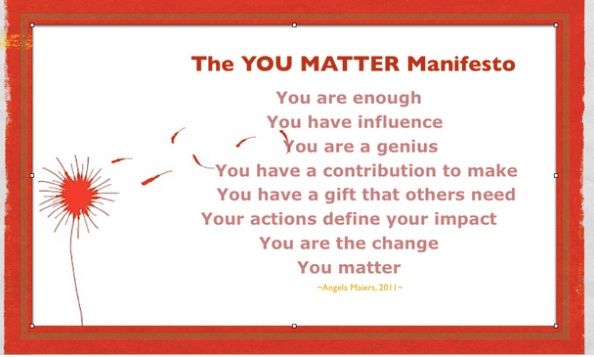
“You Matter”. The revelation that those two words can change the world seems so simple, so intuitive, yet those are not words that young people are used to hearing. Angela Maiers a long time educator, and founder of Choose2Matter decided that those two little words could be revolutionary. With her passion and enthusiasm behind the idea that we each have a unique genius to contribute, it is no wonder that her 2007 TEDx talk went viral. Thus the Choose2Matter movement was born.
“We were created for significance and one of the most dangerous things that can happen to us is the feeling that we don’t matter.”- Angela Maiers
Angela points out that she is not talking about an ego thing, studies show that feeling like you matter is a basic human need. The genius she sees in all of us is each individuals’ ability to problem solve from their own unique personal perspective. What started out as a digital community has now evolved into Choose2Matter Live events at schools across the U.S.A. In my mind perhaps no one needs to hear this more than high school kids who are in the process of self-discovery, so I was thrilled when the two-day Choose2Matter Live workshop came to my daughter’s public high school in Rhode Island.
The first thing the kids learned was the Choose2Matter Manifesto: You are enough, you have influence, you are a genius, you have a contribution to make, you have a gift that others need, your actions define our impact, you are the change, you matter. If they did not believe it before, they were now introduced to the idea that their voices and their actions can help others. The examples shown to this new group of kids of ways in which students have already made an impact through Choose2Matter are remarkable.
Honestly though, who doesn’t need to hear this manifesto? Even as adults the feeling that we matter is essential. This is an ideology that we frequently see first hand here at World Moms Blog, the power of one person, one idea brought to fruition, and how it can positively impact entire communities. Kristyn Zalota launched CleanBirth.org to provide safe birth for mothers in Laos, Alison Fraser started www.mom2momafrica to support the education of women and girls in Tanzania, and the founder of World Moms Blog Jennifer Burden created this global community of mothers from around the world when she couldn’t find what she was searching for online. These are just three examples of the many ways World moms Blog Contributors and Editors are using their passions and voices to make the world a better place. Their accomplishments inspire me to strive to do more in my own life, through their achievements I can see the possibilities when one puts their mind to solving a problem.
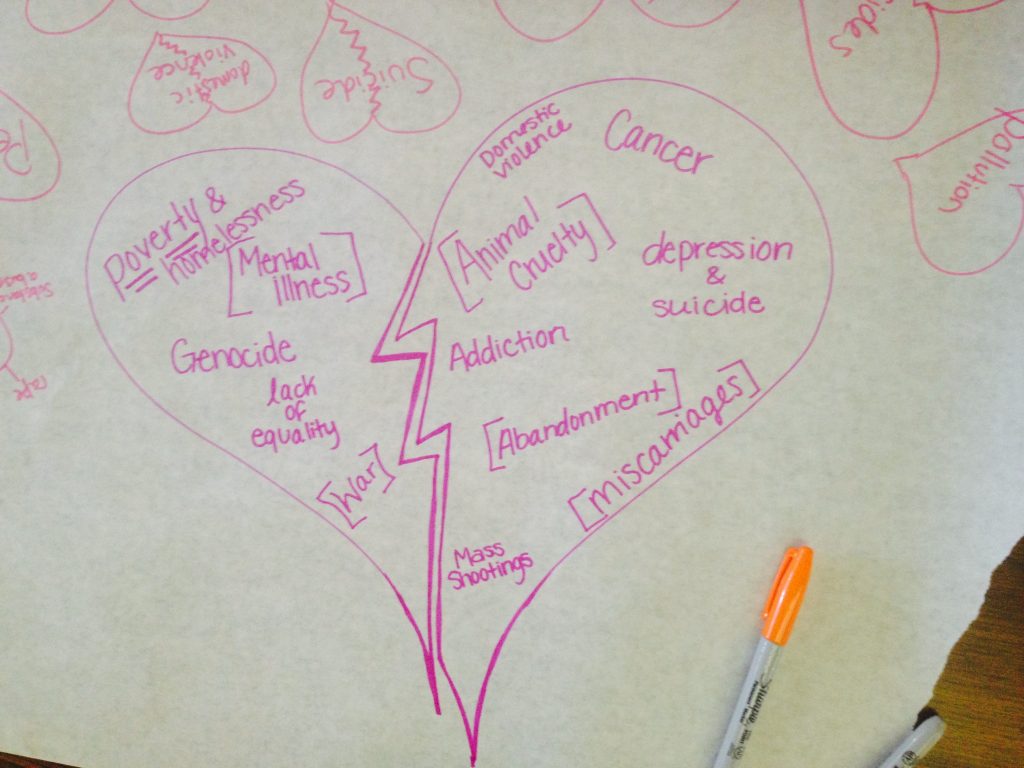
A Heart-Break Map
After the introduction, when the kids broke out into groups of “heart-break mapping” to narrow down what breaks their hearts about the world, and then come up with solutions of what they can do about it, my heart burst open. Kids narrowed down their heart breaks into solvable problems, some chose to be brave about sensitive issues they knew first hand to use their experience to try to help others. Due to a snow-day a room full of high school kids chose to voluntarily return to school on the saturday before vacation week to follow through on their ideas. It was truly amazing to watch these kids come together and talk through some of the major issues impacting society. I witnessed at least three new websites being born to begin to address some of their heart breaks , self-harm, depression, and body image issues for girls. These kids got it. As Angela and her colleague Mark told the kids, these ideas may not be the ones to solve a problem, but you are just building your muscles here, you are just getting started.
The lessons the kids at my daughter’s high school learned in those two days are sure to stay with them. The empowerment of knowing that they do matter, that they are capable of making a difference is huge. The students were left with the message that they are the ones who will need to come up with the answers to the world’s most pressing problems, because us adults just may not have all the answers. (But that is one thing I think all teenagers already seem know.)
This is an original post written for World Moms Blog by Elizabeth Atalay of Documama.
Do you have any great examples of the power of one person who made an impact to share?

Elizabeth Atalay is a Digital Media Producer, Managing Editor at World Moms Network, and a Social Media Manager. She was a 2015 United Nations Foundation Social Good Fellow, and traveled to Ethiopia as an International Reporting Project New Media Fellow to report on newborn health in 2014. On her personal blog, Documama.org, she uses digital media as a new medium for her background as a documentarian. After having worked on Feature Films and Television series for FOX, NBC, MGM, Columbia Pictures, Warner Brothers, 20th Century Fox, and Castle Rock Pictures, she studied documentary filmmaking and anthropology earning a Masters degree in Media Studies from The New School in New York. Since becoming a Digital Media Producer she has worked on social media campaigns for non-profits such as Save The Children, WaterAid, ONE.org, UNICEF, United Nations Foundation, Edesia, World Pulse, American Heart Association, and The Gates Foundation. Her writing has also been featured on ONE.org, Johnson & Johnson’s BabyCenter.com, EnoughProject.org, GaviAlliance.org, and Worldmomsnetwork.com. Elizabeth has traveled to 70 countries around the world, most recently to Haiti with Artisan Business Network to visit artisans in partnership with Macy’s Heart of Haiti line, which provides sustainable income to Haitian artisans. Elizabeth lives in New England with her husband and four children.
More Posts

by Susie Newday (Israel) | Jan 29, 2014 | 2014, Communication, Israel, Life Balance, Relationships, Stress, Susie Newday
*I wrote this a while back when I was on the verge of losing my mind because of all the thoughts and doubts in my head. On an emotional level, I was living in a state of survival. I felt uptight and tense all the time and I was barely keeping it together. To the world none of that was apparent. I was functioning, maybe even too well. After a lot of hard work, I am not in that place anymore, which is why I guess I feel it is safe to share this now. Sure I still have my self doubts and difficulties, we all do, but these days I don’t feel like I’m living every day in survival mode.
 Our lives are full of people. Unless we live like a hermit shut away from human interaction, we have no choice but to engage in human contact, both physical and verbal, numerous times on a daily basis. There are all kinds of people out there. There are those we like more, there are those we like less. There are people we despise or maybe we just think we do. And, because we are lucky there are also people whom we love.
Since I know there is someone in your life you love, I want you to close your eyes and take a moment to think about them. If you want, it can be someone you just like or admire not necessarily love. Have you pictured them well? Do you have a smile on your face?
Now comes the hard part. Why do you feel that way about them?
That question came out of my desire to understand why someone would love or like me. What is it about me or what I am doing that would cause someone to stop and say, hey I like her. And I don’t know if the answer that came to me is the truth and whether it my way of trying to explain away something that can’t be quantified and explained.
Simply put, I think people like/love/admire us for the things we do for them and for others. They like us because of the way we make them feel about themselves. Why do we love our children from the moment we set eyes on them after they’ve been born? Because just by being born they have done something for us. They have given us a new job, a new purpose, new meaning in our lives.
We all want to feel loved. We all want to have the security and comfort of knowing there is someone we can lean on. I’m saying we can’t be loved if we don’t love. We won’t have someone to lean on unless we are there for others. We all want to feel taken care of yet we won’t have that unless we take care of others.
Sometimes it feels like love is tiring. You have to do all the time. Love is work. And I wonder, if I stop, will I still be loved?
Would you still love me
If I had nothing left to give,
If I had no energy to take care of you
If I had nothing you really needed?
Would you still love me
If I didn’t feed you or clean up,
If I didn’t offer my help
If I didn’t seem to care?
Would you still love me
If my mind wasn’t quite as sharp
If I embarrassed you
With my confusion or bursts of anger?
Would you still love me
If my smile left my face forever
If my words went mute
And the music in my soul faded?
Would you still love me
Because of all I once was,
Even if now there was nothing recognizable
About the person sitting before you?
Would everything I have done until now
Be enough for you to still love me?
Love, the age old question
Pondered while hovering over the the precipice of self doubt.
I’m afraid to stop doing, to stop caring, to change the rules that have been golden up until now. I’m afraid to sway the balance of love and acceptance. I’m afraid if I do that I won’t be loved.
I yearn for unconditional love, to be able to give with truly no strings attached and to know that I am loved without having to do anything at all, just because I am a person who has a heart full of love. Is unconditional love just a fantasy residing in empty words or are we really capable of pure love? I wish I really knew.
What I do know, is that first of all I have to love myself, no strings attached. And when I feel like withdrawing, I need to love more.
Why do you think you love and are loved?
This is an original post by World Moms Blog Africa & Middle East Regional Editor, Susie Newday in Israel. You can also find her on her blog New Day New Lesson.
Photo credit to the author.
Susie Newday is a happily-married American-born Israeli mother of five. She is an oncology nurse, blogger and avid amateur photographer.
Most importantly, Susie is a happily married mother of five amazing kids from age 8-24 and soon to be a mother in law. (Which also makes her a chef, maid, tutor, chauffeur, launderer...) Susie's blog, New Day, New Lesson, is her attempt to help others and herself view the lessons life hands all of us in a positive light. She will also be the first to admit that blogging is great free therapy as well. Susie's hope for the world? Increasing kindness, tolerance and love.
You can also follow her Facebook page New Day, New Lesson where she posts her unique photos with quotes as well as gift ideas.
More Posts - Website
Follow Me: