by Susie Newday (Israel) | Jul 31, 2013 | 2013, Culture, Eye on Culture, Feminism, Inspirational, Interviews, Israel, Life Lesson, Music, Parenting, Susie Newday, Uncategorized, World Events, World Interviews, World Motherhood
When you’re offered an opportunity to interview the biggest female singing sensation in your country, you jump at it. Last month during the Israeli Presidential Conference I was lucky enough to meet and interview Rita Jahan-Foruz a singer known simply as Rita.
Rita was born in Tehran, Iran and emigrated to Israel at the age of 8. Through hard work and lots of talent she became Israel’s most successful singing artist. For the last 25 years Rita has had an illustrious career both in Israel and abroad. Her latest album “My Joys” is entirely in her native language of Pharsi. That album has become a big seller on the black market in Iran where it is forbidden, along with all other Western music. Some say that Rita’s album would go gold in Iran if it wasn’t banned.
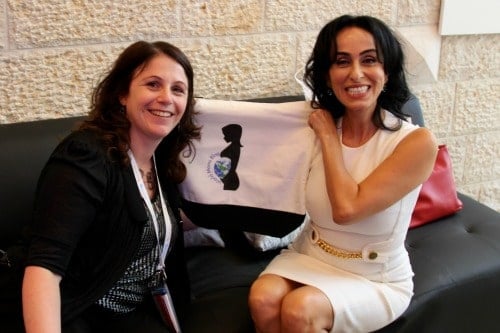
I waited in the VIP room for the interview to start, and I sat there becoming increasingly more nervous as I watched other people interview Rita and a host of other interesting people who were speaking at the conference. I did chuckle a bit to myself when Weili Dai, a top female entrepreneur and the CEO of Marvell (herself an amazing, friendly and gifted woman), came over to have her picture taken with Rita. It wasn’t the photo op that made me chuckle, it was the fact that right before the photo was snapped both of them fluffed their hair. It seems to be a universal quirk all women around the world have before being photographed. I was also quite in admiration how both of them managed to be on their feet all day in their beautiful but really high heels.
Okay, shallowness now aside.
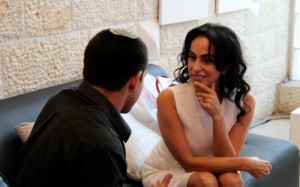
Right before our interview started, a young man who was a waiter at the event came over, sat down on the couch next to Rita and started talking to her. It was spontaneous on his part and graciously received on her part. It was only after I had tweeted a picture of them talking and commented on how friendly Rita was that someone tweeted me back saying that the waiter is connected to an organization called OneFamily (a non-profit organization that rehabilitates, reintegrates and rebuilds the lives of Israel’s thousands of victims of terror attacks) which is a cause dear to Rita’s heart.
When it was my turn I came over, said hello and introduced myself. I sat down trying to look put together, which I can tell you is not an easy task when you are lugging a knapsack, a telephone, a tape recorder, notebook and ipad.
Before I even started asking questions, I gave Rita a World Moms Blog tote bag that Jennifer Burden, the founder of World Moms Blog, had sent me to gift to her. Rita loved it, and right away started putting all her things into it.
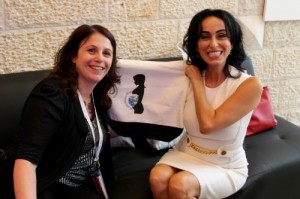
I then handed her a little gift from myself, a keychain that said in Hebrew “Music is the language of angels.” She loved that too, and you could see that her reaction was genuine and not just polite. She right away pulled out her keyring from her bag. It had lots of keys and other keychains, including one with a picture of her daughters and she clipped my gift right on. She even proudly showed it off to others.
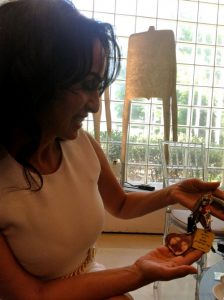
As I was about to start asking her questions, I blurted out, “I’m a bit nervous.” She looked at me in surprise and said, “Nervous? Really? Why?” as if the concept was completely foreign to her that someone would even be nervous speaking to her. That put me completely at ease, and the interview, or should I say more of a conversation, started. When I watched some of her videos later I was able to once again see her natural friendliness and charm shine through. This video of Rita recording one of her songs in Pharsi is a good example of her being down to earth and approachable.
I offered to do the interview in English or Hebrew, but Rita wanted to practice her English so we started off in English but moved back and forth. I could tell how passionate she was about certain subjects (which was often) because that was when she moved back into Hebrew in order to be able to express herself so much more freely.
Susie: World Moms Blog represents mothers from around the world. Right now we represent 20 countries including Morocco, Saudi Arabia, UAE, Egypt and many others. We write about motherhood, culture, social good, about connecting people through what they have in common.
Rita: Wow. Do you have a writer from Iran?
S: No, but if you know someone, we would love to have them on board.
I think that what you’re trying to do with music is what we at World Moms Blog are trying to do through writing, which is to bring the world together one person at a time. (Rita nodded her head at that.)
Do you see yourself as an ambassador of peace between all countries or just between Israel and Iran?
R: I think with my own existence I represent the Iranian and Israeli connection but I would love to represent as much as I can. I think that as women we have a unique way of connecting.
The male and female species are in essence two opposites. You need them both in the world, like Ying and Yang, day and night. It’s a little bit like our reproductive organs. The male behavior, like the male anatomy is surging forward, conquering, moving on with energy that is outward facing.
A woman’s energy is like our wombs. It’s meant to contain/include* and to embrace what there is no matter what. We first embrace and bring things close. We need to be able to see the strength in this, we need to influence and to realize that the place of “containing/including*” others is our strength.
It’s like a a mother who is always the center of the house. Everyone in the family comes and goes, they go a bit nuts. They cry but in the end they always come back to the middle, to the center and the nature of women is the center.
We are mothers and what happens to our children, and to the world they will inherit is important to us. We have to use our natural strengths of connecting to make sure we do what is best for them.
(*There is no great English translation for the word Rita used. The closest I got was contain but it is somewhere between contain and include with maybe a little bit of absorb.)
S: What would you suggest to women to do in order to empower themselves?
R: Not everyone can sing or dance or act or write books, but I think that each and every one of us can influence by connecting. One person connects with another and they connect with someone else from someplace place and so on. We all have to try to connect to others.
(Note: Rita is not only the best selling Israeli singer of all time, she also dances, acts and has published a children’s book. She received The Israeli Academy Award for Best Actress in 1989 for her role in The Thousand Wives of Naftali Siman-Tov, as well as the 2011 Best Actress award at the San Francisco International festival of Short Films for Ben returns Home. Her children’s book “The Girl With A Brave Heart” has been translated into English from Hebrew.)
S: That is something really close to my heart. That’s how I got to blogging, by connecting with other mothers though a forum overseas, getting to know them and having them get to know me. We were all from different cultures but we were all mothers.
One of the things which touched me was listening to you talk about how you got the love of music from your home and that your parents were very supportive of you.
R: They were supportive in their love. They didn’t understand what I was doing, going from class to class, learning acting, dancing and taking voice lessons. They didn’t understand anything about that.
S: But what I’m hearing from you is that they didn’t criticize either?
R: No they didn’t.
S: You have two daughters ages 12 and 21, right? Do you think parent/child relationships today are different then they were when you were growing up?
R: Of course. Of course. I think that back then children were not so important in what they said. They were children. Nowadays, we don’t look at children as children. They are much more important than us. We listen to them more, we are more attentive and sensitive to them. I don’t think it was like that back when I was growing up. Kids were kids. You ate and grew. No?
S: I don’t know. What I see is that kids these days are less connected to their parents than we were, at least on a daily basis. They have a lot more outlets than we had.
R: The world is changing. In this age of the television and computers, the “outside” world has more influence whereas once the “inside” world, the inner circle, had more influence.
I think that these days we give our kids so much love that maybe we spoil them too much. We are more protective of them than anyone was of us. Right?
S: I think that these days we have more to protect our children from.
R: Yes, you’re right.
S: Has fame affected your family relationship and your relationship with your daughters?
R: Of course.
S: In what ways?
R: I’m not talking about fame because fame didn’t affect anything. I am talking about not having the privacy to go for instance with my daughter to the beach. People constantly come and want to take pictures with you and you can’t possibly have privacy with your family and children outside of the house. Of course it’s something that affects you.
S: What do your children have to say about it?
R: I think they don’t like it. They are much more sensitive to people passing by and looking at them or photographing them. They are very sensitive to that.
S: Do you think your children feel any advantages of your fame?
R: Of course. They come to the concerts. They have a different type of life. Once, my daughter Meshi came home laughing at a question that someone had asked her. “What is it like to be Rita’s daughter?” She said I don’t know, I haven’t experienced anything else.
S: It sounds like she has a great sense of humor.
R: Yes, she’s amazing.
S: What is your wish for world mothers?
R: I wish for all us mothers to have the power, strength and wisdom to protect our children until they themselves have the ability to protect themselves.
I think that the most painful thing in the world is knowing that children are raped or abused and that we are not really able to protect them. That is what I am most sensitive to, knowing that somewhere out there, there is a child that is helpless and there is no one to protect him.
S: Sadly, things like that happen even to children who have people looking out for them.
R: It’s even worse when the people who are supposed to be protecting the children are the ones who do terrible things and do them harm.
S: Do you have one particular defining moment that you remember as a child?
R: Yes, yes. In Iran, my mother had a hair salon in the house. All kinds of women used to come to her. Once, a women who was almost completely bald came. All she had was wisps of hair. My mother shampooed her hair and while she was doing her hair she kept telling her you’re so beautiful, look how beautiful you are, you’re so wonderful.
I was 6, and my sister who is four years older than me was 10. My mother was working in our bedroom like she always did because that was also her work room. When the woman left, my sister said to my mother, why are you such a liar? How could you tell her she was beautiful? She was bald, she almost didn’t have any hair.
My mother then asked my sister, why do you think I was lying? My sister said, you told her how beautiful she was, what beautiful eyes she has, but she was bald. My mother then gently asked my sister, but did you look at her eyes? Her eyes were very beautiful.
And that’s the lesson I quietly learned there.
S: It seems to me that that is exactly what your book teaches, to look past the outer and see the beauty and kindness that is in each person.
R: That’s what I learned my whole life from my mother. When she looks at someone, first and foremost she looks for what’s beautiful in the person. That’s the way she sees people. That was a very big life lesson for me.
Every time I tell this story I still have goosebumps.
S: I find it amazing that I didn’t even know about your book until one of the other World Mom Bloggers told me that you had written one and it had been translated to English.
R: The book is gaining incredible momentum.
S: It should. It’s a great book with a great message and great illustrations.
(Note: The book is called The Girl With a Brave Heart. I read it in Hebrew and I love the many messages in it including the fact that people don’t always know how to ask for what they need and that we should let our hearts lead the way.)
Of course that’s when I pulled out the two copies of her book that I bought along for her to sign. I handed her a pen but she searched her bag because she has a special marker for signing books.
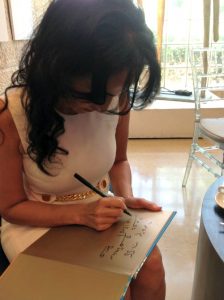
There is something so nice about talking to someone who is famous, who has performed for world leaders, who has bought so much joy to others through her music, yet still makes you feel no less important than she is. Maybe one day I will get to speak to her again because I really enjoyed our conversation.
I really hope Rita has unparalleled success in bringing people and countries together through her music. My wish for her is that one day she will get to perform in her native country of Iran, something that will mean that peace and acceptance has finally come to our world.
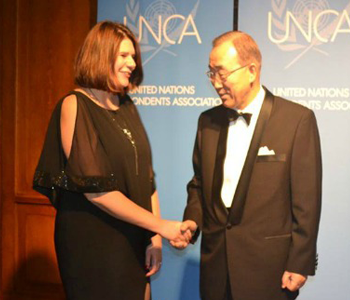
Before Rita’s performance at the UN’s main assembly hall, secretary-general Ban Ki Moon told Rita that many revolutions started from music and that it’s a place that politicians can never enter.
What do you think? Do you think music and musicians can help bring about change and be a conduit for peace?
This has been an original post to World Moms Blog by Susie Newday of Israel. You can find her positive thoughts on her blog, New Day New Lesson.
Photo credit to the author.
Susie Newday is a happily-married American-born Israeli mother of five. She is an oncology nurse, blogger and avid amateur photographer.
Most importantly, Susie is a happily married mother of five amazing kids from age 8-24 and soon to be a mother in law. (Which also makes her a chef, maid, tutor, chauffeur, launderer...) Susie's blog, New Day, New Lesson, is her attempt to help others and herself view the lessons life hands all of us in a positive light. She will also be the first to admit that blogging is great free therapy as well. Susie's hope for the world? Increasing kindness, tolerance and love.
You can also follow her Facebook page New Day, New Lesson where she posts her unique photos with quotes as well as gift ideas.
More Posts - Website
Follow Me:


by Purnima Ramakrishnan | Jul 23, 2013 | Casting a Wider Net, Economy, Education, Feminism, Government, Human Rights, Humanity, India, Inspirational, International, Motherhood, Nature, Purnima, Social Good, The Alchemist, United Nations, Women's Rights, World Moms Blog, World Voice
A couple of weeks ago, we featured a remote village, Piplantri (Western India) on the Gates Foundation. Piplantri is a model village, whose actions of change have been very well received all over India.
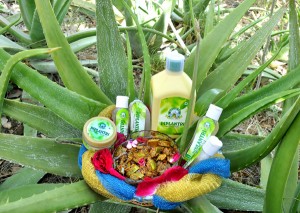
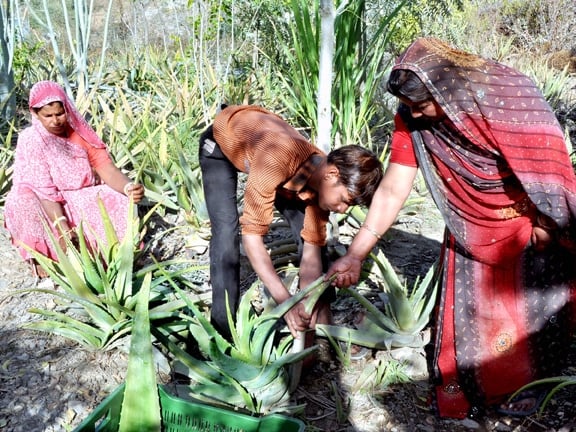
Aloe Vera products from the small scale industries
They plant 111 trees for every girl child who is born, create a fixed deposit of INR 31,000 (approx. USD 620) in her name which attains maturity when she is 18 years old and chalk up a legal agreement between the parents of the girl child and the government that they won’t get their girls married off before she is 18 years old. They also have Aloe Vera industries in which the women of the village are employed. So they have achieved MDGs #3 (promote gender equality and empower women), #4 (reduce child mortality), and #7 (ensure environmental sustainability) at one go. Today on the blog, I would like to introduce Mr. Shyam Sundar Paliwal and his wife, Anita, who were the pioneers of this change action in their village. Anita is 42 years old, and she got married after she finished her 12th grade. It was an arranged marriage and the couple were happy.
Their first daughter Kiran was 18 years old when she passed away. She died due to dehydration. That was the turning point in their life, and they vowed to make lives of others happy.
They also have another daughter Hemanshi (22) and a son Rahul (15) who is in 10th grade. Hemanshi is married and has a child, too.
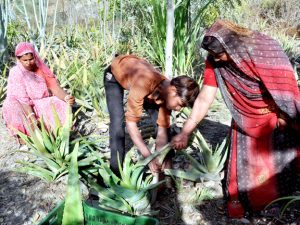
The women of the village tending Aloe Vera
Anita recalls that when she came to her in-laws place after she got married, the first lesson she received from her father-in-law was to plant banana saplings such that they bear fruits during the rainy season and then plant mango saplings around the banana trees. Banana trees absorb water during the monsoon and transfers this water to the mango trees through its roots during the arid summer season. She says she has stuck to this piece of advice to date in her village and ensured that her villagers follow such age-old farming wisdom.
Anita, who is the wife of the ex-sarpanch (ruling political head) of the village, Piplantri, is a very active community member. She is a Zila Parishad Member (Elected person of the district council). Her husband has always been supportive of her as a woman and wants her to do her best for her villagers. He has never restricted her in any way. Though she is more educated than him, he has never been jealous of her, but has only encouraged her and furthered her growth and development as an active member of their society and community. She says, if only all women of the world gets a husband like Shyam, the women of the world will be better off and we would not be speaking of women’s rights here.
Shyam Sundar won the panchayat elections in 2005 and he says he first wanted the people who worked in the government offices to be comfortable. He installed the first AC in the office, brought in some comfortable furniture and ensured that people in all echelons of the society were treated equally. (In rural India, at times, the upper caste people are given more respect and sit on chairs, whereas the lower caste people are treated shabbily and sit down on the floor. Read more about the Evils of Caste system in India here). He said, he worked on the psychology of the ruling body to make them happy and comfortable. He says, only if they are happy, they would start working on reform measures and help provide for the remaining villagers. He, at his own expense, made the offices a comfortable place to work and conducive to provide better results.
He started small. In this difficult water shortage era, he diverted the waste water from all houses/offices towards the fields. Better water conservation was ensured. If waste water does not stagnate anywhere, there would be no mosquitoes and no dengue and fewer diseases. So, he solved primarily problems with simple, cost-effective solutions.
He installed drinking RO water systems in schools. Brought in furniture for the students and made the public schools better than the expensive private schools. People started flocking towards government schools. He raised awareness slowly and in a small way, which evolved out.
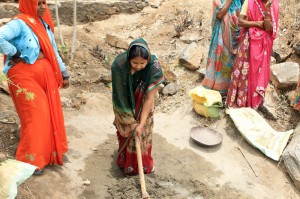
Mrs. Anita Paliwal working on the Water Harvesting Structure
He started rain water harvesting with the help of government. He built canals. He used the women of the village who were unemployed. To the left is a picture of Anita, who at times does not hesitate to get into the fields with a mean sickle. She and her husband were instrumental in starting the water harvesting structure of the village. In most of his welfare activities 90% of the employed are women and 10% alone are men. Women of the village have been blessed indeed to have him there, says Anita. In addition to 25,00,000 Aloe Vera plants, there are 10,000 rose shrubs which are also used in small-scale industries for toiletries and medicinal supplements. Women are employed in all of these schemes.

Mr. Shyan Sundar Paliwal and Mrs. Anita Paliwal with Anna Hazare
He started the Kiran Nidhi Yojna with the 76-year-old International Social Activist, Anna Hazare to ensure that no girl child is married off before 18 years old. This man who himself did not study in a college, ensures that all girl children in his village get a college degree. He also nudges the parents to get their girls married off in collective wedding, so that money is conserved and better utilised for other public welfare schemes or for their own savings. This scheme also granted government land to the parents in return for planting 111 trees on the birth of their daughter in that land, and tending to it to fruition before their girl child is 18 years old. On the death of any community member, the family is requested to plant trees again.
He says this again works on their psychology. The girl children treat the trees as their own brothers and sisters. After all, the saplings were planted on the day of their birth. And the parents get emotionally attached to the trees which came into existence on the day their family member was born or died. They then take care of it as a family member, and would under no means cut it down. He says, it is all in the hearts of the people. If people get involved with their hearts, anything is possible. He made people to get emotionally attached to nature and trees and the earth.
I learnt something new from Anita and Shyam that day – Ecofeminism. It is such a beautiful concept. Women and nature have been connected since time immemorial and this couple have harnessed it.
After all, he who was not highly educated could work on such things and make that beautiful village into a heaven, he says, the whole world could change too. And we would have no need to talk about the MDGs or uplifting of any downtrodden society/community.
When asked how he felt when his village was showcased by the Gates Foundation on their Blog, he gushed with happiness and pride. The district collector and Panchayat officials were so excited, too, he said. But his only complaint was that he could not get a hard copy of the magazine which he could show his villagers. He is so proud like a father, like the father of the heaven he created.
He also invites donation to his Kiran Yojna Scheme for the fixed deposit of INR 31000 of every girl child born in his village. He invites the contributors, readers and fans of World Moms Blog to make a trip to Piplantri. He wants people to embrace such change and for them to build upon it to suit their own society, and community.
This is an original post to World Moms Blog by Purnima, our Indian mother writing from Chennai, India. Her contributions to the World Moms Blog can be found here. She also rambles at The Alchemist’s Blog.
Photo credit to Piplantri.com
What do you think about the traditions put in place to support girls and women in the community of Piplantri?

by Alison Fraser | Jul 16, 2013 | 2013, Economy, Human Rights, India, Social Good, World Moms Blog
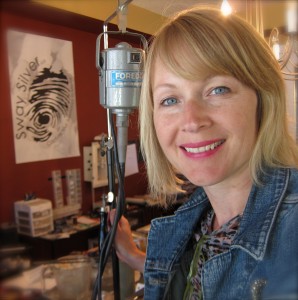
Heather Horsey of Swaysilver jewelry
As we all know, raising children in today’s society can be a financial challenge for many. As mothers, we are often seeking the best deal on the purchases we make. Like many, I do consider myself to be a responsible consumer and I try to purchase from ethical sources.
The recent tragedy in a Bangladesh factory that resulted in the loss of hundreds of lives, however, revealed that some of the stores that I purchase from on a regular basis were in some way or another linked to the poor working conditions of this particular factory.
The majority of those who lost their lives that tragic day were our fellow mothers, working to provide the basis necessities of life to their families.
Those lost in the building collapse have not been far from my thoughts since that day. My appreciation has greatly increased for the companies run by my fellow Canadian moms who I know put the ethical treatment employees as a top priority in their company operations. Peekaboo Beans, Redfish Kids Clothing, KiKi Kids, and Red Thread Design are some of my favourite Canadian brands started and operated by some fabulous Canadian moms.
The success of these businesses lead me to wonder: why can’t all companies choose to manufacture goods in an ethical manner? Isn’t it a fundamental obligation of ours? Why is that for some, despite the obvious financial challenges, this is of such high importance, and yet for many, it is not? In order to address this issue, I decided to speak to a friend and local artisan, who I know has given this very topic much thought and consideration.
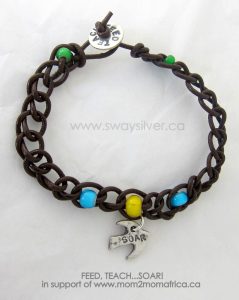
Soar bracelet by Heather Horsey
Heather Horsey makes beautiful silver jewellery in my Canadian hometown. She recently designed and marketed a “Teach, Feed, Soar” bracelet benefitting my not for profit organization, Mom2Mom Africa. I asked Heather why she chooses to run her business, Swaysilver, in such an admirable and ethical manner.
Her response was equally as admirable: “It’s no secret that for centuries the jewellery industry has been wrought with social injustices and it’s good to see some headway being made in the ethical production of jewellery by using recycled materials and lab-created gemstones. The metal I use is recycled silver, harvested from catalytic converters from the car manufacturing industry. In my opinion, a lot of good has come out of creating jobs overseas, however, it is in the best interest of everyone to make sure the working conditions are safe and pay is fair”.
It is common knowledge that overseas factories provide a huge cost-savings to many companies, enabling them to provide products to interested purchasers at bargain prices. This is a huge challenge to entrepreneurs, like Heather, who are trying to provide products at a competitive price without compromising ethical standards.
According to Heather, “while bargains are enticing, I’d rather buy from a company that I know is going above and beyond to put caring for people first no matter where the product is being made. Competing in price is a challenge only when it is assumed that I should be able to make by hand something that is quickly made by machine in a factory overseas. I do my best to create designs that are original and artistically interesting in order to set my work apart from something that is mass-produced”.
I truly believe that we need to shift our focus from finding the best possible bargain to instead ensuring that our purchased products are being made in a manner that provides safe and respectable working conditions for employees. I encourage everyone to research the way in which products from your favourite companies are produced. Our actions have a direct impact on the lives of many around the world. It is our moral obligation to help those in need, and not endanger the lives of others in order to benefit ourselves. I encourage you to support local artisans and companies of high ethical standards in your communities.
Saving a few dollars can mean the difference between life and death for others.
As mothers and consumers, we have the power to create change and prevent another needless workplace tragedy.
This is an original World Moms Blog post by Canadian writer and founder of Mom2Mom Africa, Alison Frasier.
Are you conscientious about the ethics and conditions under which the products you purchased are sourced?
Alison Fraser is the mother of three young girls ranging in age from 5 to 9 years old. She lives with her family in Cambridge, Ontario, Canada. Alison works as an Environmental Toxicologist with a human environment consulting company and is an active member of the Society of Environmental Toxicology and Chemistry (SETAC). She is also the founder and director of the Canadian Not for Profit Organization, Mom2Mom Africa, which serves to fund the school fees of children and young women in rural Tanzania. Recently recognized and awarded a "Women of Waterloo Region" award, Alison is very involved in charitable events within her community including Christmas Toy and School Backpack Drives for the local foodbank.
More Posts - Website
Follow Me:


 Malaria has been in the news this week. Or, rather, the antimalarial medication mefloquine has been getting a lot of attention. The FDA recently issued a black box warning on this old standard for soldiers, vacationers, and expats in faraway, mosquito-infested lands. Faraway lands like the Congo, where I live with my husband and two small children.