by ThinkSayBe | Feb 13, 2015 | 2015, Awareness, Communication, Cultural Differences, Education, Human Rights, Humanity, Parenting, Prejudice, Social Equality, ThinkSayBe, World Motherhood

Racism |ˈrāˌsizəm|noun: The belief that all members of each race possess characteristics or abilities specific to that race, esp. so as to distinguish it as inferior or superior to another race or races.
Prejudice |ˈprejədəs|noun: Preconceived opinion that is not based on reason or actual experience: English prejudice against foreigners | anti-Jewish prejudices.• dislike, hostility, or unjust behavior deriving from unfounded opinions.
These are the definitions of these two words as provided by the dictionary on my Macintosh device. Has everyone experienced racism and prejudices by either acting or feeling these words out, or by being victims of them? For those of us who have been prejudiced against a person or people. and have been racist against others: have we been honest with ourselves about it?
(more…)
I am a mom amongst some other titles life has fortunately given me. I love photography & the reward of someone being really happy about a photo I took of her/him. I work, I study, I try to pay attention to life. I like writing. I don't understand many things...especially why humans treat each other & other living & inanimate things so vilely sometimes. I like to be an idealist, but when most fails, I do my best to not be a pessimist: Life itself is entirely too beautiful, amazing & inspiring to forget that it is!
More Posts
Follow Me:


by Erin M. Threlfall | Feb 10, 2015 | 2015, Brazil, Education, Social Good, United Nations, World Moms Blog, World Voice
 In January of 2014, I was asked to write about MDG 6 for the Gates Foundation Blog. It was part of an initiative that WMB was taking part in to help raise awareness about the UN Millennium Development Goals (MDGs). At the same time, I was just kicking off a unit in my grade 3 class room about Social Activism.
Our unit’s central idea was: International organizations and individuals can work together to have an impact on local and global issues. During this unit of study, the children would be working to answer the following questions: What are local and global issues? How do individuals and organizations address local and global issues? What are our responsibilities as global citizens? How can we use our interest, skills and talents to have an impact on local and global issues?
It turned out, the Gates Foundation piece was perfectly timed. I shared it with the children as an example of how I was using my skills and talents as a writer to raise awareness and they became inspired to want to use their talents to help make the MDGs a reality.
The children set off researching the MDGs, identifying the major issues, who was helping, and then started to ask if they could do something to help resolve some of the issues. They were especially tuned into development goal #1: Eradicate extreme poverty and hunger and #2: Achieve universal primary education.
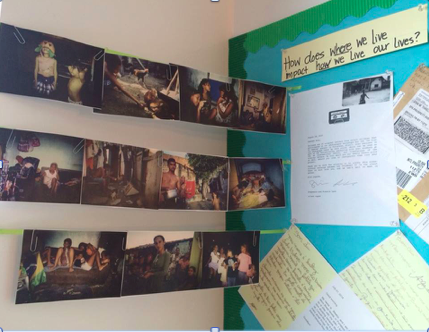
We had guest speakers from the United Nations and non-government organizations come in to talk with the children about the work that they do, we had Skype calls with people on the field, and then, as luck would have it, we had the opportunity to interview a young man from Brazil who started a newspaper in his favela when he was ten years old. The Paper’s goal was to raise awareness about issues impacting his community and to help bring about change.
Ten years later, that paper has become one of the most influential tools in impacting change on his favela, and has inspired other communities to follow suit.
My students were blown away by the fact that one ten-year old could have such an important impact on his community. They were motivated to help impact change, but how?
Sometimes, ours is not to know how, but just to have a desire and to ask the right questions. The “how” will find you, and in this case, it definitely did.
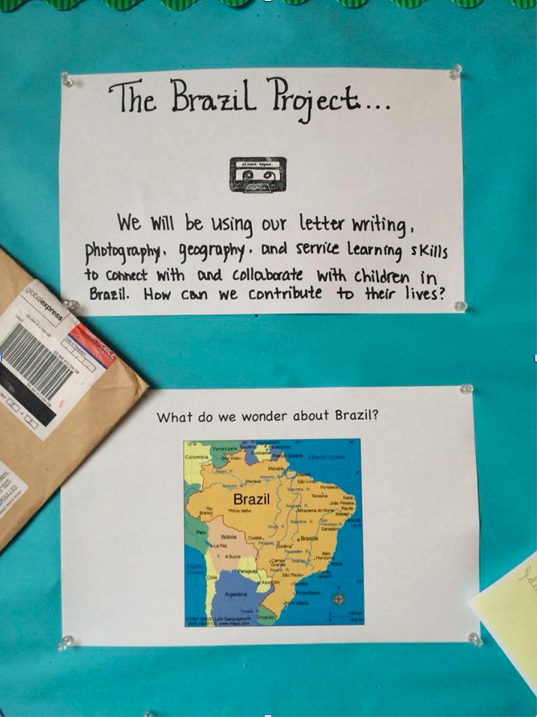
Through a series of serendipitous exchanges, at this time I was turned on to the work of two very inspiring people, Francis and Stephanie Lane and their Silent Tapes 50 Kids/50 Cameras project in Brazil. Stephanie and Francis were making their way to a favela in Fortaleza, Brazil during the World Cup to help children capture their world. They gave 50 cameras to 50 kids, and after they were taught photography skills, the kids were set free to capture their world. The project is part of a documentary initiative to bring awareness to the issues facing those living in the Favelas in Brazil. You can learn more about that here.
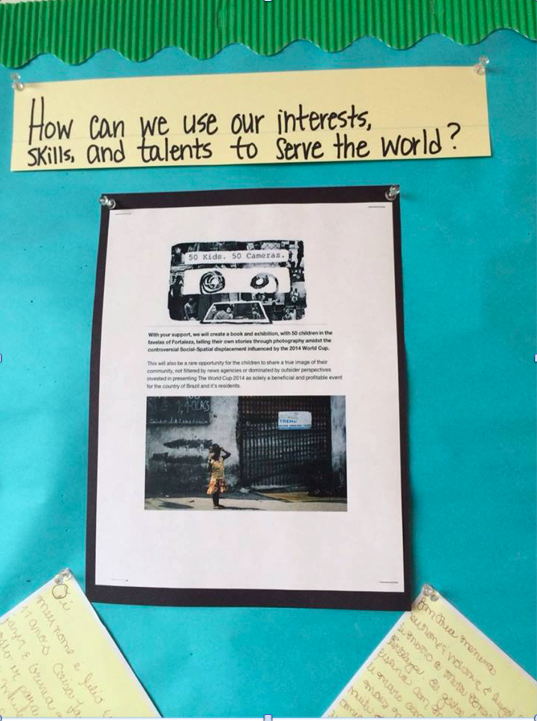
I told the children about the project, and they felt strongly that it should connect to the children at our school, the United Nations International School. It was their enthusiastic chorus of “PLEASE! Let us get to know the children!” That set the next chain of events into motion.
What has followed is an interdisciplinary cross-cultural project that connected the children in Brazil to the children in my classroom.
In collaboration with Stephanie and Francis, we arranged a pen-pal exchange between the Brazil cohort and mine. My students engaged in the same photography curriculum and captured their world in New York. During the project, we extended our look at the Millennium Development Goals, learned how to write letters, and deepened our geography skills. Perhaps the most important and lasting lesson is that of empathy.
Through the letter and photography exchange, my children became very aware of the impacts of poverty, and the reality of how this shapes another child’s reality. My students have developed a connection with children elsewhere, and really want to work to help improve their lives.
The project has taken on a life of its own. Now having gained sponsorship from UNICEF, we will be hosting a gala in April to showcase the work of the children in New York and Brazil, and to raise funds to help build a community center where the Brazilian children can gain access to education. Finally, the children’s work will be exhibited in the UNICEF wing at the UN headquarters in the spring.
This all came from that one World Moms Blog’s post assignment in which I was asked to write about the MDGs.
The opportunity to serve and make a difference: This is why I became a teacher. To help foster a generation of children who are empowered with the knowledge and skills they need to help make the world a better place. This is also why I started to write with World Mom’s Blog: to join a community of women who desire to help make the world a better place. When working together, we really can “Be the change we wish to see in the world.”
This is an original post written by Erin Threlfall for World Moms Blog.
Has there been a serendipitous chain of events that led to greater things in your life?

Originally from the US, Erin has credited her intense wanderlust and desire to live around the globe to her nomadic childhood. Every two to three years, her father’s work with a large international company provided the opportunity to know a different part of the US (VA, OH, PA, GA, SC, NY) and eventually Europe (Germany and Italy) and Asia (Thailand and Japan). Though her parents and siblings finally settled down in the heartland of America, Erin kept the suitcases in action and has called Ghana, South Korea, Togo, Bali, and now New York home. Single Mom to a fabulous seven-year-old citizen of the world, she is an educator and theatre artist who is fascinated with world cultures and artistic practices. Her big dream is to some day open a school focused on well-being and inquiry based learning to meet the needs of all her learners. In the meantime, Erin and her Little Man Edem, plan to keep investigating theatre and influencing education, one continent at a time. You can read some of her ramblings and perhaps find the common thread by checking our her personal blog, telling all about This Life http://www.erinmthrelfall.com/
More Posts - Website
Follow Me:

by Kyla P'an (Portugal) | Feb 8, 2015 | 2015, Education, International, Parenting, USA, World Voice
 I have long been an advocate of girls education. It is something I want every girl, wherever she is in the world, to have access to. I deeply believe educating girls is a major proponent in our quest to improve the world.
So when my daughter was born eight years ago, I committed myself to ensuring that she would always have the access to and support she needs in attaining the best education my husband and I can give her.
But along with the paramount importance her education is to me, so too is her understanding of how valuable having an education is and how lucky she is to have safe schools and multiple options available to her.
But how do you impart this to an eight-year-old?
Like the majority of other eight-year-olds in the US, my daughter takes it for granted that she attends school five-days-a-week, Monday through Friday. But she also attends school on Sunday, when she goes to Chinese School. And this she does not take for granted, instead she long viewed it as a hindrance to her free-time. Because, though she only spends 90-minutes a week at Chinese school, its homework load and test schedule far exceed that of her American school, where she spends more than 30-hours-a-week.
Whenever my daughter complains about the work load or Chinese school conflicting with social events, I find myself saying:
You have NO idea how lucky you are to have more than one school to attend.
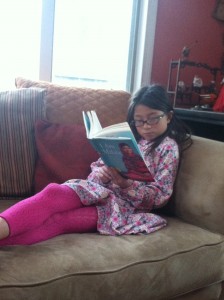
But until recently, this was a phrase delivered with little impact. That is, until my daughter started reading her latest book: I Am Malala, by Malala Yousafzai.
She received the book for Christmas, along with A Long Walk to Water, from her aunt. When she opened the gift, I was thrilled because, though I love Harry Potter and Percy Jackson, here were some stories that really mattered; finally, some glimpses into a REAL world, just one my child did not yet know.
I hoped, desperately, that she’d want to read these stories.
I was in luck.
Almost as soon as she picked up I Am Malala, she had trouble putting it down. It was filled with concepts she had trouble getting her head around: like the idea that a person could board Malala’s “school bus” with the intent to kill her or that having access to school was a privilege.
It had her asking all kinds of questions: about hardships and hurdles girls in other parts of the world have to face in order to get an education; about what it means to be a top student; about what sorts of sacrifices students (and their families) have to make in pursuit of education.
Reading Malala’s story is opening my daughter’s eyes to the opportunities and freedoms she takes for granted and it is giving her a deeper gratitude for what she has.
I don’t want my young children to worry about the injustices and evil out in the world but I do want them to understand better the many blessings they have and that not everyone has the same access to these opportunities.
Tomorrow, here in the US, our Public Broadcasting Service (PBS) will air the third and final episode of #APathAppears. In January, when World Moms Blog Founder, Jennifer Burden, World Voice Editor, Elizabeth Atalay and I attended the pre-screening of this series in New York, by invitation of @SaveTheChildren, it was episode 3 that resonated most with me.
The episode highlights Kibera, the largest slum in Kenya. But rather than showing us the desperate side of life in the slum, viewers (and readers of the eponymous book before) are introduced to Kennedy Odede and his wife Jessica and the organization they have built, Shining Hope for Communities(SHOFCO).
Like me, and so many others, SHOFCO knows that the pathway to hope is guided by educating girls. Authors Nicholas Kristoff and Sheryl WuDunn remind us that, if enough people walk in the direction of hope, ultimately A Path Appears.
You can watch the PBS series, A Path Appears online, by clicking here. Or read the book of the same title by husband and wife journalists @NickKristoff and Sheryl @WuDunn.
This is an original post to World Moms Blog by Sr. Editor and mother of two in Massachusetts, USA, Kyla P’an.
The image used in this post is credited to the author.
Kyla was born in suburban Philadelphia but spent most of her time growing up in New England. She took her first big, solo-trip at age 14, when she traveled to visit a friend on a small Greek island. Since then, travels have included: three months on the European rails, three years studying and working in Japan, and nine months taking the slow route back from Japan to the US when she was done. In addition to her work as Managing Editor of World Moms Network, Kyla is a freelance writer, copy editor, recovering triathlete and occasional blogger. Until recently, she and her husband resided outside of Boston, Massachusetts, where they were raising two spunky kids, two frisky cats, a snail, a fish and a snake. They now live outside of Lisbon, Portugal with two spunky teens and three frisky cats. You can read more about Kyla’s outlook on the world and parenting on her personal blogs, Growing Muses And Muses Where We Go
More Posts - Website
Follow Me:

by Meredith (USA) | Feb 6, 2015 | 2015, Adolescence, Boys, Childhood, Communication, Kids, Life, Motherhood, Parenting, Time, USA, World Motherhood, Younger Children
I remember when we brought my son home, he had the squishiest face, the most delicious chin, the chubbiest thighs and the most beautiful brown eyes that had every looked at me. He was the most precious thing I had ever held, touched or seen.
I remember his “clingy” phase of not wanting anyone else but me. I was so exhausted, but he was so happy to just have me with him. I remember his first days of preschool and the crying fits he had when I left and repeated to him over and over, “Mommy always comes back.” It broke my heart to leave him, but I also knew that it was part of him growing up and that it was time.
It’s funny when you hear that phrase…It’s time. It always means that change is coming… (more…)
Meredith finds it difficult to tell anyone where she is from exactly! She grew up in several states, but mainly Illinois. She has a Bachelor of Science degree in Elementary Education from the University of Illinois at Champaign/Urbana which is also where she met her husband. She taught kindergarten for seven years before she adopted her son from Guatemala and then gave birth to her daughter two years leter. She moved to Lagos, Nigeria with her husband and two children in July 2009 for her husband's work. She and her family moved back to the U.S.this summer(August 2012) and are adjusting to life back in the U.S. You can read more about her life in Lagos and her adjustment to being back on her blog: We Found Happiness.
More Posts

by Susan Koh | Feb 5, 2015 | 2015, Awareness, Caring, Childhood, Inspirational, Life Balance, Motherhood, Parenting, Responsibility, Singapore, Susan Koh, Working Mother, World Motherhood, Younger Children
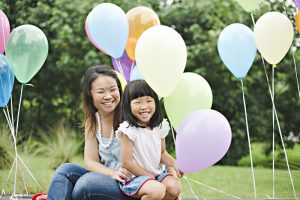 Since the start of the year, my daughter, Sophie, has been asking me to play with her as soon as we get home from work. I think it has to do with her anxiety about entering primary one in a year’s time (the age where formal studies start in Singapore). The teachers in her childcare have been telling her that she’ll have no time to play because she’ll have homework from school.
Some days, I’m glad to put down everything and play with her. But on other days, I’ll tell her to play on her own so that I can get down to the household chores. And on one of those days, when I was tired and frustrated after a full-day’s work, I lashed out at her for not being able to play independently when I have a hundred-and-one chores to see to, only to have her respond in tears.
When I questioned why she was so upset, she told me in between sobs that all children like to play and she really would like mummy to play with her.
A missed opportunity to play with your child, is a missed opportunity to enter their world and bond with them.
I can sense that my daughter’s request to play with her is really her way of saying:
“I want to spend time with you mummy”
“I want to do things with you daddy”
“I want you to be beside me”
While I may have my own agenda of what bonding with my daughter means, taking her to the playground, playing Lego, doing craft work, cooking pancakes together, her request is simply to put down what I’m doing and play with her.
And how can I allow her childhood to slip by without being a part of it? After all, we may not always have these moments:
- when our child still wants to play hide and seek with us
- our child asks for yet another bedtime story
- they hug us with all their might to show that they really really really love us
- they tickle us with the silliest things they say and infect us with their contagious laughter till our belly aches
- their little hands reach for ours looking for security in the middle of the night
- they plant a kiss on our cheeks and whisper, I love you mummy, for no reason at all; which melts us over and over again
The next time your child asks you to put down what you’re busy with so you can come play with her, don’t turn her down. A missed opportunity to play with your child, is a chance missed to enter her world and create special memories together.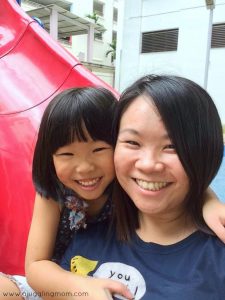
What are some of the ways you take time out of your schedule to spend quality time playing with your child?
This is an original post to World Moms Blog from our contributor in Singapore, Susan Koh.
The images used in this post are attributed to the author.
Susan is from Singapore. As a full-time working mom, she's still learning to perfect the art of juggling between career and family while leading a happy and fulfilled life. She can't get by a day without coffee and swears she's no bimbo even though she likes pink and Hello Kitty. She's loves to travel and blogs passionately about parenting, marriage and relationship and leading a healthy life at A Juggling Mom.
More Posts

by Ms. V. (South Korea) | Feb 3, 2015 | 2015, World Voice
A few months ago I was at the park with my 3-year old and my 4-month old baby. I was wearing the baby and she was breastfeeding when my son asked if I could push him on the swing. I told him I’d do it as soon as the baby was done. He sighed the heavy sigh of a firstborn who is now forced to share his mother’s attention and then entertained himself by laying his belly onto the swing seat and twisting round and round. A man from our neighborhood was walking by and offered to push him on the swing, which thrilled him, and within seconds my boy was blissfully swinging while I looked on in gratitude to the man whose name I do not know, but who I exchange greetings with on an almost daily basis.
Another mother at the park looked on this same scene with absolute horror. She couldn’t believe I was allowing this man to push my son on the swing. You see the man from our neighborhood does not have a home. He is a member of the transient population that gathers in and near the park closest to our house…
He has never been anything but kind to me and my children, has never been threatening in any way, and I have always assumed he had access to a nearby shelter at least some of the time because his person and his clothing are always quite clean. He seems to have trouble communicating verbally so we communicate through very exaggerated gestures. He’d offered to push my son through a series of such gestures that I easily understood and I gave consent both verbally and with a giant nod of my head and smile.

Photo Credit: Flickr
I was taken aback by the mother’s reaction to the situation and later I beat myself up that I hadn’t been more vocal in my own defense. I should have said more. I should have figured out a kind and non-shaming way to ask her if she would have thought me so irresponsible if I had asked her, a total stranger, to push my kid on the swing. Would she, by virtue of appearing to be a person with a permanent home, have been a more suitable swing-pusher? As it was, I almost apologetically explained that he was not a stranger to us and that I wasn’t concerned.
Like a lot of parents, I read with great interest about the parents here in the US who were under investigation for allowing their 6 and 10-year old children to walk about a mile home from the park. No matter your opinion about whether the parents were wrong or right, or whether the police either overreacted or didn’t do enough, or what you think about Free-Range Kids, I think we can all agree that there is a lot of fear surrounding our children.
Despite years of decline in violent crimes in the US, and pretty solid proof that our children are in fact growing up in a much safer world than we did, parents seem to be tending toward taking every precaution they can think of to keep their children safe. And to be clear, given the high rates of mental illness among the homeless, I do understand why a parent would be reticent to allow a homeless person to push their kid on the swing. I do not, however, think that being homeless and/or mentally ill should automatically disqualify a person from doing so.
I wonder, how is this culture of fear affecting the world-view of children, especially within the context of being of service to others?
Empathy, or the ability to understand and share the feelings of another, is the ideal motivating factor for service and social good. We do what we can to help others because we understand that it is often merely circumstances that separate us.
As far as I know, the only difference I have with the man in our neighborhood is that I have a home and an ability to communicate verbally. I could assume other things about the differences between us, but I have no other facts. Through interaction and observation and direct experience, I think that he, like me, is living his life with good intentions.
I have found that our willingness to do good for others rises in direct proportion to our belief that it could be us need of help. If we see the world as a place full of scary people out to get us, will we make that leap? If, in an effort to keep our kids safe, we give them the impression that people are not to be trusted, that they are not safe out in the world, how will they learn the critically important ability to stop seeing people as “other” and instead as fundamentally the same as they are?
Treating people as “other” objectifies them, distances them, and makes them and their pain easier to ignore. We cannot tell our children that the world is full of mostly good people with good hearts and good intentions – people just like us – and expect them to believe us if we behave as though this isn’t true, if we treat the homeless man on the street as fundamentally different, or all strangers as potential monsters.
One of the stated goals of the Free-Range Kids movement is to help children learn how to calculate risk. I think parents of my generation would do well to revisit our own abilities to calculate risk. I think we all want to raise kids who do good things in the world and serve others who are less fortunate, not because it makes them look good or because they intellectually know it’s the “right thing” to do, but because they feel and know that we are all more alike than we are different and one day it could very well be us who is less fortunate and in need of a helping hand.
This is an original post to World Moms Blog by Ms. V in the USA.
Ms. V returned from a 3-year stint in Seoul, South Korea and is now living in the US in the beautiful Pacific Northwest with her partner, their two kids, three ferocious felines, and a dog named Avon Barksdale. She grew up all over the US, mostly along the east coast, but lived in New York City longer than anywhere else, so considers NYC “home.” Her love of travel has taken her all over the world and to all but four of the 50 states.
Ms. V is contemplative and sacred activist, exploring the intersection of yoga, new monasticism, feminism and social change. She is the co-director and co-founder of Samdhana-Karana Yoga: A Healing Arts Center, a non-profit yoga studio and the spiritual director for Hab Community. While not marveling at her beautiful children, she enjoys reading, cooking, and has dreams of one day sleeping again.
More Posts
Follow Me: